Saturday, October 25, 2025
Friday, October 24, 2025
Thursday, October 23, 2025
Wednesday, October 22, 2025
Emeritus
A Press Lord Without a Rosebud
Date: January 17, 1993, Sunday, Late Edition - Final
Byline: By Andrew Sullivan;
THE best story in this sprightly, undemanding biography of the media entrepreneur Rupert Murdoch is apocryphal. When Mr. Murdoch fired Frank Giles as editor of The Sunday Times of London in 1983, he proposed that Mr. Giles assume the title "editor emeritus" for the two years remaining before his retirement. Mr. Giles asked what on earth "editor emeritus" meant. "It's Latin, Frank," Mr. Murdoch reportedly replied. " E means 'exit' and meritus means 'you deserve it.' "
Byline: By Andrew Sullivan;
THE best story in this sprightly, undemanding biography of the media entrepreneur Rupert Murdoch is apocryphal. When Mr. Murdoch fired Frank Giles as editor of The Sunday Times of London in 1983, he proposed that Mr. Giles assume the title "editor emeritus" for the two years remaining before his retirement. Mr. Giles asked what on earth "editor emeritus" meant. "It's Latin, Frank," Mr. Murdoch reportedly replied. " E means 'exit' and meritus means 'you deserve it.' "
Tuesday, October 21, 2025
Monday, October 20, 2025
Sunday, October 19, 2025
Saturday, October 18, 2025
Friday, October 17, 2025
Thursday, October 16, 2025
Wednesday, October 15, 2025
Tuesday, October 14, 2025
Monday, October 13, 2025
Sunday, October 12, 2025
Time System in the Edo Period (1603 - 1868)
https://museum.seiko.co.jp/en/knowledge/relation_16/
The length of a single Toki, the partitioned unit of time, changes from day to night, and also from season to season.
The time system that divides the length of a day into equal parts is referred to as the “fixed time system.” The current system with 24 equal parts is now universally adopted throughout the world.
A system that divides a day into day and night and partitions each into equal parts is referred to as a “seasonal time system.”
A seasonal time system was used in Japan during the Edo period. Daytime and nighttime were each divided into six equal parts called “toki .” The toki, the partitioned unit of time, varied in length from season to season in accordance with the changing length of daylight.
To tell the time in words, each of the twelve toki in daytime and nighttime was named after one of the twelve zodiac signs, beginning with the Rat at midnight. According to another method, the hours were counted backwards from midnight, such that both the Rat and Horse coincided with hour number 9 at midday and midnight, respectively. Starting from the Rat as hour number 9, time elapses to Ox (hour number 8) and to Snake (hour number 4), whereupon the counting starts from Horse again from hour number 9.
Since the same numbers appeared in both daytime and nighttime, additional words describing the times of day had to be used (night 9 or day 9, dawn 6 or dusk 6, etc.)
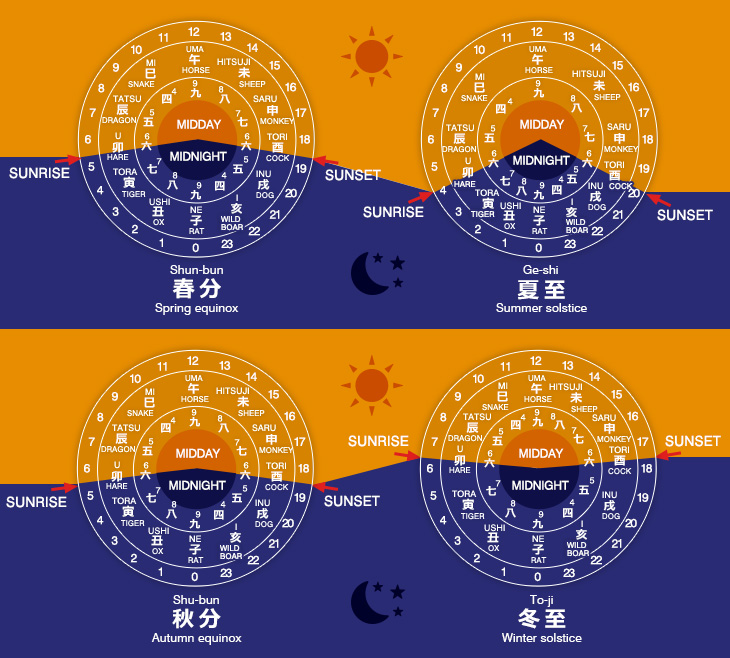
The length of a single Toki, the partitioned unit of time, changes from day to night, and also from season to season.
The time system that divides the length of a day into equal parts is referred to as the “fixed time system.” The current system with 24 equal parts is now universally adopted throughout the world.
A system that divides a day into day and night and partitions each into equal parts is referred to as a “seasonal time system.”
A seasonal time system was used in Japan during the Edo period. Daytime and nighttime were each divided into six equal parts called “toki .” The toki, the partitioned unit of time, varied in length from season to season in accordance with the changing length of daylight.
To tell the time in words, each of the twelve toki in daytime and nighttime was named after one of the twelve zodiac signs, beginning with the Rat at midnight. According to another method, the hours were counted backwards from midnight, such that both the Rat and Horse coincided with hour number 9 at midday and midnight, respectively. Starting from the Rat as hour number 9, time elapses to Ox (hour number 8) and to Snake (hour number 4), whereupon the counting starts from Horse again from hour number 9.
Since the same numbers appeared in both daytime and nighttime, additional words describing the times of day had to be used (night 9 or day 9, dawn 6 or dusk 6, etc.)
Saturday, October 11, 2025
Friday, October 10, 2025
Six cats, thirty people, four mortar shells. Two weeks in the occupied Kyiv suburb 21.03.2022 | Evheny Osievsky
https://commons.com.ua/en/dva-tizhni-v-okupaciyi-pid-kiyevom/
Thursday, October 9, 2025
Wednesday, October 8, 2025
Tuesday, October 7, 2025
Monday, October 6, 2025
Mid-Autumn, Tiger Hill, Late Ming
https://www.burninghou.se/p/mid-autumn-on-tiger-hill?utm_source=post-email-title&publication_id=6667&post_id=175367071&utm_campaign=email-post-title&isFreemail=true&r=i03&triedRedirect=true&utm_medium=email


