Wednesday, December 31, 2025
The Twilight Zone

Tuesday, December 30, 2025
Rhyton
An adorable #Greek rhyton in the shape of a #cow's head. Vessels such as this one were used in drinking parties. Since they didn't have a base, their contents had to be consumed before the vessel could be put down
Dating ca. 460 BC.

Monday, December 29, 2025
Sunday, December 28, 2025
Saturday, December 27, 2025
A Year of Ulysses Reading
https://docs.google.com/spreadsheets/u/0/d/111r-lrNUdxNt4wjD_cOuBQB17kGNEJwyPibDL2hhOBI/htmlview?pli=1
Friday, December 26, 2025

Thursday, December 25, 2025

Wednesday, December 24, 2025
The Shop Of Ghosts - G.K Chesterton
Nearly all the best and most precious things in the universe you can
get for a halfpenny. I make an exception, of course, of the sun,
the moon, the earth, people, stars, thunderstorms, and such trifles.
You can get them for nothing. Also I make an exception of another thing,
which I am not allowed to mention in this paper, and of which
the lowest price is a penny halfpenny. But the general principle
will be at once apparent. In the street behind me, for instance,
you can now get a ride on an electric tram for a halfpenny.
To be on an electric tram is to be on a flying castle in a fairy tale.
You can get quite a large number of brightly coloured sweets for
a halfpenny. Also you can get the chance of reading this article
for a halfpenny; along, of course, with other and irrelevant matter.
But if you want to see what a vast and bewildering array
of valuable things you can get at a halfpenny each you
should do as I was doing last night. I was gluing my nose
against the glass of a very small and dimly lit toy shop
in one of the greyest and leanest of the streets of Battersea.
But dim as was that square of light, it was filled (as a
child once said to me) with all the colours God ever made.
Those toys of the poor were like the children who buy them;
they were all dirty; but they were all bright. For my part,
I think brightness more important than cleanliness; since
the first is of the soul, and the second of the body. You
must excuse me; I am a democrat; I know I am out of fashion
in the modern world.
. . . . .
As I looked at that palace of pigmy wonders, at small green omnibuses,
at small blue elephants, at small black dolls, and small red
Noah's arks, I must have fallen into some sort of unnatural trance.
That lit shop-window became like the brilliantly lit
stage when one is watching some highly coloured comedy.
I forgot the grey houses and the grimy people behind me as one
forgets the dark galleries and the dim crowds at a theatre.
It seemed as if the little objects behind the glass were small,
not because they were toys, but because they were objects far away.
The green omnibus was really a green omnibus, a green Bayswater omnibus,
passing across some huge desert on its ordinary way to Bayswater.
The blue elephant was no longer blue with paint; he was blue
with distance. The black doll was really a negro relieved against
passionate tropic foliage in the land where every weed is flaming
and only man is black. The red Noah's ark was really the enormous
ship of earthly salvation riding on the rain-swollen sea,
red in the first morning of hope.
Every one, I suppose, knows such stunning instants of abstraction,
such brilliant blanks in the mind. In such moments one can see the
face of one's own best friend as an unmeaning pattern of spectacles
or moustaches. They are commonly marked by the two signs of the
slowness of their growth and the suddenness of their termination.
The return to real thinking is often as abrupt as bumping into a man.
Very often indeed (in my case) it is bumping into a man.
But in any case the awakening is always emphatic and,
generally speaking, it is always complete. Now, in this case,
I did come back with a shock of sanity to the consciousness
that I was, after all, only staring into a dingy little toy-shop;
but in some strange way the mental cure did not seem to be final.
There was still in my mind an unmanageable something that told
me that I had strayed into some odd atmosphere, or that I
had already done some odd thing. I felt as if I had worked
a miracle or committed a sin. It was as if I had at any rate,
stepped across some border in the soul.
To shake off this dangerous and dreamy sense I went into the shop
and tried to buy wooden soldiers. The man in the shop was very old
and broken, with confused white hair covering his head and half
his face, hair so startlingly white that it looked almost artificial.
Yet though he was senile and even sick, there was nothing of suffering
in his eyes; he looked rather as if he were gradually falling
asleep in a not unkindly decay. He gave me the wooden soldiers,
but when I put down the money he did not at first seem to see it;
then he blinked at it feebly, and then he pushed it feebly away.
"No, no," he said vaguely. "I never have. I never have.
We are rather old-fashioned here."
"Not taking money," I replied, "seems to me more like an uncommonly
new fashion than an old one."
"I never have," said the old man, blinking and blowing his nose;
"I've always given presents. I'm too old to stop."
"Good heavens!" I said. "What can you mean? Why, you might
be Father Christmas."
"I am Father Christmas," he said apologetically, and blew
his nose again.
The lamps could not have been lighted yet in the street outside.
At any rate, I could see nothing against the darkness but the shining
shop-window. There were no sounds of steps or voices in the street;
I might have strayed into some new and sunless world.
But something had cut the chords of common sense, and I could
not feel even surprise except sleepily. Something made me say,
"You look ill, Father Christmas."
"I am dying," he said.
I did not speak, and it was he who spoke again.
"All the new people have left my shop. I cannot understand it.
They seem to object to me on such curious and inconsistent
sort of grounds, these scientific men, and these innovators.
They say that I give people superstitions and make them too visionary;
they say I give people sausages and make them too coarse.
They say my heavenly parts are too heavenly; they say my earthly
parts are too earthly; I don't know what they want, I'm sure.
How can heavenly things be too heavenly, or earthly things
too earthly? How can one be too good, or too jolly?
I don't understand. But I understand one thing well enough.
These modern people are living and I am dead."
"You may be dead," I replied. "You ought to know.
But as for what they are doing, do not call it living."
. . . . .
A silence fell suddenly between us which I somehow expected
to be unbroken. But it had not fallen for more than a few
seconds when, in the utter stillness, I distinctly heard
a very rapid step coming nearer and nearer along the street.
The next moment a figure flung itself into the shop and stood
framed in the doorway. He wore a large white hat tilted back
as if in impatience; he had tight black old-fashioned pantaloons,
a gaudy old-fashioned stock and waistcoat, and an old fantastic coat.
He had large, wide-open, luminous eyes like those of an arresting actor;
he had a pale, nervous face, and a fringe of beard. He took in the
shop and the old man in a look that seemed literally a flash and
uttered the exclamation of a man utterly staggered.
"Good lord!" he cried out; "it can't be you! It isn't you!
I came to ask where your grave was."
"I'm not dead yet, Mr. Dickens," said the old gentleman, with a
feeble smile; "but I'm dying," he hastened to add reassuringly.
"But, dash it all, you were dying in my time," said Mr. Charles Dickens
with animation; "and you don't look a day older."
"I've felt like this for a long time," said Father Christmas.
Mr. Dickens turned his back and put his head out of the door
into the darkness.
"Dick," he roared at the top of his voice; "he's still alive."
. . . . .
Another shadow darkened the doorway, and a much larger and more
full-blooded gentleman in an enormous periwig came in, fanning his
flushed face with a military hat of the cut of Queen Anne.
He carried his head well back like a soldier, and his hot face
had even a look of arrogance, which was suddenly contradicted
by his eyes, which were literally as humble as a dog's. His sword
made a great clatter, as if the shop were too small for it.
"Indeed," said Sir Richard Steele, "'tis a most prodigious matter,
for the man was dying when I wrote about Sir Roger de Coverley
and his Christmas Day."
My senses were growing dimmer and the room darker.
It seemed to be filled with newcomers.
"It hath ever been understood," said a burly man, who carried
his head humorously and obstinately a little on one side--I think
he was Ben Jonson--"It hath ever been understood, consule Jacobo,
under our King James and her late Majesty, that such good and hearty
customs were fallen sick, and like to pass from the world.
This grey beard most surely was no lustier when I knew him than now."
And I also thought I heard a green-clad man, like Robin Hood,
say in some mixed Norman French, "But I saw the man dying."
"I have felt like this a long time," said Father Christmas,
in his feeble way again.
Mr. Charles Dickens suddenly leant across to him.
"Since when?" he asked. "Since you were born?"
"Yes," said the old man, and sank shaking into a chair.
"I have been always dying."
Mr. Dickens took off his hat with a flourish like a man calling
a mob to rise.
"I understand it now," he cried, "you will never die."
Tuesday, December 23, 2025
Monday, December 22, 2025
Sunday, December 21, 2025
Saturday, December 20, 2025
Friday, December 19, 2025

Thursday, December 18, 2025
Wednesday, December 17, 2025
Tuesday, December 16, 2025
Guest By Shin Hae-uk, translated by Spencer Lee-Lenfield
Monday’s already on its way.
By Tuesday, my room
will lose its human smell,
and though I’m not Wednesday,
I’ll fill its place,
take off my clothes.
Since I’ll have no height
I’ll rob my room
through the doorgap
(edges—sides—angles),
then minus me and Wednesday
my room will be quintessentially
quadrilateral.
Wouldn’t it be great to hug this room,
just rub my face over the walls?—
that desire seizes me,
embraces me in Wednesday’s stead,
and though I can stand shame,
I count not knowing
how high it will rise,
waiting for something like Monday . . .
But someone out there loved
this room before I did.
Someone tall.
Before it had a nick or scratch,
unafraid of Wednesdays or gravity.
Monday, December 15, 2025

Sunday, December 14, 2025

Saturday, December 13, 2025

Friday, December 12, 2025

Thursday, December 11, 2025
Public Sans
https://eyeondesign.aiga.org/the-u-s-governments-public-sans-is-a-typeface-fit-for-civic-duty/
Wednesday, December 10, 2025
Tuesday, December 9, 2025
Monday, December 8, 2025
Sunday, December 7, 2025
Cataclysm: Dark Days Ahead
Cataclysm: Dark Days Ahead is a turn-based survival game set in a post-apocalyptic world. Struggle to survive in a harsh, persistent, procedurally generated world. Scavenge the remnants of a dead civilization for food, equipment, or, if you are lucky, a vehicle with a full tank of gas to get you the hell out of Dodge. Fight to defeat or escape from a wide variety of powerful monstrosities, from zombies to giant insects to killer robots and things far stranger and deadlier, and against the others like yourself, that want what you have…
Saturday, December 6, 2025
Friday, December 5, 2025
Why the phrase "thunder and lightning", and not "lightning and thunder"?
https://english.stackexchange.com/questions/273976/why-the-phrase-thunder-and-lightning-and-not-lightning-and-thunder
Thursday, December 4, 2025

Wednesday, December 3, 2025
Tuesday, December 2, 2025

Monday, December 1, 2025
Sunday, November 30, 2025
Saturday, November 29, 2025

Friday, November 28, 2025
Thursday, November 27, 2025
Wednesday, November 26, 2025
Tuesday, November 25, 2025

Monday, November 24, 2025
Sunday, November 23, 2025
Saturday, November 22, 2025
Friday, November 21, 2025
Thursday, November 20, 2025
Wednesday, November 19, 2025

Tuesday, November 18, 2025
Monday, November 17, 2025
Raglan sleeve coat guide
https://www.mrporter.com/en-gb/journal/fashion/derek-guy-overcoat-guide-25376568
Sunday, November 16, 2025
Saturday, November 15, 2025
Friday, November 14, 2025

Thursday, November 13, 2025
Wednesday, November 12, 2025
Tuesday, November 11, 2025
Monday, November 10, 2025
Sunday, November 9, 2025
Saturday, November 8, 2025
Friday, November 7, 2025

Thursday, November 6, 2025
Solar Textures
These textures represent real planetary maps in equirectangular projection. You can use them in 3D rendering, or just open them in any image viewer and explore the surface of planets :)

Wednesday, November 5, 2025
Tuesday, November 4, 2025
Monday, November 3, 2025
Old English Poetry Project
https://web.archive.org/web/20141021074825/http://oepoetryproject.org/
a collaborative space for reading, commenting on, crafting, and refining translations of the oldest poetry written in the English language (from circa 650 to 1100 C.E.).
There are over 35,000 lines in this remarkable corpus of surviving texts, and our ambition is to provide base translations of every single line (eventually). This archive offers immeasurable linguistic and literary riches for anyone who reads English either as a native language or an acquired one.
Our hope is that this site will allow these ancient poems new and continued lives in a digital format that engages and links multiple audiences, building an online community of scholars, readers, and poets. Our idea is to challenge users to remake these old songs into new ones, into poems with one foot in the contemporary age and another in the early middle ages. In this we’ve been inspired by contemporary poets like Paul Muldoon, Seamus Heaney, and Penelope Pelizzon, as well as poets in the modernist tradition and beyond like W. H. Auden, Stephen Spender, Ezra Pound, Gerard Manley Hopkins, and others. We don’t reject careful prosaic translation, but we do embrace poetic realizations that transport or connect the Old English texts into other times and cultural frames. See our translation manifestos.
The project leaders (Bob Hasenfratz and Miller Oberman) invite users, both scholars and poets, to submit alternate versions of entire poems, parts of poems, or individual lines (especially in the comments). Please email us if you’d like to offer a translation in English or any other language.
an open source plugin for WordPress created by the Institute for the Future of the Book, lies at the heart of the project: it allows users to leave comments on individual words and lines, sections, and entire poems, to critique the choices we’ve made and to offer alternative translations.
The layout and functionality of the Old English Poetry Project are evolving and we welcome suggestions for improving the interface and what it does.
Bob and Miller
Maxims II (in London, British Library, Cotton Tiberius B.i)
 bobhasenfratz@gmail.com
Monday, October 6th, 2014
¶ 1A king must hold a realm. Cities are seen from afar,Leave a comment on line 10
¶ 2those that endure on this earth, ingenious work of giants,Leave a comment on line 20
¶ 3marvelous work of wallstones. Wind in the air is fastest,Leave a comment on line 30
¶ 4thunder sometimes is loudest. The glories of Christ are great,Leave a comment on line 40
¶ 5(His) fate is the strongest. Winter is the coldest, 5Leave a comment on line 50
¶ 6spring the frostiest (it is cold for the longest time),Leave a comment on line 60
¶ 7summer, the sunniest (the sky is the hottest),Leave a comment on line 70
¶ 8autumn, the most awesome: it offers to menLeave a comment on line 80
¶ 9the year’s produce, which God puts aside for them.Leave a comment on line 90
¶ 10Truth is the clearest; treasure, the most precious, 10Leave a comment on line 100
¶ 11–gold to every man–and the old one, the wisest,Leave a comment on line 110
¶ 12astute, in ancient-years, he who before has experienced so much.Leave a comment on line 120
¶ 13Wax clings wondrously. Clouds scud.Leave a comment on line 130
¶ 14Good company must encourageLeave a comment on line 140
¶ 15a young atheling for the attack, and for ring-giving. 15Leave a comment on line 150
¶ 16A earl must be audacious; the edge (must) awaitLeave a comment on line 160
¶ 17battle along with the helmet. A hawk must remainLeave a comment on line 170
¶ 18wild on the glove. A wolf must be in the woods,Leave a comment on line 180
¶ 19a lonely exile. A boar must (be) in the forest,Leave a comment on line 190
¶ 20tough in its tusk-power. A good man must 20Leave a comment on line 200
¶ 21build a house in his homeland. A spear must be in hand,Leave a comment on line 210
¶ 22a dagger geared with gold. A gem must be on a ring,Leave a comment on line 220
¶ 23standing high and wide. Among the waves, a streamLeave a comment on line 230
¶ 24must mix the sea-flood. A mast belongs on a ship,Leave a comment on line 240
¶ 25a sail-yard swinging from it. A sword must rest in the lap, 25Leave a comment on line 250
¶ 26lordly iron. A dragon must be in a den,Leave a comment on line 260
¶ 27ancient, proud in its possessions. Fish must be in the water,Leave a comment on line 270
¶ 28breeding a brood. A king must be in the hall,Leave a comment on line 280
¶ 29bestowing rings. A bear belongs on the heath,Leave a comment on line 290
¶ 30old and awe-inspiring. A river from the hills 30Leave a comment on line 300
¶ 31must flow flood-gray. An army must be united,Leave a comment on line 310
¶ 32a troop of triumph-tough men. Honor must be in an earl;Leave a comment on line 320
¶ 33morals, in a man. In this world, the woods mustLeave a comment on line 330
¶ 34bloom with blossoms. An embankment must standLeave a comment on line 340
¶ 35green on earth. God must be in heaven, 35Leave a comment on line 350
¶ 36judger of deeds. A door is necessary for a hall,Leave a comment on line 360
¶ 37the wide mouth of the building. A rim belongs on a shield,Leave a comment on line 370
¶ 38firm protector of fingers. A bird must boundLeave a comment on line 380
¶ 39upwards in the sky. A salmon must glide,Leave a comment on line 390
¶ 40darting through an eddy. A shower in the sky 40Leave a comment on line 400
¶ 41must mix with wind to come into this world.Leave a comment on line 410
¶ 42A thief must skulk under dark clouds. A demon must live in a fen,Leave a comment on line 420
¶ 43alone on the land. A lady must with secret cunning,Leave a comment on line 430
¶ 44a woman, look for a lover if she does not wish to be theLeave a comment on line 440
property of a people,[1]Leave a comment on line 440
¶ 45that a man would acquire her with rings. The briny deepLeave a comment on line 450
must surge with salt, 45Leave a comment on line 450
¶ 46its mist-cover and water-rush, forest-streams must flowLeave a comment on line 460
¶ 47around each and every country. Cattle must exist on the earth,Leave a comment on line 470
¶ 48mating and multiplying. A star must be in the heavens,Leave a comment on line 480
¶ 49brightly shining, as the Measurer bid it to do.Leave a comment on line 490
¶ 50God must be against evil; youth, against age, 50Leave a comment on line 500
¶ 51life must be against death; light must be against dark,Leave a comment on line 510
¶ 52army against army, an enemy against the others;Leave a comment on line 520
¶ 53loathed against the loathed must fight for land,Leave a comment on line 530
¶ 54create a crime. A wise man must always considerLeave a comment on line 540
¶ 55the conflict in this world; the criminal must be hanged, 55Leave a comment on line 550
¶ 56fairly repaid for the felonies he committed beforeLeave a comment on line 560
¶ 57against mankind. The Measurer alone knowsLeave a comment on line 570
¶ 58where his soul afterwards will sojournLeave a comment on line 580
¶ 59as well as all the spirits who step before GodLeave a comment on line 590
¶ 60after their death-day, awaiting their doom, 60Leave a comment on line 600
¶ 61in the embrace of the Father. The future isLeave a comment on line 610
¶ 62dark and deep. Only the Judge knows it,Leave a comment on line 620
¶ 63the Father-Emancipator. No one will ever come backLeave a comment on line 630
¶ 64here under our roofs who could report to menLeave a comment on line 640
¶ 65here for sure what the Savior’s decree might be, 65Leave a comment on line 650
¶ 66the (final) home of the victory-folk, where He himself lives.Leave a comment on line 660
¶ 67[1] Lit., “if she does not wish to be prosperous/profitable to a people.”
Sunday, November 2, 2025
Rome


The Ruin
These wall-stones are wondrous —
calamities crumpled them, these city-sites crashed, the work of giants
corrupted. The roofs have rushed to earth, towers in ruins.
Ice at the joints has unroofed the barred-gates, sheared
the scarred storm-walls have disappeared—
the years have gnawed them from beneath. A grave-grip holds
the master-crafters, decrepit and departed, in the ground’s harsh
grasp, until one hundred generations of human-nations have
trod past. Subsequently this wall, lichen-grey and rust-stained,
often experiencing one kingdom after another,
standing still under storms, high and wide—
it failed—
The wine-halls moulder still, hewn as if by weapons,
penetrated [XXXXXXXXXXXXXXXXXXX] savagely pulverized [XXXXXXXXXXXXXX] [XXXX] shined [XXXXXXXXXX] [XXXX] adroit ancient edifice [XXXXX] [XXXXXXX] bowed with crusted-mud —
The strong-purposed mind was urged to a keen-minded desire
in concentric circles; the stout-hearted bound
wall-roots wondrously together with wire. The halls of the city
once were bright: there were many bath-houses,
a lofty treasury of peaked roofs, many troop-roads, many mead-halls
filled with human-joys until that terrible chance changed all that.
Days of misfortune arrived—blows fell broadly—
death seized all those sword-stout men—their idol-fanes were laid waste —
the city-steads perished. Their maintaining multitudes fell to the earth.
For that the houses of red vaulting have drearied and shed their tiles,
these roofs of ringed wood. This place has sunk into ruin, been broken
into heaps,
There once many men, glad-minded and gold-bright,
adorned in gleaming, proud and wine-flushed, shone in war-tackle;
There one could look upon treasure, upon silver, upon ornate jewelry,
upon prosperity, upon possession, upon precious stones,
upon the illustrious city of the broad realm.
Stone houses standing here, where a hot stream was cast
in a wide welling; a wall enfolding everything in its bright bosom,
where there were baths, heated at its heart. That was convenient,
when they let pour forth [XXXXXXXXX] over the hoary stones
countless heated streams [XXXXXXXXXXX] until the ringed pool
hot [XXXXXXXXXXXXXX] where there were baths
Then is [XXXXXXXXXXXXXXXXX]. That is a kingly thing—
a house [XXXXX],
a city
Saturday, November 1, 2025
Learning by Dying: Combat Performance in the Age of Sail
Learning by Dying: Combat Performance
in the Age of Sail
Daniel K. Benjamin and Anca Tifrea
Between 1660 and 1815 the combat fatality rate among British navy captains
fell by 98 percent, even as the combat success of the British Navy rose dra-
matically. Both developments can be explained as a result of learning by do-
ing among British commanders. This learning was importantly driven by th
extensive wartime experience accumulated over this period, combined wi
the unparalleled financial incentives for combat success offered to Briti
commanders.
1650 and 1680 there was a revolution in naval warfare. The
great battle fleets that were to dominate the age of sail were cre-
ated; state navies replaced armed merchantmen with highly specialized
warships; the line of battle was introduced; and the broadside became
the dominant method of dispensing firepower. These development
were the product of a rapid maturation of the state as an organization o
taxation and control, and led to state monopolization of force at sea
They also yielded a struggle at sea sufficiently intense and protracted t
be labeled the "Second Hundred Years War."1 Despite massive naval
investment by the French and Dutch in the late seventeenth century, an
by the Spanish and French after 1 720, Britain ultimately established it
self as the undisputed ruler of the world's oceans - a position it main-
tained into the twentieth century.
The Journal of Economic History, Vol. 67, No. 4 (December 2007). © The Economic
History Association. All rights reserved. ISSN 0022-0507.
Daniel K. Benjamin is Alumni Distinguished Professor, Department of Economics, Clemson
University, Clemson, SC 29634-1309; and Senior Fellow, PERC, 2048 Analysis Drive, Boze
man, MT 59715. E-mail: wahoo@clemson.edu. Anca Tifrea is Senior Associate, KPMG
LLP, 303 Peachtree St., Atlanta, GA 30308. E-mail: atifrea@kpmg.com.
Financial support from the Earhart Foundation and from the Spiro Center of Clemson Univer-
sity is gratefully acknowledged. We thank Jan Glete for providing us with unpublished data
Roger Knight for many helpful discussions, and N. A. M. Rodger for his criticisms of an earlie
draft. None is responsible for what follows. William R. Dougan, James Foreman-Peck, David
Haddock, P. J. Hill, Philip Hoffman, Patrick Minford, two anonymous referees, and semina
participants at Clemson University, Cardiff University, and the London School of Economic
also provided useful comments. Tom Evans, Paul Seufert, and Ruthira Naraidoo performed ad
mirably as research assistants. Part of this research was conducted while Benjamin was a visit-
ing professor at Cardiff University, Wales and an Honorary Caird Research Fellow at the Na
tional Maritime Museum, Greenwich; the research support of both institutions is gratefully
acknowledged, as is the encouragement and assistance of Patrick Minford of Cardiff University,
Nigel Rigby and Janet Norton of the National Maritime Museum, and Sarah Palmer of Green
wich University.
See, for instance, Lavery, Ship and Line; Glete, Navies; Palmer, "'Military Revolution'" ;
Tunstall, Naval Warfare; and Rodger, Command
968
Learning by Dying 969
The narrative history of this struggle has been well do
ably told by naval historians.2 Our intent is to supplement
in three ways. First, the existing historical narratives are
nature; we seek to quantify the process by which Britain
of the ocean. Second, we hope to show that despite Br
(such as those suffered during the War of American Ind
origins of the process that culminated in victory over Na
can be traced to the First Dutch War 150 years before
tantly, we show that Britain's ultimate dominance at sea w
nation of a long process of learning, one in which both e
incentives played crucial roles.
We do not seek to rewrite British naval history. Nothin
denies the importance of the geographical, political, and f
that long have been central to the histories of this period
shall make clear, many of the familiar themes, including
status and the backdrop of continental land wars, are ess
story. We focus on the mechanism by which these large
fested themselves in the outcomes of warfare at sea, and
fairly precise terms the fundamental continuity of the under
The hallmark of the sea battles fought in the decades a
widespread carnage. Comprehensive casualty counts ar
available, but casualties among commanding officers in t
were reliably recorded, and they speak unequivocally.
gagement, the Four Days' Battle in June 1666, 10 Roy
captains died in combat; this was nearly 8 percent of all
captains afloat at the time.3 During the two wars with th
1660s and 1670s, more than 60 English post-captains wer
tion, a time when there were an average of but 114 rated
English navy. Published battle narratives plus the limited
available in published sources suggest that the butche
quarterdeck had its counterpart between decks 4
There are many reasons for the high casualty rates of th
cluding the close quarters of the North Sea and the Engl
2 James, Naval History; Mahan, Sea Power; Clowes, Royal Navy; Creswell,
Glete, Navies; Lavery, Nelson 's Navy and Nelson and the Nile; Lewis, Nav
History; Palmer, '"Military Revolution'" and "'Soul's Right Hand'"; and
World and Command.
To oversimplify: Post-captains commanded "rated" or "post" ships - those
the period, were officially armed with 20 guns or more. The commander of
sel commonly was addressed as "captain," but his official title was "master
We generally use "English" for the period before the 1 707 legislative uni
England, and "British" for the period after 1 707, but we also use "British" a
tor when little harm is done by the imprecision.
4 See, for example, Clowes, Royal Navy; Tunstall, Naval Warfare; and Rodge
970 Benjamin and Tifrea
where the key battles took place, and the fact that the Englis
were eager to stand and fight. We argue that one other fac
work. Between 1650 and 1680, firepower became concentrat
before, and delivered by ships built to administer and with
punishment than ever before. Commanders erred often in
this firepower and avoiding its adverse consequences, m
proved fatal for them and their crews. The result was hi
rates. As tactics were learned and improved, fewer mistake
and casualties declined. Among British captains, who are th
our study, much of the learning took place rapidly, but it co
into the eighteenth century. By the Great Wars of 1793-181
ships were at least twice as powerful as their predecessors o
before, combat at sea was far less deadly for British captain
learned how to win - or lose - without killing nearly as man
selves or their men.
The learning that reduced fatality rates among captains is
in the combat success of the Royal Navy. Over the 150 year
by our study, the British navy markedly increased the losses
on enemy fleets, relative to the combat losses it suffered. A
the performance of the navy's command structure improved
idly in the first half of our sample, improvement continued
the period we study. The culminating triumph of the Napole
thus traceable in the data back to the initial engagements o
Anglo-Dutch war, more than 150 years before.
We focus on the British navy for two reasons. First, syst
on battle outcomes during this period are of higher quality for
other navies - perhaps because Britain succeeded, and thus m
recorded its activities. Second, by 1815 no one doubted Brit
nance at sea, yet in 1650 no one could have predicted that o
quantifying the process by which Britain prevailed we also s
tors we believe should be given more weight in discussions
riod. Specifically, we argue that the ability of British captain
form experience into success stemmed from two key facts: t
and men of the British navy had far more opportunity than ene
to develop their combat skills, and they were given unparal
cial incentives to succeed. This combination of opportunity
thus helped fuel the Royal Navy's rise to greatness.
HISTORICAL PERSPECTIVE
The execution of King Charles on 30 January 1649 marked the c
mination of the English Revolution and presaged the dawn of a new
Learning by Dying 97 1
Friday, October 31, 2025

Thursday, October 30, 2025
Wednesday, October 29, 2025
Tuesday, October 28, 2025


Monday, October 27, 2025


Sunday, October 26, 2025


Saturday, October 25, 2025

Friday, October 24, 2025
Thursday, October 23, 2025
Wednesday, October 22, 2025
Emeritus
A Press Lord Without a Rosebud
Byline: By Andrew Sullivan;
THE best story in this sprightly, undemanding biography of the media entrepreneur Rupert Murdoch is apocryphal. When Mr. Murdoch fired Frank Giles as editor of The Sunday Times of London in 1983, he proposed that Mr. Giles assume the title "editor emeritus" for the two years remaining before his retirement. Mr. Giles asked what on earth "editor emeritus" meant. "It's Latin, Frank," Mr. Murdoch reportedly replied. " E means 'exit' and meritus means 'you deserve it.' "
Tuesday, October 21, 2025
Monday, October 20, 2025
Sunday, October 19, 2025
Saturday, October 18, 2025
Friday, October 17, 2025
Thursday, October 16, 2025

Wednesday, October 15, 2025
Tuesday, October 14, 2025
Monday, October 13, 2025
Sunday, October 12, 2025
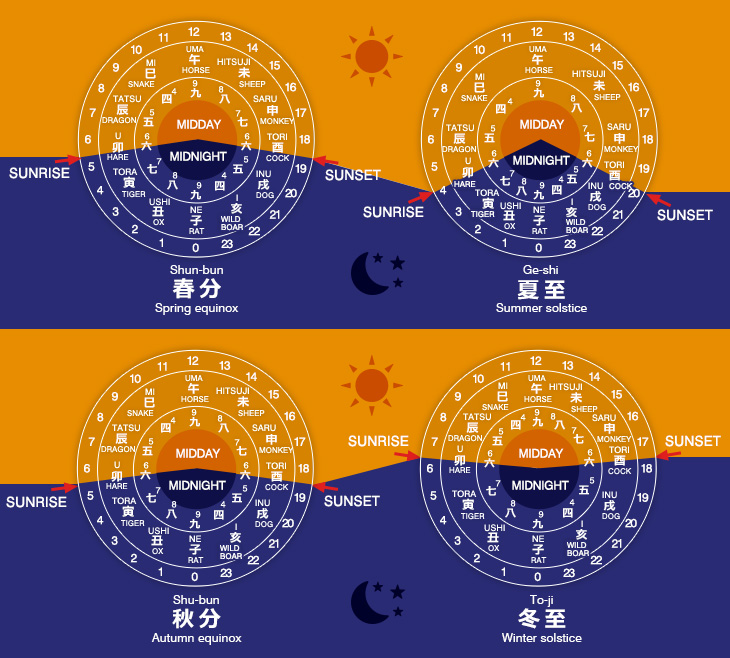
Time System in the Edo Period (1603 - 1868)
The length of a single Toki, the partitioned unit of time, changes from day to night, and also from season to season.
The time system that divides the length of a day into equal parts is referred to as the “fixed time system.” The current system with 24 equal parts is now universally adopted throughout the world.
A system that divides a day into day and night and partitions each into equal parts is referred to as a “seasonal time system.”
A seasonal time system was used in Japan during the Edo period. Daytime and nighttime were each divided into six equal parts called “toki .” The toki, the partitioned unit of time, varied in length from season to season in accordance with the changing length of daylight.
To tell the time in words, each of the twelve toki in daytime and nighttime was named after one of the twelve zodiac signs, beginning with the Rat at midnight. According to another method, the hours were counted backwards from midnight, such that both the Rat and Horse coincided with hour number 9 at midday and midnight, respectively. Starting from the Rat as hour number 9, time elapses to Ox (hour number 8) and to Snake (hour number 4), whereupon the counting starts from Horse again from hour number 9.
Since the same numbers appeared in both daytime and nighttime, additional words describing the times of day had to be used (night 9 or day 9, dawn 6 or dusk 6, etc.)
Saturday, October 11, 2025

Friday, October 10, 2025
Six cats, thirty people, four mortar shells. Two weeks in the occupied Kyiv suburb 21.03.2022 | Evheny Osievsky
https://commons.com.ua/en/dva-tizhni-v-okupaciyi-pid-kiyevom/
Thursday, October 9, 2025

Wednesday, October 8, 2025
Tuesday, October 7, 2025

Monday, October 6, 2025
Mid-Autumn, Tiger Hill, Late Ming
https://www.burninghou.se/p/mid-autumn-on-tiger-hill?utm_source=post-email-title&publication_id=6667&post_id=175367071&utm_campaign=email-post-title&isFreemail=true&r=i03&triedRedirect=true&utm_medium=email


