The length of a single Toki, the partitioned unit of time, changes from day to night, and also from season to season.
The time system that divides the length of a day into equal parts is referred to as the “fixed time system.” The current system with 24 equal parts is now universally adopted throughout the world.
A system that divides a day into day and night and partitions each into equal parts is referred to as a “seasonal time system.”
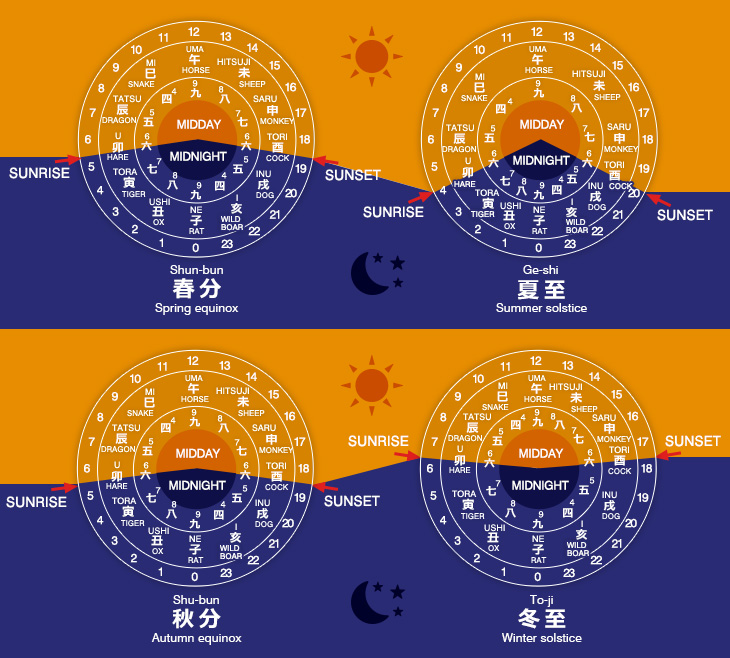
A seasonal time system was used in Japan during the Edo period. Daytime and nighttime were each divided into six equal parts called “toki .” The toki, the partitioned unit of time, varied in length from season to season in accordance with the changing length of daylight.
To tell the time in words, each of the twelve toki in daytime and nighttime was named after one of the twelve zodiac signs, beginning with the Rat at midnight. According to another method, the hours were counted backwards from midnight, such that both the Rat and Horse coincided with hour number 9 at midday and midnight, respectively. Starting from the Rat as hour number 9, time elapses to Ox (hour number 8) and to Snake (hour number 4), whereupon the counting starts from Horse again from hour number 9.
Since the same numbers appeared in both daytime and nighttime, additional words describing the times of day had to be used (night 9 or day 9, dawn 6 or dusk 6, etc.)

No comments:
Post a Comment