Thursday, April 30, 2020

Dice and the Laws of Probability

https://www.edcollins.com/backgammon/diceprob.htm


Let's imagine you are playing a game which uses dice. You are about to roll three of them. You NEED to roll at least one 6. A 6 appearing on any one (or more) of the three dice will win the game for you! What are your chances?


33.3 %


42.1 %


50 %


66.6 %

Quite some time ago, I was over at a friend's house watching him and another friend play a board game called Axis & Allies. At one point this exact scenario came up - Kent was planning on rolling three dice and really wanted at least one 6 to appear. He made a comment that with three dice, his chances were 3/6 or 50%.

Kent's reasoning was, with one die, the chances of rolling a 6 were 1/6 which is correct. He also believed if he were to roll two dice, his chances were double this or 2/6. This is INCORRECT and this is where his faulty reasoning begins.

Knowing a little bit about the laws of probability, I quickly knew the fraction "2/6" for two dice and "3/6" for three dice was incorrect and spent a brief moment computing and then explaining the true percentages.

Unfortunately, I do not believe I was successful in explaining to Kent why my figures were correct. Maybe I can do so here.

Obviously, with Kent's logic above, if the chances of rolling a 6 with two dice is 2/6 and the chances of rolling a 6 with three dice is 3/6, then the chances of rolling a 6 with six dice would be 6/6 !! 100%?? Of course, this is obviously incorrect. I don't care how many dice you roll, the chances of rolling a 6 will never be 100%.

When you roll just one die, there are six different ways the die can land, as shown by the following graphic:



When two dice are rolled, there are now 36 different and unique ways the dice can come up. This figure is arrived at by multiplying the number of ways the first die can come up (six) by the number of ways the second die can come up (six). 6 x 6 = 36.

This graphic shows this very nicely. I've used two different colored dies to help show a roll of 2-1 is different from a roll of 1-2.
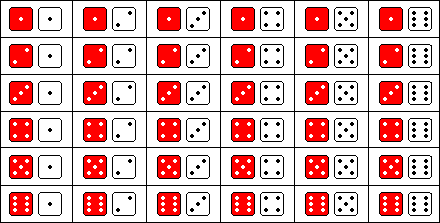


If you use the above graphic and count the number of times is 6 appears when two dice are rolled, you will see the answer is eleven. Eleven times out of 36 or 30.5 %, slightly less than the 33.3% (2/6) Kent thought. When you roll two dice, you have a 30.5 % chance at least one 6 will appear.

This figure can also be figured out mathematically, without the use of the graphic. One way to do so is to take the number of ways a single die will NOT show a 6 when rolled (five) and multiply this by the number of ways the second die will NOT show a 6 when rolled. (Also five.) 5 x 5 = 25. Subtract this from the total number of ways two dice can appear (36) and we have our answer...eleven.

So, let's use this same method to answer our question and determine the chances of at least one 6 appearing when three dice are rolled.

Take the chances of a 6 NOT appearing on the first die...


5 / 6

and multiply this by the chances of a 6 NOT appearing on the second die...


5 / 6 x 5 / 6 = 25 / 36

and multiply this by the chances of a 6 NOT appearing on the third die...


25 / 36 x 5 / 6 = 125 / 216

So, there are 125 out of 216 chances of a 6 NOT appearing when three dice are rolled. Simply subtract 125 from 216 which will give us the chances a 6 WILL appear when three dice are rolled, which is 91. 91 out of 216 or 42.1 %, not quite the 50% Kent originally thought.

Here is a table showing the fractions and percentages of a 6 appearing (or any other single digit for that matter) and not appearing with several different numbers of dice:


Chances of NOT
rolling a 6
Chances OF
rolling a 6


...with just one die
5 / 6
83.33 %
1 / 6
16.67 %

...with 2 dice
25 / 36
69.44 %
11 / 36
30.56 %

...with 3 dice
125 / 216
57.87 %
91 / 216
42.13 %

...with 4 dice
625 / 1,296
48.23 %
671 / 1,296
51.77 %

...with 5 dice
3,125 / 7,776
40.19 %
4,651 / 7,776
59.81 %

...with 6 dice
15,625 / 46,656
33.49 %
31,031 / 46,656
66.51 %

...with 7 dice
78,125 / 279,936
27.91 %
201,811 / 279,936
72.09 %

...with 8 dice
390,625 / 1,679,616
23.26 %
1,288,991 / 1,679,616
76.74 %

...with 9 dice
1,953,125 / 10,077,696
19.38 %
8,124,571 / 10,077,696
80.62 %


Notice you have just over a 50 % chance (51.77) of rolling at least one 6 when rolling four dice. With six dice it's just over 66 %. Also notice even when you roll nine dice, rolling a 6 is far from a certainty - you have just a little better than 80 % chance of rolling this 6. This means, on the average, even when you roll nine dice, two times out of ten you will not roll a single 6!

Hope this helped clear it up, Kent!

Wednesday, April 29, 2020

Monday, April 27, 2020

Tokyo Windows


Masataka Nakano’s Tokyo Windows is a visually engaging reflection on the city scape of Tokyo, viewed from various windows in and around the city’s local. From apartment windows in Ginza, station windows of Shibuya to stairway passages, Nakano’s Tokyo wonderfully brings to focus places and iconic landmarks of the city in a considered and refreshing perspective.


Sunday, April 26, 2020

Scott And Scurvy

https://idlewords.com/2010/03/scott_and_scurvy.htm


Writing about the first winter the men spent on the ice, Cherry-Garrard casually mentions an astonishing lecture on scurvy by one of the expedition’s doctors:

Atkinson inclined to Almroth Wright’s theory that scurvy is due to an acid intoxication of the blood caused by bacteria...
There was little scurvy in Nelson’s days; but the reason is not clear, since, according to modern research, lime-juice only helps to prevent it. We had, at Cape Evans, a salt of sodium to be used to alkalize the blood as an experiment, if necessity arose. Darkness, cold, and hard work are in Atkinson’s opinion important causes of scurvy.


Now, I had been taught in school that scurvy had been conquered in 1747, when the Scottish physician James Lind proved in one of the first controlled medical experiments that citrus fruits were an effective cure for the disease. From that point on, we were told, the Royal Navy had required a daily dose of lime juice to be mixed in with sailors’ grog, and scurvy ceased to be a problem on long ocean voyages.

But here was a Royal Navy surgeon in 1911 apparently ignorant of what caused the disease, or how to cure it. Somehow a highly-trained group of scientists at the start of the 20th century knew less about scurvy than the average sea captain in Napoleonic times. Scott left a base abundantly stocked with fresh meat, fruits, apples, and lime juice, and headed out on the ice for five months with no protection against scurvy, all the while confident he was not at risk. What happened?

...

By all accounts scurvy is a horrible disease. Scott, who has reason to know, gives a succinct description:

The symptoms of scurvy do not necessarily occur in a regular order, but generally the first sign is an inflamed, swollen condition of the gums. The whitish pink tinge next the teeth is replaced by an angry red; as the disease gains ground the gums become more spongy and turn to a purplish colour, the teeth become loose and the gums sore. Spots appear on the legs, and pain is felt in old wounds and bruises; later, from a slight oedema, the legs, and then the arms, swell to a great size and become blackened behind the joints. After this the patient is soon incapacitated, and the last horrible stages of the disease set in, from which death is a merciful release.

One of the most striking features of the disease is the disproportion between its severity and the simplicity of the cure. Today we know that scurvy is due solely to a deficiency in vitamin C, a compound essential to metabolism that the human body must obtain from food. Scurvy is rapidly and completely cured by restoring vitamin C into the diet.

Except for the nature of vitamin C, eighteenth century physicians knew this too. But in the second half of the nineteenth century, the cure for scurvy was lost. The story of how this happened is a striking demonstration of the problem of induction, and how progress in one field of study can lead to unintended steps backward in another.

An unfortunate series of accidents conspired with advances in technology to discredit the cure for scurvy. What had been a simple dietary deficiency became a subtle and unpredictable disease that could strike without warning. Over the course of fifty years, scurvy would return to torment not just Polar explorers, but thousands of infants born into wealthy European and American homes. And it would only be through blind luck that the actual cause of scurvy would be rediscovered, and vitamin C finally isolated, in 1932.

It is not easy to find fresh foods that lack vitamin C. Plants and animals tend to be full of it, since the molecule is used in all kinds of biochemical synthesis as an electron donor. But the same reactive qualities that make the vitamin useful also make it easy to destroy. Vitamin C quickly breaks down in the presence of light, heat and air. For this reason it is absent from most preserved foods that have been cooked or dried. Its destruction is also rapidly catalyzed by copper ions, which may be one reason sailors, with their big copper cooking vats, were particularly susceptible.

Because our bodies can't synthesize the vitamin, they have grown very good at conserving it. It takes up to six months for scurvy to develop in healthy people after vitamin C is removed from the diet, and only a tiny daily amount is enough to keep a person healthy.

It has been known since antiquity that fresh foods in general, and lemons and oranges in particular, will cure scurvy. Starting with Vasco de Gama’s crew in 1497, sailors have repeatedly discovered the curative power of citrus fruits, and the cure has just as frequently been forgotten or ignored by subsequent explorers.

Lind tends to get the credit for discovering the citrus cure since he performed something approaching a controlled experiment. But it took an additional forty years of experiments, analysis, and political lobbying for his result to become institutionalized in the Royal Navy. In 1799, all Royal Navy ships on foreign service were ordered to serve lemon juice:
The scheduled allowance for the sailors in the Navy was fixed at I oz.lemon juice with I + oz. sugar, served daily after 2 weeks at sea, the lemon juice being often called ‘lime juice’ and our sailors ‘lime juicers’. The consequences of this new regulation were startling and by the beginning of the nineteenth century scurvy may be said to have vanished from the British navy. In 1780, the admissions of scurvy cases to the Naval Hospital at Haslar were 1457; in the years from 1806 to 1810, they were two.

(As we'll see, the confusion between lemons and limes would have serious reprecussions.)

Friday, April 24, 2020

Wednesday, April 22, 2020

Hai Zi


Hai Zi, who committed suicide at age 25, remains one of the most celebrated poets in China especially with the younger generations. Some very creative years, 250 short poems, 400 pages of long poems, short stories, plays. His complete works were published in 1997 by his friend, the poet Xi Chuan.

Two important collections of English translations (1.2). In France, Hai Zi is known only through three pages of poems published by the “Anthology of Chinese Poetry” in the collection of La Pléiade (3) and nine poems translated by Romain Graziani in the excellent “Anthology of the new Chinese poetry “, directed by Chantal Chen-Andro (4).

Hai Zi was born in a small village in Anhui Province in 1964. At age 15, he was admitted to the Legal Department of the prestigious Peking University. A brilliant student and a poet who starts publishing in magazines like his friends Luo Yihe and Xi Chuan. Graduated at age 19, he became a professor at the Chinese University of Political Science and Law and edited the journal of the university.

An intensive creative period during five years; an isolated life in Beijing devoted to writing as an almost unknown poet. A difficult life especially as his contacts with his village had gradually became loose. Few travels except on the Qinghai Plateau and Tibet; a trip to Delingha in 1988 where a monument recalls his memory and a festival of poetry.

On March 2, 1989, he lied down on the train track in Shanghaiguan, 300 kilometres east of Beijing. This suicide, a few months before the Tiananmen massacre in June, will be one of the reasons for the real worship that will be given to him, especially on his tomb, on a hill near his village.

The debate on the causes of his suicide is not over; the references to death and to autumn are constant in his work. He suffered from his isolation, depression, hallucinations that he thought were related to the practice of qigong; he was afraid of being mentally ill. The suicides of poets round him will multiply; his friend Luo Yihe in May 1989 and the most dramatic, that of Gu Cheng in New Zealand in 1993 after he murdered his wife.

Poems that do not deal with the city or the great historical turmoils. He says he is influenced by the Chinese classics (the Book of Odes and Qu Yuan) but also Homer and Greek mythology. He also invokes Van Gogh, his “emaciated brother”.

A poem, “The Swan” (1986.5), gives us a summary of his preferred themes.


In the night, I hear distant sounds of swans flying across the bridge

the river in my body

echoes them


as they fly across the soil of birthing days, the soil of dusk

there is a wounded swan

only the beautiful, blowing wind knows

she is wounded, but she keeps flying


and the river inside my body is too heavy

heavy as a door hanging on a house

as they fly across the distant bridge

I cannot echo them in exquisite flight


they fly like heavy snow over the cemetery

through the heavy snow there is no way to my door

-bodies have no doors-only fingers

erected in a cemetery, like ten frostbitten candles


on my soil

on the soil of birthing days

there is a wounded swan

just like in the folk singer’s song


Haizi was too young to be part of the students sent to the countryside, who during the years 1970-74, wrote poems, copied in secret hand-written poetry. Some of these texts will be published in the magazine “Today” founded in Beijing by Bei Dao and Mangke in 1978, which was posted on the Walls of Democracy before being banned at the end of 1980.

He was not part of the group of “misty” poets of the early 1980s, which were made famous by Beidao, Gu Cheng, Mangke, Yang Lian … This group refuses the revolutionary “realist” tradition and poetry at the service of politics. Poetry is an individual creation, it is a mirror of oneself. The focus is on the image in the creative process even if it is accompanied by sometimes complex and obscure texts.

The generation of Hai Zi is very different, it did not experience the re-education in the countryside, could go to university, knows the works of the world literature, the great movements of thought and all the “isms” (existentialism, surrealism, structuralism …).

One must also note a certain mysticism and the Bible was one of the books found around his body after his suicide. Reading this text was not so common at the time. All this is acceptable to the Party because the poet shows no interest in politics. He refers to an ideal life in the country as shown by “Facing the Ocean, Spring Warms Flowers Open” (1989, 6), his most famous poem which is part of the textbooks of high school students since 2003.


starting from tomorrow, become a content person

feed the horses, split wood, roam the world

starting from tomorrow, I’ll concern myself with grains and vegetables

I have a home, facing the ocean, spring warms flowers open


starting from tomorrow, I’ll write letters to all the relatives

to tell them of my contentedness

what that content lightening flash told me

I will tell everyone


give a warm name to every river and every mountain

strangers, I send you my blessings

I hope for you a splendid future

I hope that your lovers become family

I hope that in this dusty world you become content

I only hope to face the ocean, as spring warms and flowers open


Bertrand Mialaret


(1) “Over Autumn Rooftops,” poems by Hai Zi, translated by Dan Murphy, Host Publications, 2010, 270 pages.

(2) “Ripened Wheat”, selected poems by Hai Zi, translated by Ye Chun. The Bitter Oleander Press; 2015, 200 pages.

(3) “Anthology of Chinese Poetry”, published under the direction of Rémi Mathieu. Gallimard, the Pléiade; February 2015, 1600 pages

(4) “Le ciel en fuite”, Anthology of the new Chinese poetry, established and translated into French by Chantal Chen-Andro (and Martine Vallette-Hemery for Taiwan). Circé 2004, 390 pages.

(5) “The Swan”, translated by Dan Murphy, p. 69.

(6) “Facing the Ocean, Spring Warms Flowers Open”, translated by Dan Murphy; p. 319.

Monday, April 20, 2020

Sunday, April 19, 2020

Saturday, April 18, 2020

The Czesław Miłosz Papers

https://archives.yale.edu/repositories/11/resources/799

Overview

The Czesław Miłosz Papers document the life and work of the poet, essayist and Nobel Laureate Czesław Miłosz. The papers consist of writings, correspondence, photographs, personal papers, audio material, and printed material (including newspaper clippings, printed ephemera and clandestine samizdat publications), spanning the years 1880-2000, with the bulk of the material dating from 1940 to 1989. While some writings, photographs and personal documents pre-date the Second World War, the earliest correspondence dates from 1946.

Czesław Miłosz, 1911-2004

Czesław Miłosz, poet, essayist and Nobel Laureate, was born on June 30, 1911 in Šeteniai (Szetejnie), Lithuania and died on August 14, 2004 in Kraków, Poland, at the age of 93. He married Janina Dłuska (1909-1986) in 1944 and they had two sons: Anthony and John Peter. His second wife Carol Thigpen, whom he married in 1992, died in 2002.

Miłosz grew up in Lithuania amid diverse languages and ethnicities (including Polish, Lithuanian, Russian and Jewish) yet retained a strong attachment to his native country and language throughout his decades of life in Western Europe and the United States. As a child and young adult, Miłosz lived under an unstable series of governments and regimes, witnessing the political and social upheavals of the two world wars and rise of the Eastern Bloc. Miłosz studied law at Stefan Batory University in Vilnius (also known as Vilnius University). It was during this time that he published his first poetry in the University publication Alma Mater Vilnensis (1930), and later in a slim printed collection Poemat o czasie zastygłym (1933). He also co-founded the literary group and journal Żagary in Vilnius. While traveling to Paris in the 1930s he met a distant relative, Oscar V. de Lubicz Milosz, who was to be an important lifelong influence.

After completing his studies Miłosz worked in radio, first for Polish Radio in Vilnius (1936-1937). His second collection of poems Trzy zimy (1936) was published during this time. When he was dismissed, apparently for political reasons (perhaps because he included Jewish authors in his literary programming), he moved to Warsaw and worked for Polish National Radio until the outbreak of the Second World War.

During the war, Miłosz produced several clandestine publications including the anthology Pieśń niepodległa (Invincible song) and the collection of his poems Wiersze (Poems, under the pseudonym Jan Syruć). His war-time poems are ironically juxtaposed to the profound trauma of the war and the Nazi occupation of Warsaw. In Świat (The World) Miłosz created defiantly serene portraits of faith, hope, love, fear and recovery that are nevertheless testament to the heaviness of war (and in stark contrast to his earlier poems written in Vilnius). This and other poetry from 1936-1945 is collected in Ocalenie (Rescue [1945]).

After the Second World War, Miłosz became a cultural attaché for the People's Republic of Poland in New York and Washington, D.C. He then accepted a post in France in 1950. Increasingly estranged from the Polish government, he defected in 1951, obtaining political asylum in France. His defection prompted criticism from leftist intellectuals (Pablo Neruda was among his outspoken critics). As Miłosz struggled with his exile and his role as a Polish-language poet in France, he published his analyses of contemporary political upheaval in numerous prose works and regular contributions to Kultura, the Polish-language literary monthly published in Paris. His first post-emigration volume of poems, Światło dzienne, was published by Institut Literacki in 1953. In Poland, his work was circulated chiefly in clandestine copies between 1951 and 1980 since his writing was censored.

Much of Miłosz's prose writing in the 1950s was semi-autobiographical. His early life in rural Lithuania inspired the characters in the novel Dolina Issy (The valley of Issa, 1955). Zniewolony umysł (The captive mind, 1953) and Zdobycie władzy (The seizure of power, 1955), which thrust him into the international spotlight, examined the moral and psychological pressures of life under a repressive totalitarian regime, providing context for his decision to defect. Rodzinna europa (Native realm, 1959) explores the difficulties of balancing his Eastern European identity and strong attachment to the Polish language with his life as an émigré.

Miłosz emigrated to the United States in 1960. He initially accepted a temporary lectureship at the University of California, Berkeley and was appointed Professor of Slavic Languages and Literatures in 1961. He maintained close ties with the Polish émigré community in Paris, visiting frequently and continuing his association with Instytut Literacki. His works of literary criticism and anthologies of Polish poetry published in the 1960s (including Postwar Polish poetry [1965] and History of Polish literature [1969]) drew increasing attention to Polish literature in Europe and the United States.

In the United States, Miłosz was confronted with the fact that Polish literature was little-known in American circles, referring to himself as "Wrong Honorable Professor Milosz/Who wrote poems in some unheard-of tongue" (Magic Mountain [1975]). Any trace of self-conceived obscurity vanished in 1980 when he won the Nobel Prize for Literature. The decision to award Miłosz the prize was made just before the democratic Solidarity labor strikes in Poland became widespread (activity that led to the imposition of martial law in Poland and eventually to the democratic change of government in 1989). These events, together with the appointment of Pope John Paul II two years prior, constituted a dynamic affirmation of Polish culture in the world spotlight.

In 1981, Miłosz visited Poland for the first time since his defection thirty years earlier. He was welcomed by immense crowds who celebrated his writing and his recognition as Nobel Laureate. He met with numerous literary and political figures, including Lech Wałęsa (leader of the Solidarity movement and future President of the Republic of Poland).

Miłosz continued to travel extensively after his retirement from teaching in 1978, accepting appointments as a visiting lecturer from, among others, Harvard University and the University of Michigan. He traveled to Poland regularly and his visits were increasingly lengthy until he moved to Kraków in 2000. He continued to publish numerous volumes of poetry and prose works, including translations of his own poetry into English.

Miłosz was a prolific translator to and from Polish and his translations introduced many modern Polish poets (including Aleksander Wat and Anna Świrszczyńska) to English-language readers. He undertook the monumental task of translating portions of the Bible after studying the fifteenth-century Puławski Psalter. His English translations of Polish poetry are are compiled in anthologies such as Czas niepokoju (1958) and Mowa wiązana (1986).

Miłosz received numerous prizes and honors, including the Prix Littéraire Européen (1953), the Neustadt International Prize for Literature (1978), the Nobel Prize for Literature (1980), and a National Medal of Arts (1990). Additional information on Czesław Miłosz is available in standard print and online biographical resources.

Thursday, April 16, 2020

Wednesday, April 15, 2020

Chopin - Prelude in E Minor (Op. 28 No. 4)

At Chopin's own request was played at his funeral.


Monday, April 13, 2020

Saturday, April 11, 2020

Thursday, April 9, 2020

1933: WA votes to secede from Australia


First published in The Age in April 10, 1933

SECESSION REFEREDUM

BIG “YES” MAJORITY

PECULIAR FEATURES OF VOTE


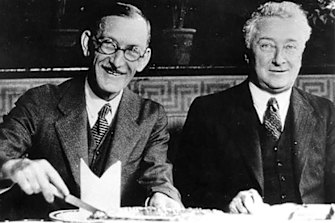
Anti-secession advocates Charles Samuel Nathan, and Joseph Lyons (Prime Minister) during in 1933.CREDIT:STATE LIBRARY OF WESTERN AUSTRALIA


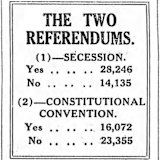
Voting on the referendum of secession or a Federal convention to consider the removal of the disabilities developed under federation presented peculiar features. The electorates returning Labor representatives voted strongly for secession. Agricultural votes show five to two in favor of secession. Metropolitan votes so far show comparatively small majorities for secession.

PRIME MINISTER’S COMMENT

Disappointed But Not Surprised

What Commonwealth Will Do

Commenting on the referendum in West Australia, the Prime Minister stated today that he was naturally disappointed at the result, although judging by the feeling that had been displayed in the campaign, he was not surprised at the verdict. Clearly a majority of the people in West Australia in their present mood were impervious to the logic of incontrovertible facts, and were prepared to give vent to their feelings against the eastern States, irrespective of the consequences. As far as the Commonwealth Government was concerned, it would proceed with the proposal already announced to invite the State to express their views as to the desirability of holding a constitutional convention, and also to get into the question of the assistance required by the smaller States.


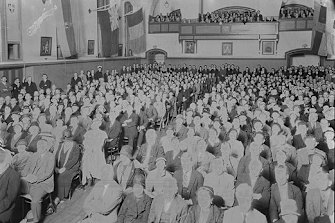
Secession meeting in the Perth Town Hall in 1933.CREDIT:STATE LIBRARY OF WESTERN AUSTRALIA

Asked whether the Commonwealth Government proposed to take any other action, the Prime Minister stated that would depend upon what West Australia did.

COMMENT IN LONDON

Futility of the Referendum

The referendum on the West Australia secession issue has created much interest here.


The “Observer” says: - “Federation like marriage, is for better or worse, richer or poorer, but there is no constitutional divorce court to which an aggrieved partner like West Australia can resort. The secession poll will be quite ineffective, except as an indication of public feeling.”


First published in The Age on April 10, 1933. CREDIT:THE AGE ARCHIVES

The “Times” says: - “No State maintains more pronounced individually or sturdier local patriotism than West Australia. It is a small community, engaged in a hard struggle for existence, and out of sight is apt to be out of mind. There has always been a feeling that Commonwealth authorities have little interest in its peculiar difficulties, and it is inevitable that West Australia should regard herself as the Cinderella in the sisterhood of States, but it is only within the last two or three years that the movement for secession has been taken seriously. With the depression has come a change of temper, and the movement in favor of secession gathered strength so fast that an affirmative vote is regarded as quite possible. The outsider may doubt whether the movement would have become so strong but for the handicap placed on West Australian development by a tariff policy framed in the interests of the secondary industries of the eastern States. Under the present system the west State suffers all the disadvantages of protection and free-trade, and enjoys the benefits of neither. Whether she would be better off under secession, even if secession were possible, is another question. The State even now gains more than she loses by being part of the Australian Commonwealth. It is evident that Federal statesmen admit the existence of serious grievances, and are prepared to do their utmost to remedy them. Doubtless many who vote for secession will do so in order to drive the lesson home.”

The financial editor of the “Daily Telegraph” says: - “Though some Australian stockholders might become uneasy in the event of a secession vote in West Australia, such a vote would have no sinister meaning. West Australia could not secede from the Commonwealth without the consent of the majority of the votes of all the other states. A vote for secession can be regarded only as a vigorous protest against Commonwealth taxation regulations, which bear unduly on States almost wholly dependent on primary products.”

The financial editor of the “Daily Herald” says: - “As a result of Perth messages there is a tendency to offer West Australian stocks for sale, but there is no cause for alarm. The vote will have no legal or constitutional effect.”


Wednesday, April 8, 2020

Monday, April 6, 2020

Le Monde diplomatique

https://mondediplo.com/

Le Monde diplomatique is the place you go when you want to know what’s really happening. This is a major international paper that is truly independent, that sees the world in fresh ways, that focuses on places no other publications reach. We offer a clear, considered view of the conflicting interests and complexities of a modern global world.
To make sense of what is happening in the world, behind the misinformation, Le Monde diplomatique is essential reading, every month, every yearJohn Berger

We specialise in authoritative journalism, whether it’s a view on US policy statements or on the unfolding dramas in Iran, Palestine or Pakistan. Le Monde diplomatique stands out in an increasingly uniform media landscape for its critical vision, in-depth analysis of world issues and reportages that illuminate the state of the planet. We find the stories that the commercial media often miss altogether (or discover we’ve been there first). Our contributors are experts in their fields – area specialists, academics, writers, journalists who are close to the issues and to the people making the news.
The essential source for alternative thinking and creative remediesHarper’s Magazine

Our readers include politicians, diplomats, policy-makers, journalists, lecturers, think-tank researchers, NGOs, opinion formers, students, and anyone who wants the real stories, reliable research and an independent viewpoint.

Le Monde diplomatique is a world-famous voice in journalism dating back to 1954 (it began as a journal to keep diplomats up to date on world events). Based in Paris, under the umbrella of the French daily newspaper Le Monde, it soon acquired an international reputation for its incisive monthly articles. In 1996, it won editorial and financial independence by forming its own company (1).
Unique, invaluable, reliable, the English edition is wonderful news for those who hope to understand the world or change it for the betterNoam Chomsky

LMD is now more than ever a truly international newspaper linking people who take a serious interest in world events across the globe:

• More than a million people worldwide read Le Monde diplomatique
• there are 29 different editions (print and internet)
• published in 20 languages

English edition

LMD in English is a concise version of the Paris-based parent edition, publishing all the major stories each month, expertly translated, and with some London-based commissions too.

Saturday, April 4, 2020

Thursday, April 2, 2020