Lecture at Division of Philosophy, Art & Critical Thought, The European Graduate School, 2014
Before beginning I would just like to remind you something which seems obvious, that is to say, that I will give my talk in English. But, as English is not my mother tongue, something relevant will certainly be lost. Why say that? What I would like to underline is that today general domination of English in conferences, universities and other places of that kind, should not be considered so innocent. The commonplace here is that English is used as a kind of lingua franca as Latin was used in europe in fifteenth, sixteenth and seventeenth century——the analogy is misleading, because Latin did not belong to any particular country was not spoken to by any particular country, while english, as you know, is proper let's say to a couple of nations. And I think we should reflect on that.
Now let's begin my talk.
The title of my talk echoes the title of a lecture that Gilles Deleuze gave in Paris in March 1987. If by chance you have seen the video which was taken that moment, you will remember that Deleuze defines the act of creation as an act of resistance. Resistance to death first of all but also resistance to the paradigm of information to which the power is exerted in those society that Deleuze called control society. Each act of creation according to Deleuze resists to something, so, for instance, Bach music is an act of resistance against the separation of the holy and the profane. As you see, Deleuze did not define what does resistance mean, and seems to give to the term the current meaning of the opposition to an external force or threat. The way in which I work is often an attempt to perceive what Feuerbach called the capability of development contained in the work of the authors I love. So, in this case I will try to develop this idea of an act of creation is an act of resistance. So I will try to interrogate what remain unsaid in Deleuze’s lecture. I must first say that I do not feel at ease concerning the usage of the term ‘creation’ referring to artistic practice. By the way, while I was investigating the genealogy of this term, I discover that a part of its responsibility belongs to the architects: when medieval theologians trying to explain the divine creation of the world, they had this example: they will say, as the house pre-exists in the mind of the architect, so God created the world looking to a model in his mind. So Thomas (Aquinas?) will write like this: Thomas distinguished clearly between the ‘creare ex nihilo’ or ‘to create starting from nothing’ which defines divine creation, and ‘facere de materia’ and ‘to make from matter’ that defines human productions. But as you see, the comparison between the activity of the architect and God's creation contains already the transposition of a theological paradigm to the activity of the artist. So I prefer to speak instead of an act of creation of a poetic act. And if in my talk I will continue to use the term 'creation' and it should be understood simply in the sense of the greek verb ‘poie’, produce.
The fact of explaining resistance only as an opposition to an external force does not seem sufficient, adequate to me, in order to comprehend, to understand what a poetic act is. I think and I’m convinced that as the potentiality which the act of creation allows, frees, must be internal to act, in the same way, also the resistance must be internal to the act of creation. Let me now say something about this concept of potentiality, as you know the concept of potentiality in western philosophy has a long history and starting from Aristotle’s has indeed a central position. As you know Aristotle opposes and links together at same time, potentiality ‘dynamis’ and actuality ‘energeia’, and this opposition has been transmitted as an heritage to western philosophy and also to western science. And it is true that this opposition of potentiality and actuality that Aristotle explains what we call poetic act, act of creation, which coincided for him mostly with the exercise of ‘tecknai’. So the example which he uses in order to explain the passage from potentiality into actuality are simply that the architect, the flute player, the sculptor, the grammarian etc . , in any case, each time that a certain technique is processed by certain man. But according to Aristotle, the man who has a potentiality can both exert it, realize it in the act, but also not to exert it. Potentiality, and this is the real genius thesis of Aristotle, is essentially defined in its possibility of not being exerted. So the architect has a potentiality because it can build but also cannot build. there were philosophers called Megarians that objected to Aristotle that a potentiality can only exist in act. But Aristotle answered, if this would be true, then an architect would be an architect only when builds, while we considered an architect or poet being a architect or poet also in the moment when they do not build or exert the potentiality.
So what defines the mode of being of potentiality is that it exists in the form of the mastery on a privation. So a potentiality, the man has the potentiality, must remain in relation to this potentiality also when it does not exert it. and Aristotle will push to the extreme these thesis and he will say, I quote him: “ Impotentiality is a privation contrary to potentiality. Each potentiality is impotentiality of the same and with respect to the same. So each potentiality of doing something is at the same time potentiality not to do something. So there is a kind of specific ambivalence in each human potentiality, which maintains potentiality in relation to its privation, and this relation defines, according to Aristotle, the essence of potentiality. So, Man, we could say, is the living being which exists in the mode of potentiality, that is to say, that he can its impotentiality. He possesses his potentiality in the mode of impotentiality. So he can do and be because he can remain in a relation which is not being and not doing.
So now if we remember that in the example that Aristotle gives for potentiality-impotentiality refers to essentially to technologies: music, grammar architecture, medicine etc., then we can say that man is the living being which exists essentially in the dimension of the potentiality, but also at the same time in the dimension of impotentiality. Each human potentiality is at the same time impotentiality. Each ability to do or to be is constitutively related to its own privation. And this is precisely the origin of the exorbitance of human potentiality. Human potentiality is so stronger than any animal potentiality because it can remain in relation with its own privation. Other animals, other living beings can only their specific potentiality, can this or that behavior which is described in their biological vocation. Men, on the contrary, is an animal who can its own impotentiality. And the greatness of his potentiality is measured by the abyss of his impotentiality.
Now after this philosophical digression let me go back to our interrogation of the act of creation. If we consider what we said, this means that the poetic act cannot be understood according to the an ordinary representation, as a simple transition from potentiality to actuality. The artist is not a man who has a potentiality to create that, at certain moment, we do not know how and the why, he will carry out into actuality. If any potentiality is constitutively impotentiality, potentiality-not-to, how can we understand the passage to the act? Let's say, if the pianist, if for the pianist, the realization of its potentialities to play is certainly the execution of the sonata on the piano, what happens to his potentiality not to play in the very moment in which he begins to play? how can a potentiality-not-to realize itself? I think that we can now understand in a better way perhaps, the relation between creation and resistance: in any poetic act there is something that resists to creation and counters expression. You know, the verb resist comes from the latin ‘sisto’ which means etymologically to arrest, to restrain something but also to stand still. This power that hinders and arrests potentiality in its movement towards the act is what Aristotle calls impotentiality: the power not to. Potentiality contains within itself an ambivalence: it is an ambiguous being which not only can both a thing and it's contrary, but contains in itself an intimate and irreducible resistance. Now, if this be true, we must look at the act of creation, the poetic act as a field of tensions stretching out between potency and impotency, to can and cannot, acting and resisting. Man can master his potentiality only through his impotentiality, but precisely for that reason there is not such a thing as a mastery on potentiality. This means that to be a poet means to be fully and helplessly delivered to one’s own impotentiality, this is a poet: A man who is completely abandoned to its impotentiality. So the highest potentiality is a potentiality that can both its potency and it's impotency. If every potentiality is potentiality to be to do or not to be to do, the transition to the act can take place only transferring into the act the potentiality-not-to: the resistance. This means that each pianist has the potentiality to play and the potentiality not to play, but Glenn Gould is only the pianist who cannot-not play. And turning his potentiality to his own impotentiality, can, so to say, his potentiality not to play. Contrary to the mere ability and to talent which can only play, thus the act, maestria and mastery keeps and exerts in the act the potentiality not to play. Let's now consider more tentatively the action of the resistance in a poetic art, what is this inner resistance in the poetic act. Similarly to Walter Benjamin calls the inexpressive , which breaks and interrupt in the work the pretension of the appearance to give itself to totality, in the same way, resistance acts as a critical power which holds back and restrains the blind drive of potentiality towards the act, and in this way it impedes that potentiality consumes itself and exhaust itself entirely in the work. If creation was only a potentiality to do something, potentiality which can only pass blindly into the act, then art would be reduced to an execution of an order or even a prescription which has dismissed and denied the resistance and the potentiality-not-to. So it would be really an inadequate conception of art : as something that must be necessarily passing to the act. So contrary to a common misunderstanding, the maestria is not a formal perfection, it is rather the ability to conserve impotency and potency in the act. It is the retention of an imperfection in the perfect form. This is like the Navacho woman who said that she would rather leave a little imperfection in the tissue she was weaving in order not to remain imprisoned in it. If she did not leave an imperfection in the tissue then there would have been no exit for her, and she will remain in prison, and the same is true for the artist and the maestro has to leave an imperfection.
So in the painting of the maestro and in the page of the great writer, the resistance of the potentiality-not-to, inscribes itself as an inner mannerism always present in every true artwork, every true masterwork. And it is precisely on these internal resistance that also critique can find its foundation. What an error of taste, the lack of taste, reveals is always a lack concerning the potentiality not to. An artist who lacks of taste is incapable to refrain from doing or adding something, so the lack of taste is always the impossibility of a refraining from doing an act, this spoils very often artworks.
So we can represent in this perspective the act of creation as a complicated dialectics between an impersonal element which precedes and overcomes the subject and the personal element which tenaciously resists to the first. The style of an artist does not depend only from the impersonal element, from his creative power, it depends also from what seems to resist to it and almost fight against it. This is the inner mannerism I mentioned before, that always marks the style of a great artist. A real artist, the style of great artists contains always an inner mannerism. A well-known example: an art historians knows that the old Tiziano completely changes his style. The late painting of the Titian are so different from what it used to be his style, that art historians say that Titian becomes Impressionists, if you are familiar with the later Titian paintings. If you like, for instance, the Annunciation in San Salvatore in Venice, there you will see that the color becomes a kind of confused magma, and the brush paint seems to strike and injure the canvas; and, that's very interesting, Titian used to sign his painting with the formula “Titian made it” but these late paintings for instance the Annunciation in San Salvador is signed “Titian made it, made it”: twice. meaning he made it and unmade it, exaggerated, there is an undoing. That is also true for the style of the old Goethe and also for Plato. Allready ancient commentators say that in the late dialogues Plato becomes completely artificial, full of a mannerism and repetitions. The old Goethe, according to some linguists did not write anymore in German etc etc., this is true for, always true. ... the late Shakespeare becomes mannerist.
But another and in my opinion even better example is the allegories of the creation in Kafka, where the great artist is defined by its absolute incapability concerning its own art. If you remember the marvelous short piece by Kafka and it's the confession of the great swimmer. I quote it: “I have, admittedly, broken a world record. But if, however, you were to ask me how I have achieved this, I could not answer adequately. Actually, I cannot even swim. I have always wanted to learn, but have never had the opportunity”. And then another instance of the same thing famous story of Josephine the Songstress of The Mouse Folk, who does not know how to sing and can only whistle like any mouse can do but even not so good as the other mouse. But precisely, Kalka wrote, precisely for this inability she, I quote, “can produce effects that no other singer would ever realize and that only her inadequate means can achieve” . I think that nowhere as in this two figures, the usual representation of the artist has been so radically called into question. Josephine sings with her impotentiality of singing, like the great swimmer swims with his incapability to swim. The fact is that the potentiality-not-to is not simply another potentiality besides the potentiality to do. It is what I will call its inoperativity. That is to say something that results from the deactivation of the usual conception, the usual relation between potentiality and actuality. I mean that there is an inner link between the potentiality-not-to and what I will call inoperability. Like Josephine, through her inability to sing, makes inoperative and exhibits, so to say, the whistle each single mouse can do, in the same way potentiality-not-to suspending and deactivating potentiality-to, shows it as such, exposes it as such. So the right way how to represent the relation between potentiality and impotentiality, we must not think that there is a potentiality-not-to which precede the potentiality-to ( for instance the potentiality-not-to sing which precedes the potentiality-to sing), and that must therefore abolish itself so that the potentiality can realize itself into the act. The potentiality-not-to is a resistance internal to potentiality which impedes it's exhaustion in the act and oblige potentiality to turn towards itself and to become, so to say a potentiae potentiae: a potentiality which can its own impotency. Let me do an example: the work of Velasquez Las Meninas, which results from this suspension of potentiality, does not represent and expose only its subjects its objects. It presents itself at the same time, and in the same gesture the potentiality through which the painting came into being. Great poetry does not simply says what is saying but also says the fact that it is saying it: the potentiality and the impotentiality of saying.
Painting is the suspension and the exposition of the potentiality of the sight, exactly like poetry is the suspension and exposition of language. And I think this is the only possible meaning of expressions such as: poetry-of-poetry or painting-of-painting. Poetry is suspended and exposed in the poem like painting is suspended and exposed in the painting. I am aware that terms such as: suspension, inoperativity, deactivation, continuously punctuate my lecture, and therefore it is perhaps time for me to try to define something as a-poetics-of-inoperativity . In order to do that let me just quote again an extraordinary passage from Aristotle Nicomachean Ethics, where the philosopher is reflecting on the problem of what is the work of man, what is the Ergo, the work of man. I go to this extraordinary passage : “as for the flute player for the sculptor for every artisian and more generally for all those who have a work, an ergo and the praxis, it should be in the same way also for men as such, if there is for men as such a thing as a work. Or should we rather say that for the carpenter and for the shoemaker there is a work, but for men as such there is none, because he was born Argos: without a precise work. So man he is born without a proper work, man as such”. This very interesting hypotheses of the kind of the constitutive worklessness of men as such, absence of a work for man as such, is so disturbing that Aristotle immediately abandoned the question. So he will not continue to take seriously this question. Let me try on the contrary to take it to take this hypothesis seriously and attempt to take man as a being without any possible work. A being that no proper work can pretend to define. By the way these hypotheses is not scandalous and does not cease to appear in the history of Western culture. We will just quote two example to appreciate the reappearances of this worklessness of man in 20th century.
There are two little books and just two little books. the first one is the extraordinary little book by the Dutch anatomist Ludvig Bulk, the title is the the problem of mentioned: Becoming Human of Men as of in Anthropogenesis. According to Bulk, it's very interesting, men does not derive from adult primate but from the baby phase of a primate, a primate who had not acquired the capability of reproducing themselves. So man is a baby of monkey who has constituted himself in an autonomous species. He proved that anatomy of men which is a similar not to the anatomy of an adult monkey but is similar to the anatomy of the baby of the monkey. But then this futility of men explains the peculiar effect that compared as you know with other animals men remain forever in a potential condition so that we can adapt themselves to all environment to all of our limitation to all formal activity but no one of these activities can define him. So you know so men is a potential being which lacks any biological predetermined location. The second case comes from a history of art, it is an extraordinary little booklet by Kazimir Malevich, the title is Inoperativity as the Real Truth of the Man. Against the tradition which says man's realization only in work, Malevich states clearly that in Inoperativity is the highest form of humanity. And then what in his painting responds to this highest form of humanity is the use of the blank, the white, all white paintings: the last stage of Suprematism in painting. So it is an example of the poetics of Inoperativity at work.
I think that we can now better understand the essential function, the traditional role that western philosophy always assigned to theory and contemplation and Inoperativity. The true human praxes is a praxes which by making inoperative all the works and functions of living being opens then to a new possible usage. Contemplation and Inoperativity (but Inoperativity does not mean do nothing, quite the contrary) are in this perspective the metaphysic agent operators of anthropogenesis: of the becoming human of man, which frees men by any biological or social destiny or vocation, opens him to those peculiar form of worklessness that we are accustomed to name politics and art.
I hope that what I meant when I spoke of poetics of inoperativity is now perhaps better understandable. And perhaps the most appropriate paradigm for this operation, this activity which consists in making inoperative all human work, is poetry itself. Because what is poetry if not an operation in language and on language that deactivates and renders inoperative the usual communication and information functions of language, in order to open it to a new possible use? I mean that Divine Comedy and Cavalcanti’s poems are the contemplation of Italian language. ( ? ) troubadour are the contemplation of provençal language. Rimbaud’s Illuminations are the contemplation of the French language. Holderlin Hymn are the contemplation of German. Hopkins or John Donne's poem are the contemplation of the English language. And what poetry accomplishes for the potentiality of speaking, politics and philosophy must achieve for the potentiality to act: by making inoperative all economical, religious and social whatever works, they show what the human body can and open it to new possible usage.
Monday, November 30, 2020

Sunday, November 29, 2020
Saturday, November 28, 2020
Decibel Levels
Inaudible Range (Less than 10 dB)
-9 World’s quietest room
0 Lowest audible sound to human ear
10 Average silent room
Barely Audible Range (10 to 40 dB)
You’ll be able to hear these, but it will take a lot of effort, and there can’t be any distractions.
13 Hum from a light bulb (switched on)
15 Pin drop on solid floor from 1 meter
30 Nighttime in rural area
35 Main hall of a library
40 Human whispering
45 Hum from a refrigerator
Normal Range (40 to 85 dB)
Listening to these sounds poses little or no risk to the average person. 85 decibels is the highest volume that poses no health dangers.
50 Corporate office environment
55 Rainfall; light traffic (closed windows)
60 Average conversation between adults
65 Acoustic piano; moderate traffic
70 Busy restaurant
80 Vacuum cleaner; hairdryer
85 Garbage disposal; school cafeteria
Dangerous Range (85 to 115 dB)
Sounds at this range can damage your hearing, either immediately or through prolonged exposure. Without ear protection, nobody should be exposed to 90 dB for more than 8 hours per day, 100 dB for 2 hours, 105 dB for 1 hour, or 110 dB for more than half an hour.
90 Tractor
95 Truck or motorcycle engine
100 Subway platform at rush hour; orchestra from the first row
105 Pneumatic drill; car stereo at max. volume
110 Rock concert from the gallery; car stereo with two 6×9 speakers and 100 watts
115 Power saw; backhoe; ambulance siren
Serious Injury Range (115 dB to 140 dB)
There is no safe amount of exposure to volumes in this range. Being near a sound above 115 dB for any length of time without protection can cause permanent hearing damage. At this level, you’ll also begin to feel the sounds in parts of your body other than your ears.
120 Rock concert from the front row; thunderclap overhead
125 Cymbal crash; loudest possible human scream
130 Jet engine taking off; air raid siren
135 Firecracker
140 Shotgun blast directly beside ear
Deadly Range (140 dB to 200 dB)
Forget hearing damage — these sounds will give you permanent everything damage. Below about 170 dB, ear protection can still save you, but store-bought earplugs and earmuffs won’t be enough. You’re also likely to start having other problems with whatever is creating the noise (here’s a hint: don’t stand next to a pound of TNT).
150 Formula One car at full throttle
160 Inside jet engine or rock concert speaker bin
170 7,000-horsepower engine
180 1 pound of TNT detonating 15 feet away
190 Grenade blast epicenter
200 Causes immediate death
Extreme Range (more than 200 dB)
Since we’ve already established that being near sounds above 200 decibels will kill you instantly, these are just here as fun facts. Note that since it’s not possible to put a decibel meter near many of these events and have it survive, dB levels above 200 are mostly theoretical.
210.6 Epicenter of a magnitude 2.0 earthquake
213 Sonic boom
214 Space shuttle launch
215 U.S.S. New Jersey firing all 9 of its 16-inch guns
235.2 Epicenter of a magnitude 5.0 earthquake
243 Volume of the largest non-nuclear explosion in history – the “British Bang” which in 1947 destroyed an entire island with 6,700 tons of ordnance
248 Center of the atomic bomb blasts at Hiroshima and Nagasaki
282 Center of the Tsar Bomba test conducted by the Soviet Union, believed to be the loudest sound ever created by humans
286 Center of the Mount Saint Helens volcanic eruption
310 Theoretical volume of nature’s loudest sound, the eruption of Indonesia’s Krakatoa volcano
160 Inside jet engine or rock concert speaker bin
170 7,000-horsepower engine
180 1 pound of TNT detonating 15 feet away
190 Grenade blast epicenter
200 Causes immediate death
Extreme Range (more than 200 dB)
Since we’ve already established that being near sounds above 200 decibels will kill you instantly, these are just here as fun facts. Note that since it’s not possible to put a decibel meter near many of these events and have it survive, dB levels above 200 are mostly theoretical.
210.6 Epicenter of a magnitude 2.0 earthquake
213 Sonic boom
214 Space shuttle launch
215 U.S.S. New Jersey firing all 9 of its 16-inch guns
235.2 Epicenter of a magnitude 5.0 earthquake
243 Volume of the largest non-nuclear explosion in history – the “British Bang” which in 1947 destroyed an entire island with 6,700 tons of ordnance
248 Center of the atomic bomb blasts at Hiroshima and Nagasaki
282 Center of the Tsar Bomba test conducted by the Soviet Union, believed to be the loudest sound ever created by humans
286 Center of the Mount Saint Helens volcanic eruption
310 Theoretical volume of nature’s loudest sound, the eruption of Indonesia’s Krakatoa volcano
Friday, November 27, 2020
Thursday, November 26, 2020
Mishima Yukio
Mishima was born Hiraoka Kimitake in 1925. As the Shōwa era (1926–89) began the following year, the author’s age remained in step with the numbering of the era; he was 20 in 1945 (Shōwa 20) and 45 when he died in 1970 (Shōwa 45). Divide the period into three, and there are the first 20 years of Shōwa that were dominated by years of warfare culminating in unprecedented collapse, the next 25 of rapid economic growth that lifted the country up from its burnt-out ruins, and the 20 or so that followed. Mishima’s life overlapped with the first two of these parts, which could be seen as most representative of the period as a whole. Although the curtain finally came down on the Shōwa era in 1989, as the economic bubble burst, he could be said to have already followed its spirit to the grave.
Mishima believed that literary works represented their age, while at times expressing disagreement and offering new historical visions. This was particularly the case from his 1956 work Kinkakuji (trans. The Temple of the Golden Pavilion) onward. The main genre of modern Japanese literature was the I-novel, in which authors sincerely recorded their own experiences and incidents around them; writers with the same sense of creativity as Mishima were extremely rare. On the international stage, however, authors celebrated for their contributions to the novel like Balzac, Flaubert, Thomas Mann, Tolstoy, and Dostoyevsky all transcended their era, criticizing society and thrusting their artistic vision on the world. Mishima was a writer in this tradition.
Debut at 16
Mishima was born in Yotsuya, Tokyo. This was technically in the prestigious Yamanote district on the west side of the city center, but in fact it was a poor locality, left behind in the reconstruction that followed the Great Kantō Earthquake of 1923. His grandmother Natsuko, from a distinguished samurai family, was dissatisfied with the living environment there. Mishima’s grandfather was formerly the governor of the southern half of the island known as Karafuto in Japan (now wholly administered by Russia as Sakhalin). However, he was forced out of office after a bribery scandal, and Natsuko compensated for her lost dreams and shattered self-esteem through devotion to her grandson.
As Natsuko suffered from sciatica and Mishima had a weak constitution, they often spent their days together in the sickroom. Mishima, who loved fairy tales and picture books, later let his own imagination fly, drawing and writing stories. In “Sekai no kyōi” (The Wonder of the World), a story he wrote when he was 10, autumn comes to an island paradise and with the extinguishing of a candle, it is plunged into darkness.
Although Mishima was not himself from an aristocratic family, he attended Gakushūin, a school for children of the upper classes. His poor health played a part in his undistinguished performance in elementary school. From junior high school, however, his teachers helped lift him to become one of the institution’s outstanding students. At 16, he made his literary debut with his first story to be published outside school magazines. In “Hanazakari no mori” (The Forest in Full Flower; 1941), the narrator enters the flow of time before he was born, and rediscovers the origin of life. This was when Mishima adopted his pen name. It was also the year Japan attacked Pearl Harbor, initiating the Pacific War.
Mishima graduated from Gakushūin High School at the top of his class in 1944 and enrolled in the Faculty of Law at Tokyo Imperial University (now the University of Tokyo). Although poor health exempted him from military service, Mishima’s first collection that year, bringing together “The Forest in Full Flower” with four other stories, had been intended as a posthumous publication. The end of the war the following year left him facing a dilemma. Older authors forced into silence during the war years and up-and-coming writers back from the battlefields let forth a flood of fiction, while Mishima, who despite his youth had been creatively active during this time, found he had lost his place in the literary world. Half deciding to abandon his idea of becoming a novelist, he joined the Ministry of Finance after graduating from university, and began on the bureaucratic career path.
Instead of giving up fiction, however, Mishima quit his job at the ministry after nine months to work on a new novel. Kamen no kokuhaku (trans. Confessions of a Mask), published in 1949, had a narrator based on the author himself, who looks back on the circumstances that led him to accept his homosexuality. In one notable scene, the narrator first becomes sexually excited on seeing a picture of the martyrdom of Saint Sebastian, who was bound to a tree and shot with arrows. The novel did not represent Mishima’s own coming out as gay, though. Rather, with an insistence that everyone is wearing masks, it poured cold water on the kind of sensibility that believes unquestioningly in the identity of the self. This irony resounded with the psychologically troubled young people who had to live through the chaos of wartime and the immediate postwar period, making Confessions of a Mask a bestseller.
Success and Miscalculation
Having returned to the literary scene, Mishima drew a lively picture of the gay community in occupied Japan in Kinjiki (trans. Forbidden Colors), published from 1951 to 1953, and presented an innocent story of first love in his 1954 Shiosai (trans. The Sound of Waves). He also ventured into drama with the 1956 collection Kindai nōgakushū (trans. Five Modern Nō Plays) and the 1954 kabuki play Iwashiuri koi no hikiami (trans. The Sardine Seller’s Net of Love). In 1956, at the age of 31 he published The Temple of the Golden Pavilion, based on the real-life arson of Kinkakuji, the titular Kyoto temple, by one of its acolytes in 1950. It became one of his best received works and was translated into many languages.
By the time it was published, Japan’s economic boom years had begun. What drew so many readers to this novel about the arson incident of six years before? Reborn after the tribulations of war, the country was rising toward prosperity. Even so, it was only a decade or so since the war ended, and the dark memories of that time were slow to fade. They remained deeply rooted in people’s minds as an inner threat to the bright dreams of postwar democracy, progress, and affluence. The Temple of the Golden Pavilion spoke for the internal unease many in the new society felt.
From the inner perspective, democracy and economic growth were nothing other than masks. Continuing to wear them meant losing sight of the roots of existence, and falling into nihilism. Mishima made nihilism the subject of his 1959 work Kyōko no ie (Kyōko’s House), which tells the story of four young people leading lonely lives in Tokyo and New York around 1955.
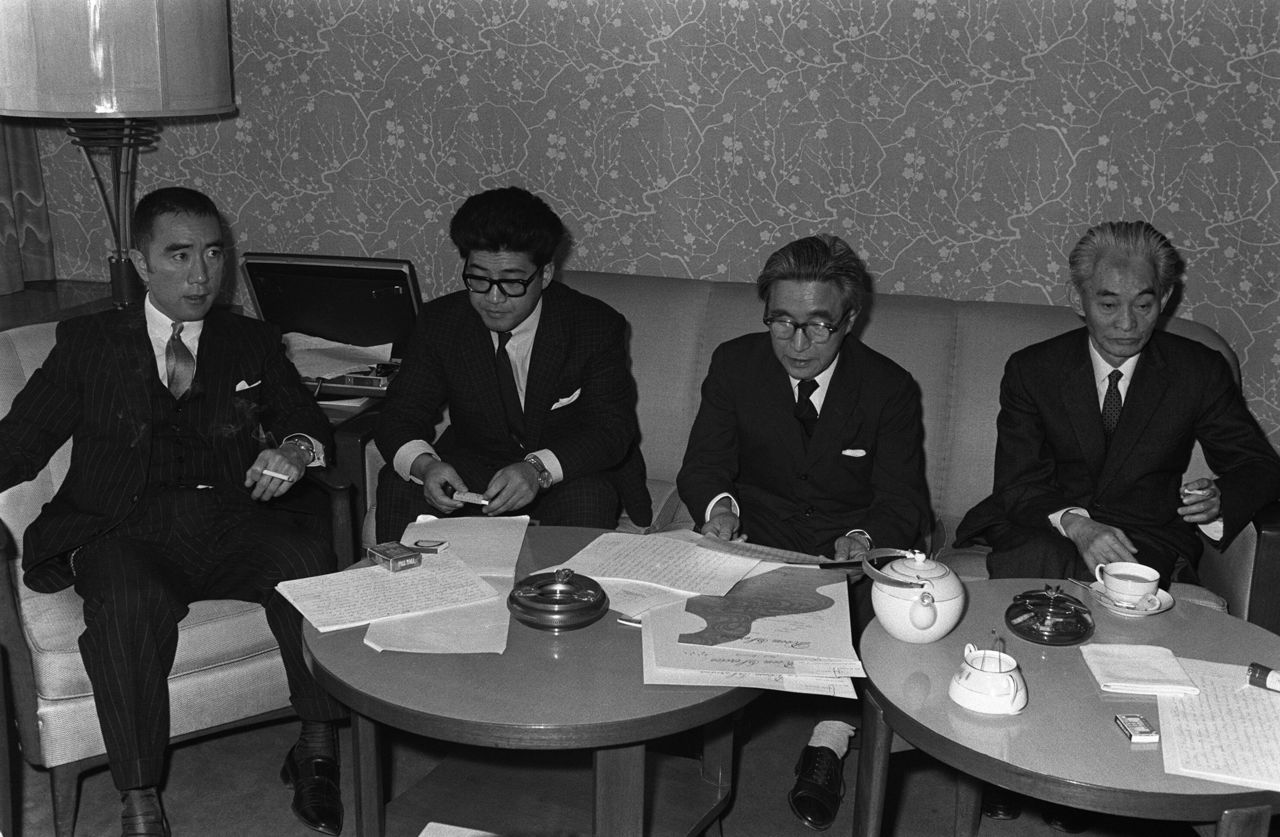
(From left to right) Authors Mishima Yukio, Abe Kōbō, Ishikawa Jun, and Kawabata Yasunari come together to read a joint statement in Tokyo on February 28, 1967, protesting against the Cultural Revolution in China. (© Jiji)
Here he made a great miscalculation. The generation of readers who embraced The Temple of the Golden Pavilion were lukewarm about Kyōko’s House. By 1959, the people bustling through a new and bigger economic boom were no longer interested in the question of nihilism. For Mishima, who had tried to depict some of the darker aspects of the age in his novel, this was a grave shock.
The Final Manuscript
Mishima went on to seek new ways of being outside the literary sphere, acting in the 1960 gangster movie Karakkaze yarō (Afraid to Die) and becoming the subject of the 1963 photography collection Barakei (Ordeal by Roses) by Hosoe Eikō. With their success, he became a media favorite.
This meant, however, catering to the postwar society that made no attempt to understand Kyōko’s House. The greater the media reaction he stirred up, the greater his sense of self-denial. To counter this situation, he could only take on the challenge of creating a literary work that captured the age and offered a new vision of history on a greater scale than ever before. This was the tetralogy Hōjō no umi (trans. The Sea of Fertility).
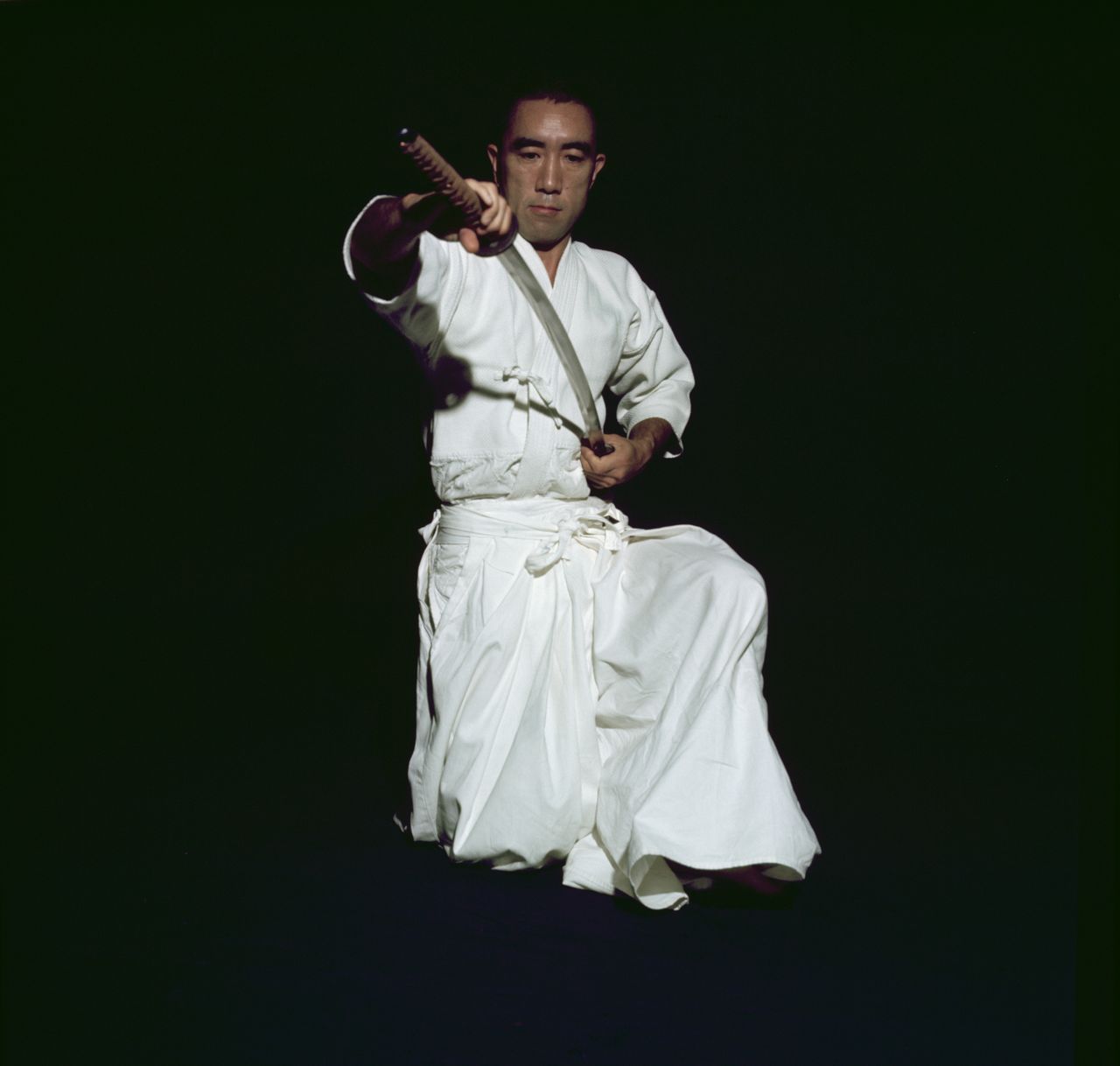
Mishima Yukio practicing the martial art of iaidō on July 3, 1970. (© Jiji)
In the four books, its protagonist apparently reincarnates through the twentieth century. The opening depicts a memorial ceremony for those who died in the Russo-Japanese War of 1904–5. Its bleak atmosphere lingers in the background throughout The Sea of Fertility, demonstrating that the roots of postwar nihilism were already present in the Meiji era (1868–1912). As the successive reincarnations fight against this rejection of principles in their pursuit of life, a joyful enlightenment seems certain in the final part.
However, while this was the ending in the original concept, the fourth book actually finishes with the twist that the stories of reincarnation were no more than an illusion. After handing the final manuscript in to be edited on November 25, 1970, Mishima caused a sensation with his suicide. The truth behind the act is still unknown. One thing I can say is that Mishima vividly portrayed the nihilism the age was moving toward in his ending to The Sea of Fertility. I take his death by his own hand as having been an act aimed at encouraging each one of us to discover how to overcome that nihilism.
This year marks 50 years since Mishima Yukio’s (1925–70) spectacular suicide in November 1970. Events have been held around the world to commemorate the author’s life and work. Featuring somewhere at almost all these events have been the artfully posed photographs of Mishima taken by Hosoe Eikō (1933–) and published in 1963 under the title Barakei (Ordeal by Roses), one of the most original photo books of the twentieth century. The series features Mishima in a variety of poses, proudly showing off his muscular physique, the result of many years of dedicated bodybuilding. The photographs—taken between autumn 1961 and spring 1962, mostly at the writer’s home in the Magome district of Tokyo—encapsulated Mishima’s self-image and brought it to vivid life in photographs that used a variety of sophisticated techniques to create an astonishing world of provocative sensuality and sumptuous estheticism. Hosoe was 28 years old at the time, and one of the rising stars of Japanese art photography.
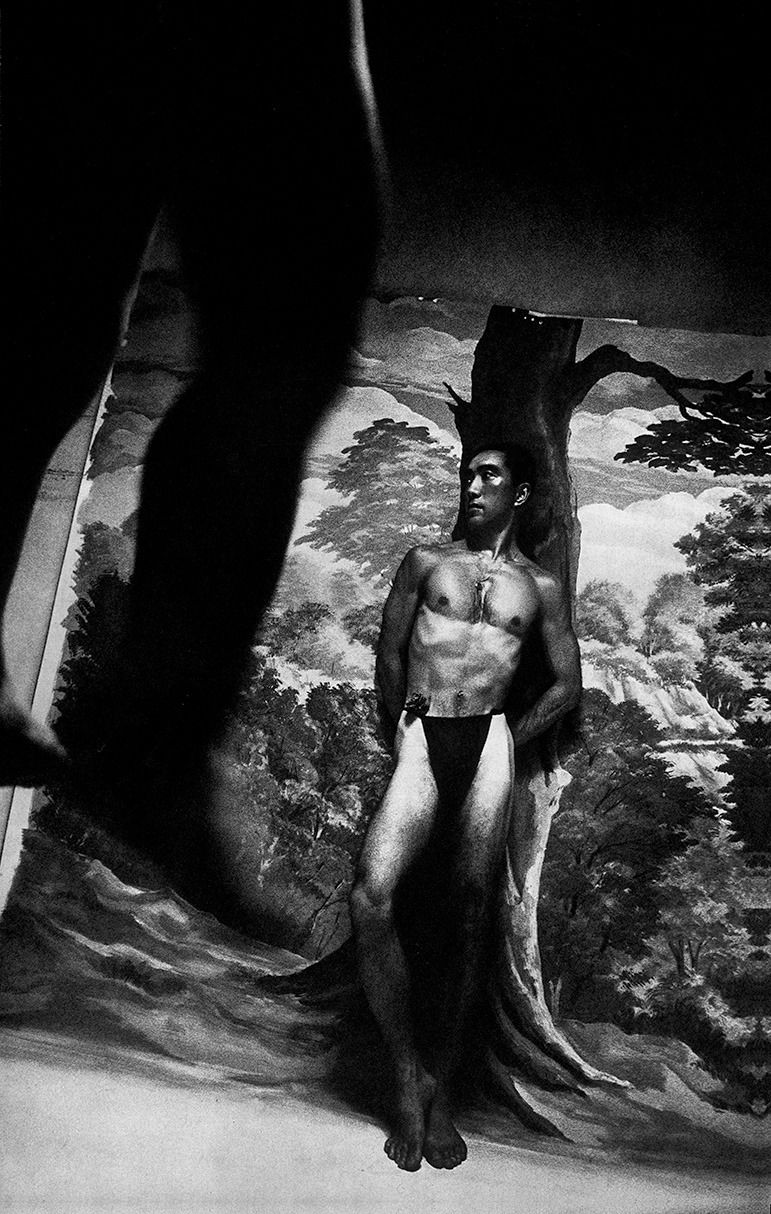
Barakei (Ordeal by Roses) #34, 1961
Visions of an Artist
The initial connection between Hosoe and Mishima came through choreographer Hijikata Tatsumi (1928–86), creator of the dynamic and revolutionary new butoh form of modern dance. Hijikata and Mishima were close friends, and in 1959 Hijikata developed a dance piece based on Mishima’s novel Kinjiki (Forbidden Colors). Hosoe attended a performance, and was immediately struck by the artistic possibilities of the thrilling new style of dance. He visited Hijikata backstage after the performance, and was soon taking photographs of Hijikata, the model Ishida Masako, and their fellow dancers. Hosoe used the bodies of these dancers to create a series of graphic images of “men and women, as human beings captured in the concreteness of sex,” (to borrow the phrase of photography critic Fukushima Tatsuo), in a series of strikingly vivid images, their unembellished rawness accentuated by the stark contrast between black and white. The images came out in book form in 1961, under the title Otoko to onna (Man and Woman).
Mishima saw this collection and other photographs of Hijikata and his troupe that were used in programs for the group’s performances, and became fascinated by Hosoe’s style. Via his editor, he approached Hosoe and commissioned him to take a new series of photographs. The first time they met, Mishima told the photographer: “I will give myself up to you as the subject matter for your camera. I want you to feel free to use me as you see fit and take whatever images your vision suggests.” Hosoe took Mishima’s words at face value, and proceeded to take a series of astonishing photographs whose shocking originality was a world apart from any kind of banal celebrity shoot or conventional author photo. At their first shoot, Hosoe wrapped a naked Mishima in garden hose and stood him on marble flagstones depicting an elliptical mosaic zodiac, with one end of the hose in his mouth. Mishima stands with a mallet in his right hand, Hosoe looking down at him from a stepladder, Mishima staring intensely into the camera with a gaze that seems to contain all the power of his muscular physique.
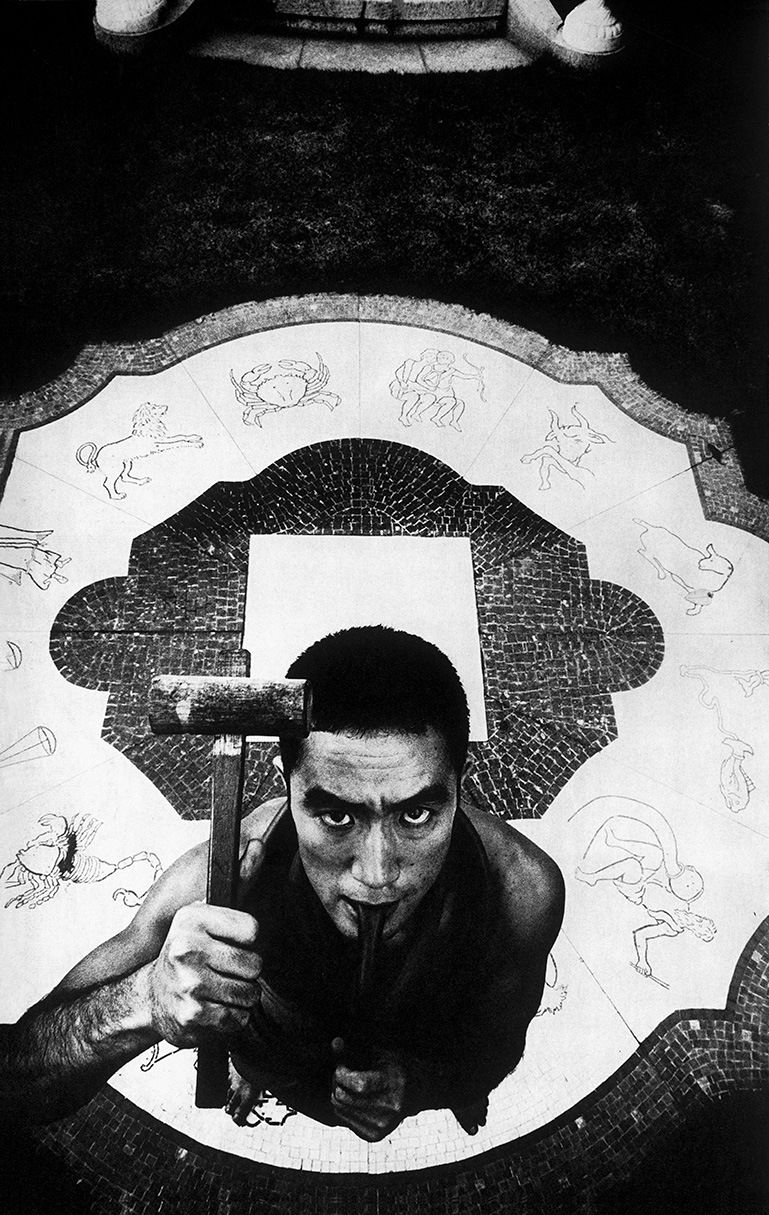
Barakei (Ordeal by Roses) #5, 1961.
Mishima loved these groundbreaking photographs, which seemed to refuse any attempt at straightforward interpretation, and the two men agreed to meet again for further sessions. For the second shoot and the remainder of their collaboration, Mishima sent his wife and children out of the house before shooting started, claiming that the decadent photographer and his friends would have a “bad influence on their morals.” The images often incorporated elements from Mishima’s favorite works of art, such as “Sleeping Venus” by the Venetian painter Georgione, and Botticelli’s “Birth of Venus.” Mishima invited Hijikata and his troupe to his house and posed with them, as well as posing for several shots with the actress Enami Kyōko (1942–2018). Occasionally the collaborators left the Mishima residence to shoot in other locations, including a building site on the grounds of a church strewn with red bricks.
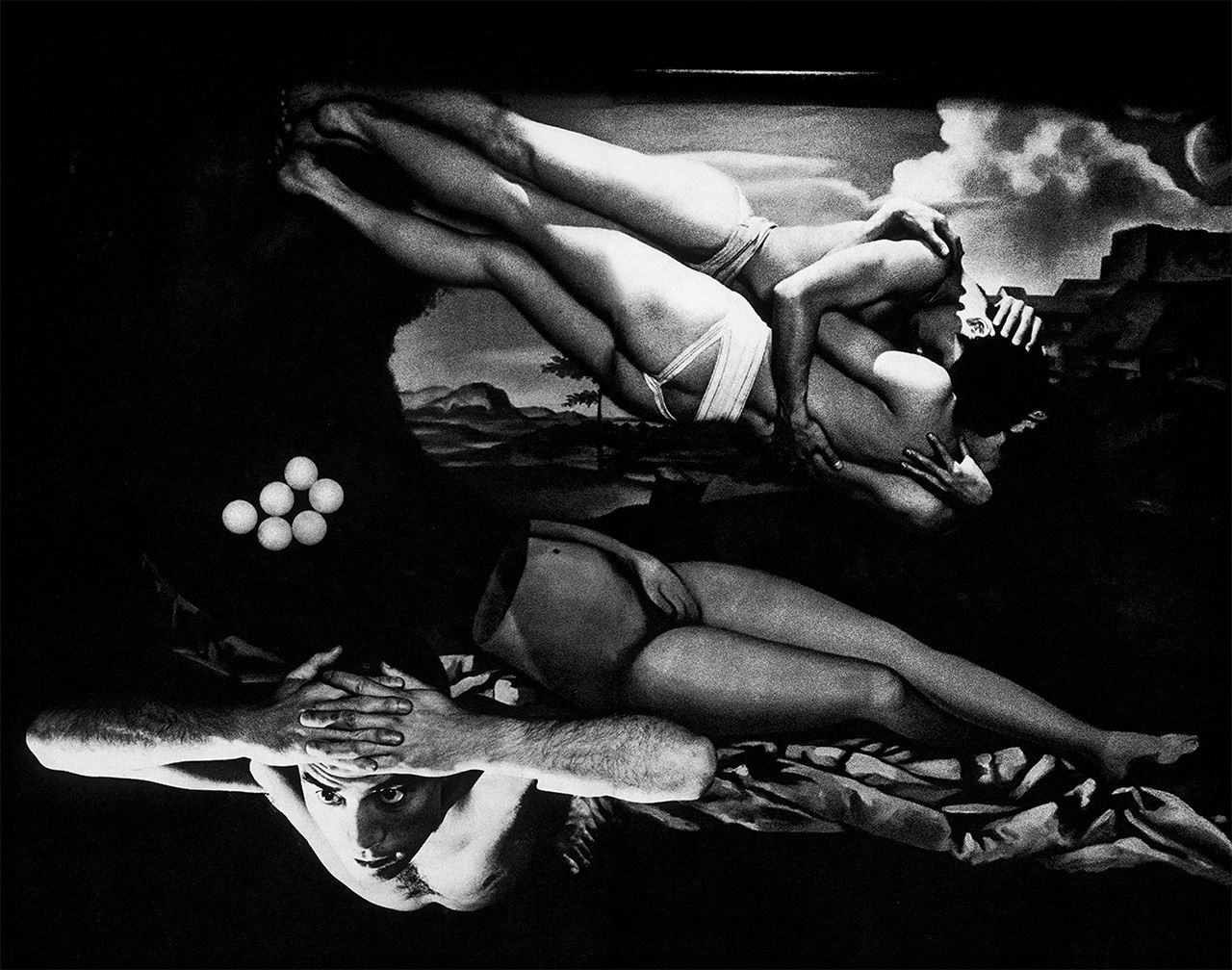
Barakei (Ordeal by Roses) # 16, 1961.
Gradually, a vision took shape that Mishima described in the following terms in his preface to the photographs when they were published in book form: “The world to which I was abducted under the spell of his lens was abnormal, warped, sarcastic, grotesque, savage, and promiscuous . . . yet there was a clear undercurrent of lyricism murmuring gently through its unseen conduits.”
One of the people who played an important role in the darkroom, helping to develop and print the images, was Moriyama Daidō, who later became a well-known photographer in his own right. Moriyama had moved from Osaka to Tokyo in 1961 and was working as Hosoe’s assistant. The Mishima project was one of his first assignments. It was not an easy job, responding to the ideas as they poured from Hosoe and trying to make them a reality. Moriyama remembers the difficulties he faced in the darkroom, where he had to call on all his skills and ingenuity to print images that would match Hosoe’s vision, using low sensitivity mini-copy film, then lowering the sensitivity even further and combining several negatives into a composite montage. Moriyama Daidō later became known for his peerless skills in finishing and developing his prints. It is fair to say that much of the groundwork for his subsequent career was laid down during this period working with Hosoe on his pictures of Mishima.
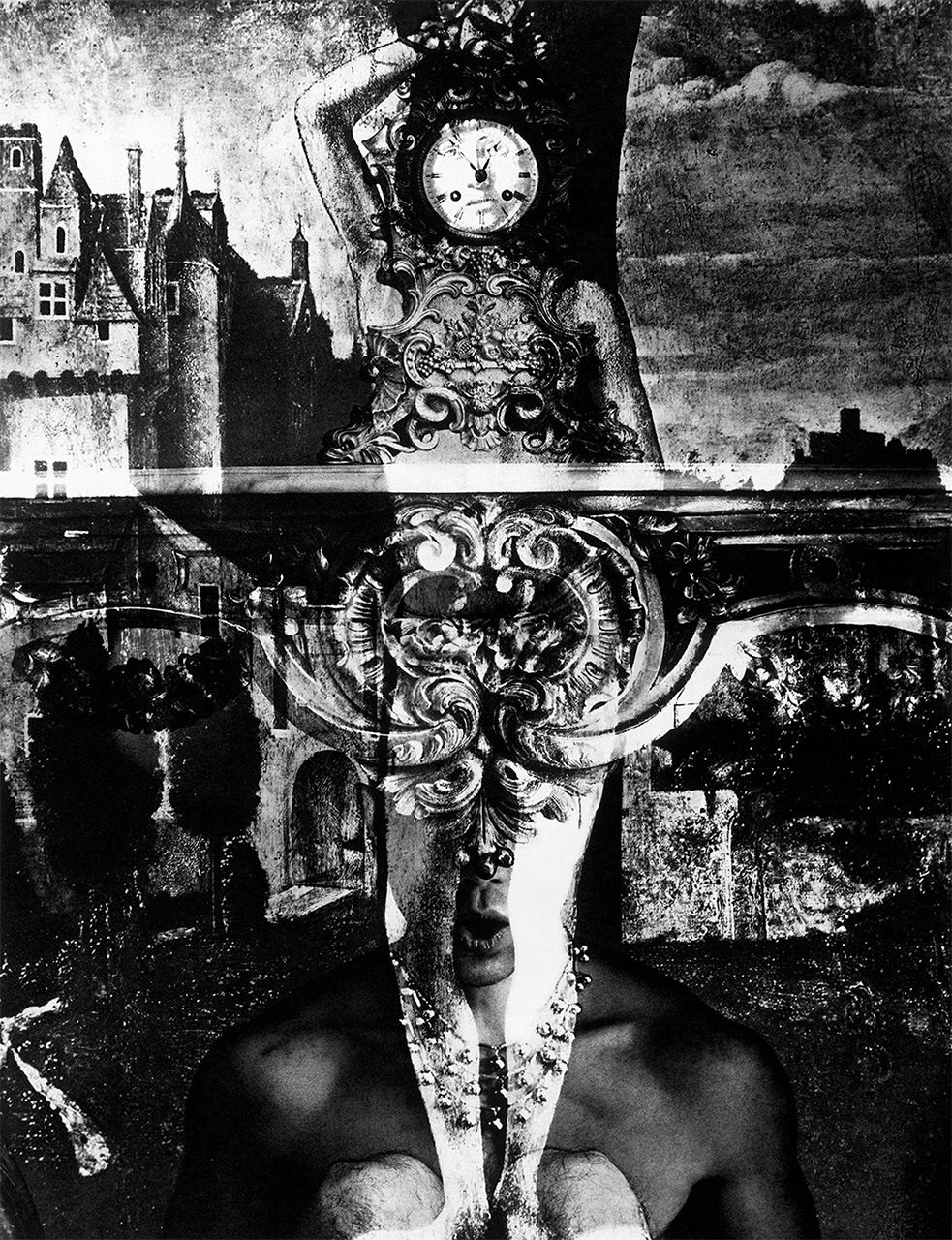
Barakei (Ordeal by Roses) #29, 1961.
Mishima’s Esthetics of Life and Death
The first of the photographs appeared on the cover and frontispiece of Bi no shūgeki (Assault of Beauty), a collection of Mishima’s critical essays published by Kōdansha in 1961. They were then displayed at the Non exhibition at the Matsuya Department Store in Ginza, Tokyo, in January 1962, organized by Fukushima Tatsuo, with the participation of leading photographers including Narahara Ikkō (1931–2020), Tōmatsu Shōmei (1932–2012), Kawada Kikuji (1933–), Ishimoto Yasuhiro (1921–2012), and Imai Hisae (1931–2009).
Then, in March 1963, the photographs were published as Barakei (which originally carried the English title “Killed by Roses,” later amended to “Ordeal by Roses”), in a large-format luxury book designed and bound by designer Sugiura Kōhei (1932–). The photographs were presented in five chapters: “Chapter One: Preface,” “Chapter Two: Daily Civilian Life,” “Chapter Three: The Scornful Clock, or the Slothful Witness,” “Chapter Four: Various Blasphemies,” and “Chapter Five: Ordeal by Roses.”
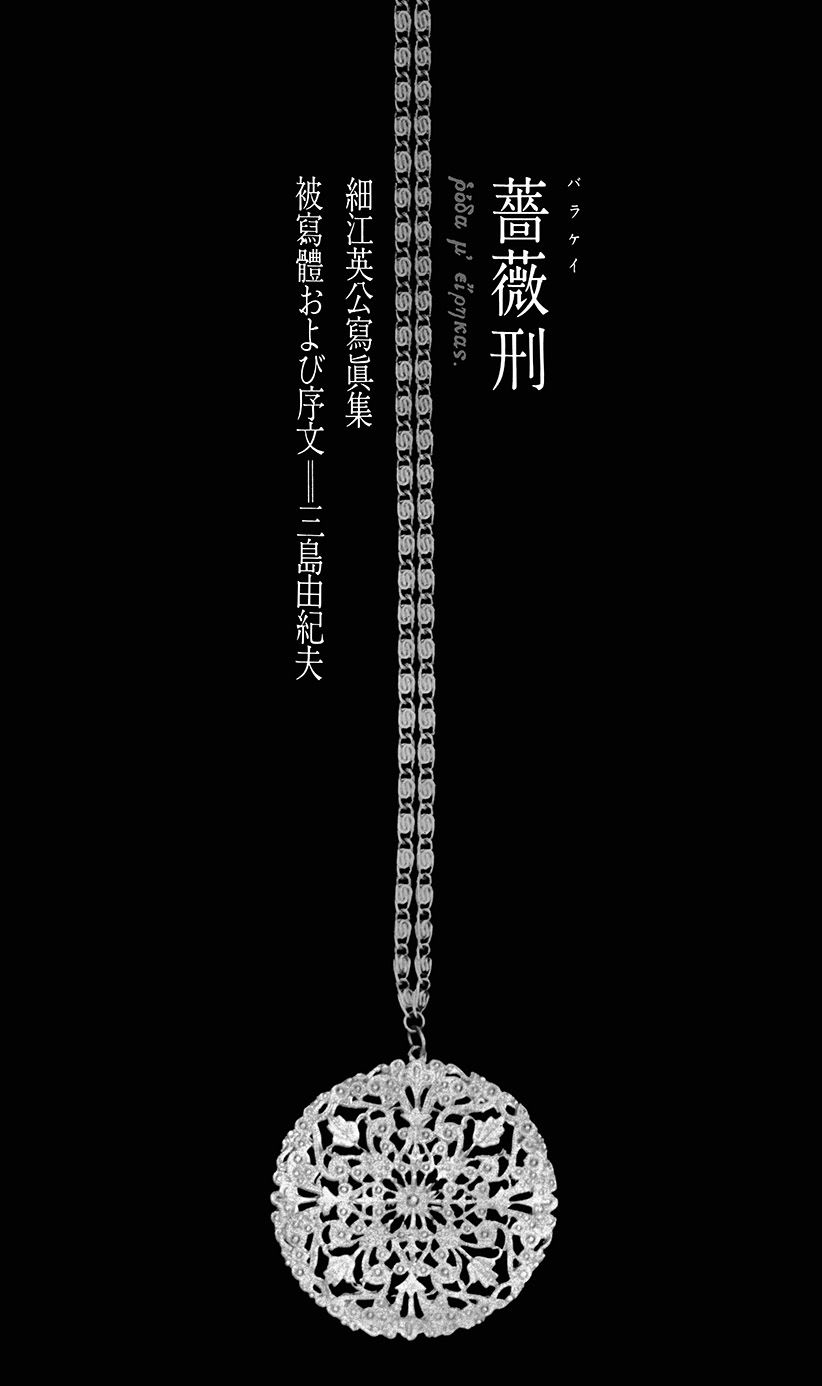
The large-format edition of Barakei, designed by Sugiura Kōhei and published in 1963.
Once a decision was made to publish the photographs in book form, Hosoe wrote to Mishima and asked him to suggest a title. Mishima replied with several suggestions: “Sketches of Martyrdom,” “Man and Roses,” “Passion Variations,” “Death and Loquaciousness,” and Barakei or “Ordeal by Roses,” (literally “punishment by roses,” rendered as “Killed by Roses” in the first edition). Hosoe knew as soon as he saw it that this last suggestion should be the title: it struck him as the perfect encapsulation of Mishima’s esthetic values and his view of life and death. The book was critically well received, and won a prize that year.
Plans for a Revised Edition, Delayed by Seppuku
Hosoe continued to develop his vision, working again with Hijikata Tatsumi on the collection Kamaitachi, named after a legendary weasel-like demon native to the rural Tōhoku region where both men had grown up. Published by Gendai Shichōsha in 1969, the photos showed Hijikata alongside ordinary local people. But the earlier Mishima collection continued to play on Hosoe’s mind. In 1970, a plan arose for a new, international edition of Barakei. The design would be the responsibility this time of Yokoo Tadanori (1936–). After consultation between Hosoe, Mishima, and Yokoo, it was decided to make a number of significant changes to the composition and layout of the photographs. The book was scheduled to come out in November that year, but had to be postponed for a month or so when Yokoo was involved in a car accident.
The galleys for the new edition were shown for the first time at an exhibition on Mishima at the Tōbu Department store in Ikebukuro in October that year. One section of the exhibit featured enlarged images from Barakei under the title “River of Flesh.” Hosoe was struck by a comment Mishima had written for the exhibition: “I will never accept the decay of the flesh.” Around the same time, Mishima delivered the manuscript for a preface he had promised to write for Hosoe’s photography collection Hōyō (Embrace), considerably ahead of schedule: this too was quite out of the ordinary.
Despite these omens, Mishima’s spectacular suicide by seppuku or ritual disembowelment at the Self-Defense Forces headquarters at Ichigaya on November 25, 1970 came as a complete shock. Hosoe immediately suspended work on the new edition of his book—he simply did not know how his photographs of Mishima would be received by the media in the chaos after the author’s death. But the bigger reason had to do with his pride: He did not want anyone to think he was “cashing in” on Mishima’s death by publishing a book of photographs certain to attract controversy so soon after the author’s suicide.
But a phone call from Mishima’s wife Yōko persuaded him to change his mind. “I hope you will go ahead with plans to publish the new edition of the book. My husband was looking forward to it so much.” Following a quick change of plan, the new edition of Barakei saw the light of day after all. The international edition Barakei (Ordeal by Roses) was published by Shūeisha International in January 1971.
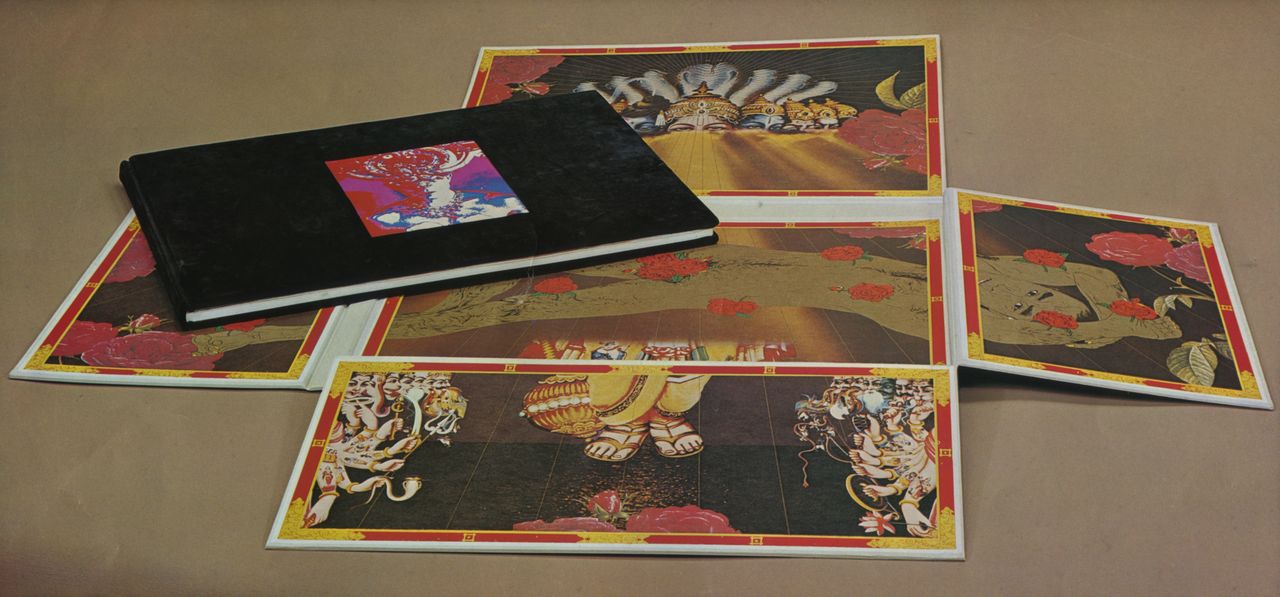
The new edition of Barakei, designed by Yokoo Tadanori and published in 1971. The box containing the collection of photographs opens to reveal a Buddhist-influenced, Indian-style picture of Mishima.
A Collaboration Between Two Uncompromising Artists
Looking at Barakei anew all these years later is to be reminded of how distinctive and special the book was. The slipcase for the original edition attributes the book to “Hosoe Eikō: Photographs; Mishima Yukio: Subject and Preface.” The message was clear: this was a collaboration between two artists in a relationship of equality.
Mishima certainly lived up to his promise to become the “subject matter” for Hosoe’s photos. But he remained a commanding, indelible presence throughout the shoot: in his own house, richly imbued as it was with its owner’s distinctive sense of esthetics, surrounded by the furniture and fittings he had chosen himself, and showing off the toned muscular physique of which he was so proud, Mishima had something of the air of a prowling tiger patrolling his territory. Hosoe refused to take a backward step before this charismatic and dominating personality, maintaining his own individuality and vision as a photographer in the face of one of the dominant writers of his time, manipulating and controlling him just as he would a dancer or bodybuilder or any other model. The result was a competitive collaboration between two gifted artistic sensibilities, the writer and the photographer engaged in an artistic arm-wrestle, each refusing to yield to the other. This remarkable collection of photographs remains a fitting testament to the integrity and vision of two proudly independent artists.
Wednesday, November 25, 2020
By Alan Ramsey
Labor farewells a decent bloke in an abnormal job
By Alan Ramsey
October 18, 2008 — 11.00am
The Labor Party farewelled Tim Gartrell two nights ago. It was a great send-off with some splendid speech-making. Labor in high mood knows how to enjoy itself, especially when giving homage to one of its own. Gartrell, 38, has spent all his working life in union and party politics, including 10 years at ALP national headquarters, five of them as national secretary and federal campaign director. But it consumed his life. Now Kerry, in Sydney, has her husband back. "It was time to go," Gartrell told his farewell dinner gathering of 300 in Canberra on Thursday night. And in the going we got two hilarious anecdotes about the frog and the dog.
Sydney's John Faulkner has never given a better speech. Faulkner is the spiritual father of the NSW Labor Left, now in his 20th year in the Senate and a minister in each of the Hawke, Keating and Rudd governments. Gartrell was a Faulkner protege. In 1993, Gartrell got what Faulkner called "Tim's big break" in politics: five weeks' leave as a union industrial officer to work full-time in that year's election, campaigning for Labor's memorably whacky Peter Knott in the NSW South Coast seat of Gilmore, held by the Nationals.
Said Faulkner: "The experience was indescribable. I am still recovering from a grand announcement I made in Kiama [as the Keating government's environment minister] to save a threatened species of frog, which had the misfortune of living in Gilmore in an open drain, two metres wide and two metres deep, that ran through a public park. I made the announcement and turned to Peter for a comment. But he'd gone. He'd pissed off, across the park, to where he yelled back to the cameras, 'I've found one!' It seemed unlikely but Peter yelled, 'There it is!' And as the TV cameras swung round for his David Attenborough moment, Peter fell arse-over-head into the drain."
Gartrell's dog story was no less sensational.
He recalled: "One sunny day Knotty was door-knocking his way up a street when he came to an open front gate of a nice old house with a friendly, large German Shepherd in the front yard. Knotty patted the dog, strode to the front door and knocked. The retired couple who answered were pleased to see him and asked him inside. So Knotty went in and the dog came along and jumped up on the couch. Things went well. His anti-GST spiel was working, But something didn't seem right. As the couple sat listening politely, the dog grew more and more agitated. Then it began attacking one of the couch pillows, shaking [it] aggressively.
"Knotty was wondering when the couple would pull the dog into line, but he thought, it's their house, their dog, and he went on talking. The couple went on nodding politely, occasionally looking at the dog with concern. Then the cushion attack reached fever pitch, with feathers and dog foam flying. So Knotty gently asked, 'Excuse me, you've got a lovely dog there, but feel free to discipline it.' 'Our dog?' the couple stammered. 'We thought it was your dog.' "
"Knotty went on to win the seat, clinching it the night before the election at the Jamberoo folk festival with his own version of Give Me A Home Among The Gum Trees, sung in an Akubra to the lyrics, 'Give me a home without a Hewson/He's really gruesome/He frightens me/with his GST'. I returned triumphant to Sydney."
There was much more but Faulkner got the serious business of the evening spot on when he concluded: "The role of ALP national secretary is one of the toughest, most thankless, in federal politics. It is crucially important but needs to be invisible. While others tend to get the accolades, usually the national secretary only gets the brickbats …
"Political culture thrives on larger-than-life characters who make for good headlines … But politics itself - the business of winning elections, of changing the government so you can implement good policy for the people who depend on you and who need you to deliver - depends on those who get on and do the job, who put the party first, ahead of their personal and factional interests. If Tim isn't a normal, decent bloke, he's done a good job maintaining the impression for a decade in national machine politics. But I know Tim is a decent, normal bloke in an abnormal job, usually in abnormal times. All of us here tonight, all of us in the party and the broader labour movement, owe him our gratitude, our admiration and our thanks. Tim, you leave as our national secretary without enemies, without regrets, and I suspect, without hesitation."
It was a memorable night.
Alan Ramsey
Tuesday, November 24, 2020
Dogs of War

https://www.doublemisfire.com/2019/07/retro-review-warhammer-armies-dogs-of.html?m=1
With so little information on what to look forward to, I thought I'd look back at my personal-all time favourite Games Workshop publication (sorry Skavenslayer), a flawed masterpiece, and possible long lost ancestor of Cities of Sigmar...
If you're relatively new to the hobby you may never have heard of Dogs of War. Released halfway though the 5th edition of Warhammer Fantasy Battle, in autumn 1998, Warhammer Armies: Dogs of War was the brainchild of the esteemed Nigel Stillman, and is an unusual footnote in the game and setting's history. Warhammer 5th edition shared its army books with 4th, and by early 5th edition all the army books for the game's staples were "done" (with High Elves and Chaos having been done twice), allowing the design team to focus on crafting absorbing supplements like narrative campaign packs, and a new edition of Warhammer: Siege.
With the introduction of their army book, Dogs of War became a blanket term for the Warhammer World's mercenaries, the book containing rules for 15 unique mercenary Regiments of Renown, able to either be hired as allies for other armies, or fielded as a standalone force of rogues commanded by a charismatic mercenary general, with the army's pay chest acting as a characterful substitute for a conventional battle standard bearer.
The original Warhammer Armies books (battletomes to a beardling) were designed to supply a player everything they needed to know about their chosen army in a low-internet age, and were packed to capacity with histories, maps, colour text, bestiaries and timelines with a density that's never quite been matched since - Dogs of War being no exception. Each Regiment of Renown's rules were accompanied by a gorgeous two page spread telling you everything you needed to know about them, and the book also contained a 25 page gazetteer and chronicle of city states of Tilea, the anarchic and ungovernable country heavily inspired by Renaissance Italy that the majority of the Regiments of Renown hailed from, as well as rules for six special characters drawn from Tilea's storied history.
This book blew my preadolescent mind. I'd never known armies like this could exist on the tabletop, and had previously been a dedicated Dwarf player who dabbled in Empire and Orcs and Goblins, but now wanted more than anything to field a cosmopolitan army of cutthroats united under a charismatic commander in a quest for glory and gold.
Nigel Stillman, like Rick Priestly was a trained archaeologist, and the book's background gave him tremendous license to flex the muscles of his historical knowledge, expanding the land of Tilea (a part of the Old World previously only really known for supplying the Empire with mercenary crossbowmen), into a fully fleshed out set of feuding city states usually ruled by Merchant Princes (though one was once ruled by a pig), largely based on 14th century Italy, with its own extensive history and culture, rivalling that of any other Warhammer nation or faction, all woven together in his trademark effortlessly whimsical, charming style. The Tileans' existing fondness for crossbows was expanded upon, but their trademark weapon became the pike, a much longer spear allowing regiments to fight in ranks of four instead of the usual two. Tilean trade routes and the exploits of mercenaries outside of the Old World were also detailed, with (albeit brief) passages shedding light on Araby, Cathay and the eastern Hobgoblin Khans.
Conventional Warhammer armies fought either to destroy and enslave things, or to not be destroyed or enslaved, but the Dogs of War's motivations were a thirst for exploration, adventure and cold hard cash. Many outlandish elements and characters from Warhammer's wild early days like Juggo Joriksonn, and 'the Magnificent' Sven Hasselfriesian also made cameos, surfacing for the first time in years. Warhammer has always been built on a rich foundation of black, gag-based humour, and it probably reached its peak here, with names like Juan Cornetto and Gossipa Lotta, the story of Borgio the Besieger defeating an orc waaagh by splitting the horde and its component orcs into three parts, and maybe the single greatest piece of storytelling ever produced by Games Workshop, attributed to Alessio Cavatore and reproduced below:
The massive accompanying range of metal miniatures was even more impressive than the book itself, with each of the 15 Regiments of Renown having been sculpted to a level unsurpassed by the standards of the time. Most of these were the work of Alan and Michael Perry, displaying their equally vast historical expertise, and inimitable skill at sculpting humans when creating the Tileans and Al Muktar's Desert Dogs. The remaining three non Tilean regiments were sculpted by Trish Morrison, Colin Dixon and Dave Andrews, with Chris Fitzpatrick lending his hand to a couple of characters in some of his earliest released sculpts for GW.
Special mention has to go to the gorgeous rural Italian style scratch-built scenery created for the book, presumably by Dave Andrews, with vineyards, villas and fountains making a massive contribution to the colour section. The artwork and graphic design on display also marked a new high for Warhammer publications, perfectly setting the tone for Tilea, the Regiments of Renown, and creating some crazy depictions of unique mercenary heroes and units who never made it into miniature form, but could still serve as hobby inspiration today.
The book's (non special) character options consisted of a two page spread of relatively generic human general, hero and wizard options, with the sole exception being the Paymaster and his unique entourage of Bodyguards, a Money Lender, and a great big treasure chest. More detailed rules for creating your own unique mercenary general, with a choice of races and special traits were teased in the book and would later appear in an issue of White Dwarf.
Regiments of Renown formed the rest of the book's army list, with no option for generic Tilean or mercenary regiments. A reinvented concept, Regiments of Renown were originally a thing in the first and second editions of Warhammer, boutique units sold complete in a box, with rules and a vibrant backstory printed on the back. Few of the original Regiments of Renown were mercenaries, and none Tilean, with only Golgfag's Mercenary Ogres reappearing in Warhammer Armies: Dogs of War a decade later (though Skarloc became a Wood Elf special character, and Ruglud's Armoured Orcs and Mengil Manhide's Manflayers appeared much later as mercenary units in 6th edition WFB. No idea what happened to Joseph Bugman...). If you're interested in the original Regiments of Renown, they're all catalogued on http://solegends.com/citrr/
The 15 Regiments of Renown featured in the book comprised of:
The Alcatani Fellowship - Tilean pikemen
Leopold's Leopard Comany - Tilean pikemen
Ricco's Republican Guard - More Tilean pikemen
The Marksmen of Miragliano - Tilean crossbowmen
Braganza's Besieger's - Heavily armoured Tilean crossbowmen with big shields
Pirazzo's Lost Legion - Tileans who could be built as pikemen or crossbowmen - are you seeing a theme here?
Voland's Venators - Tilean knights
Vespero's Vendetta - Skirmishing Tilean duellists
Bronzino's Galloper Guns - Tilean light cannons pulled by horses
The Birdmen of Catrazza - Tilean crossbowmen mounted on Da Vinci style flying machines
Golgfag's Mercenary Ogres
Long Drong's Slayer Pirates - Exactly what they sound like, based out of Sartosa, the Tilean pirate capital
Asarnil the Dragon Lord - An exiled High Elf prince on the back of a dragon, now residing in Tilea
Beorg Bearstruck and the Bearmen of Urslo - Norse/Chaos marauders lead by a werebear
Al Muktar's Desert Dogs - Araby light cavalry, lead by a frankly weird T.E. Lawrence pasticheAll of these regiments were lead by a named captain (usually a hero level character), and a few (Golgfag's, Desert Dogs and Bearmen) even got named supporting casts. Their histories and in game rules ranged from the conventional (pike and crossbow units) to the brilliantly absurd (slayer pirates). Part of the promotion for the army's release involved life sized FOR HIRE! and WANTED! posters of the various mercenary captains decorating Games Workshop stores.
Six named, or special characters (as they were called back in the day) were included:
Borgio the Besieger - An infamously hard to kill Merchant Prince and mercenary general wielding a mace made out of a cannonball that once got lodged in his chest
Leonardo da Miragliano - The genius engineer, scientist and alchemist best known for later moving to the Empire and building the Steam Tanks. Answers on a postcard who he's based on
Lucrezzia Belladonna - Lucrezia Borgia if she'd also cast spells.
Mydas the Mean (and Sheikh Yadosh!) - Paymaster, apparently very generous
Lorenzo Lupo - Merchant Prince who reaaaaally liked movies about gladiators
Marco Colombo - The Merchant Prince who discovered LustriaAll these guys had enough bespoke quirks and special rules to warrant their special status - a lot of the special characters appearing in earlier army books had were just generic lords and heroes with set lists of magic items... available to generic lords and heroes of their race anyway.
It's interesting to note that Leonardo da Miragliano and Marco Columbo were both long dead "historical" characters (historical in this case meaning who were no longer around in the "present day" Warhammer timeline, and not the direct knockoffs of real world historical figures they incidentally were), and while this wasn't uncommon in Warhammer Armies books at the time, with characters like Magnus the Pious and Gorbad Ironclaw having rules, it did feel like a bit of an oversight in the case of Dogs of War, with Leonardo and Marco having lived hundreds of years before any of the Regiments of Renown, making fighting alongside them a seem like a weird oversight. Borgio was also a historical character, but had been murdered in the bath with a toasting fork only a year after the coronation of Karl Franz, and so could feasibly have lead an army of most of the Regiments of Renown. Leonardo and Marco were the only two special characters not to receive models (though Marco was much later two limited edition miniatures, one in 2003 and another in 2013), so maybe the studio were aware of this.
More Regiments of Renown were promised in the book, and in the months after the the initial wave of Dogs of War releases we saw five more regiments released with rules appearing in White Dwarf:
Lumpin Croop's Fighting Cocks - Halfling Scouts
Tichi-Huichi's Raiders - Skinks on Cold Ones, fighting across the Old World to retrieve Slann relics
Olgah Khan's Hobgoblin Wolfboyz - Also released with Ghazak Khan, a Hobgoblin merenary general
Johan and Wilhelm - Imperial Witch Hunter and Warrior Priest duo
The Giants of Albion - Giants. With attendant druid!
To say these new Regiments of Renown were on the wackier side was an understatement - maybe they'd been held back from the book because of it. Still, they were all nice concepts, and good excuses to sculpt models for and explore the less developed parts of the Warhammer World (apart from the skinks, who just felt like leftovers from the Lizardman release a couple of years before).
With Dogs of War slotting so perfectly into the setting, while standing out as much as they did without being like anything else in it, you're probably wondering why they remain a curious footnote in Warhammer history, and didn't set the gamers' brains on fire, becoming a staple of the game's identity for years to come. If you get down to brass tacks, the main answer is the book's unique format.
Warhammer Armies: Dogs of War wasn't a single, coherent book. It was one half Warhammer Armies: Tilea, and one half Regiments of Renown: A Warhammer Supplement, the background coming from the former, and the army list the latter. The book's background section spoke at length about the culture of the different principalities and republics of Tilea, and its mercenary armies, how they fought and thought differently to the other human nations of the Old World, but gave no option to create a Tilean or mercenary army of your own devising, and only a prescribed list of 15 fixed units to use, leaving little room for self expression.
Allies and special characters were both huge taboos in most gaming groups and on the events scene at the time of Dog of War's release, owing largely to special characters of that era coming with an "ask your opponent's permission, these guys are powerful" disclaimer, and a White Dwarf J-Files editorial by Jervis Johnson a couple of years prior that discussed different types of play (an early precursor to open, narrative and matched play?) including a suggested list of tournament restrictions, quickly adopted for pickup games that disallowed special characters or allies on the grounds that they were potentially too imbalanced for fair play (a stigma that's only disappeared in very recent years). This didn't mean a lot for most armies, as Teclis could easily be used to represent a regular Mage, or Karl Franz an Empire General, and allies could only make up a maximum 25% of your force anyway, but the nascent Dogs of War, released as a brand new range of what essentially amounted to special character allies (mercenaries), didn't look like a sensible investment to most players.
It's also worth noting that that in 1998, the hobby was in the very earliest murmurs of the plastic revolution, with the first multipart plastic regiment kits having been released, and despite the comparative crudeness of their sculpts (if you don't believe me Google the Chaos Warriors), made up for it in the excitement for their customisation, tridimensionality and price point. Dogs of War didn't even have access to the monopose plastics that preceded the multipart kits, used by players to build up their regiments on a budget.
Dogs of War (are to me at least), Warhammer's great tragedy, if they'd been designed as two separate projects, with an army list of generic Tileans and mercenaries (with their own plastic kits!) establishing a distinct identity for itself as the game's third human faction, and the more outlandish Regiments of Renown saved for a Champions of Chaos style supplement, then I'm sure they would have captured more hobbyists' imaginations (and wallets), but hey, hindsight!
The beginning of Warhammer 6th edition finally featured a Dogs of War army list released in White Dwarf with "regular" versions of pikemen, crossbowmen, venators, duellists and the like, plus mercenary dwarfs and Norscans, and several more eccentric units disowned by 6th edition's Warhammer Armies: The Empire in halflings, Hot Pots, and equipment options for cavalry units allowing Kislev Wingles Lancer and Horse Archers to be fielded; fighting alongside the named Regiments of Renown (later reprinted with a few points revisions in Warhammer Annual 2002, and Warhammer Chronicles 2004). The option to field Dogs of War was listed as a rare unit entry in every 6th edition army book bar Bretonnians (who apparently turned their noses up at hiring mercenaries), and the original Warhammer Armies: Ogre Kingdoms gave the option to field various ogre units as mercenaries in other armies. 6th edition even saw three new Regiment of Renown released, with modern versions of Ruglud's Armoured Orcs and Mengil Manhide's Manflayers, and a new undead unit made up of the skeletons of various non-human races called the Cursed Company.
However the Dogs of War miniatures line was considered significantly dated by the end of 6th edition, with every other army bar Chaos Dwarfs receiving almost entirely new, massively overhauled miniatures ranges focused around multipart plastics, and with GW having no plans to revisit Tilea, Dogs of War and mercenaries were quietly dropped as a concept when 7th hit in 2006.
Because they'd never been popular before being neglected like Bretonnians or even Sisters of Battle had once been, and had never really been considered a proper army, and more a collection of allied contingents, nobody ever really clamoured for Dogs of War to return, and they quietly faded into obscurity before Tilea was destroyed off-screen by skaven in the opening pages of the End Times in 2014, leading to a brief mass materialisation of internet outrage picketers, claiming they'd all been massive Dogs of War fans for nearly two decades and their faces had been spat in. Who knows, maybe they'd been like me and politely held out for the Tileans triumphant return, only to finally snapped after having their delusions publicly crushed?
Despite the glaring faults that caused its failure to launch, Warhammer Armies: Dogs of War is a forgotten gem, rich with brilliant stories, artwork, and humour, depicting the Warhammer World in a fresh way that still feels entirely true to the unique spirit of the setting, woven together with flare and charm. While the inhabitants of Tilea are probably considerably more self interested than those of the Mortal Realms, Dogs of War gives a fantastic insight into the disparate armies and inhabitants of cosmopolitan City States, that any Cities of Sigmar fan lucky enough to find a copy sold at a reasonable price should endeavour to grab right away.
If you're relatively new to the hobby you may never have heard of Dogs of War. Released halfway though the 5th edition of Warhammer Fantasy Battle, in autumn 1998, Warhammer Armies: Dogs of War was the brainchild of the esteemed Nigel Stillman, and is an unusual footnote in the game and setting's history. Warhammer 5th edition shared its army books with 4th, and by early 5th edition all the army books for the game's staples were "done" (with High Elves and Chaos having been done twice), allowing the design team to focus on crafting absorbing supplements like narrative campaign packs, and a new edition of Warhammer: Siege.
With the introduction of their army book, Dogs of War became a blanket term for the Warhammer World's mercenaries, the book containing rules for 15 unique mercenary Regiments of Renown, able to either be hired as allies for other armies, or fielded as a standalone force of rogues commanded by a charismatic mercenary general, with the army's pay chest acting as a characterful substitute for a conventional battle standard bearer.
The original Warhammer Armies books (battletomes to a beardling) were designed to supply a player everything they needed to know about their chosen army in a low-internet age, and were packed to capacity with histories, maps, colour text, bestiaries and timelines with a density that's never quite been matched since - Dogs of War being no exception. Each Regiment of Renown's rules were accompanied by a gorgeous two page spread telling you everything you needed to know about them, and the book also contained a 25 page gazetteer and chronicle of city states of Tilea, the anarchic and ungovernable country heavily inspired by Renaissance Italy that the majority of the Regiments of Renown hailed from, as well as rules for six special characters drawn from Tilea's storied history.
This book blew my preadolescent mind. I'd never known armies like this could exist on the tabletop, and had previously been a dedicated Dwarf player who dabbled in Empire and Orcs and Goblins, but now wanted more than anything to field a cosmopolitan army of cutthroats united under a charismatic commander in a quest for glory and gold.
Nigel Stillman, like Rick Priestly was a trained archaeologist, and the book's background gave him tremendous license to flex the muscles of his historical knowledge, expanding the land of Tilea (a part of the Old World previously only really known for supplying the Empire with mercenary crossbowmen), into a fully fleshed out set of feuding city states usually ruled by Merchant Princes (though one was once ruled by a pig), largely based on 14th century Italy, with its own extensive history and culture, rivalling that of any other Warhammer nation or faction, all woven together in his trademark effortlessly whimsical, charming style. The Tileans' existing fondness for crossbows was expanded upon, but their trademark weapon became the pike, a much longer spear allowing regiments to fight in ranks of four instead of the usual two. Tilean trade routes and the exploits of mercenaries outside of the Old World were also detailed, with (albeit brief) passages shedding light on Araby, Cathay and the eastern Hobgoblin Khans.
Conventional Warhammer armies fought either to destroy and enslave things, or to not be destroyed or enslaved, but the Dogs of War's motivations were a thirst for exploration, adventure and cold hard cash. Many outlandish elements and characters from Warhammer's wild early days like Juggo Joriksonn, and 'the Magnificent' Sven Hasselfriesian also made cameos, surfacing for the first time in years. Warhammer has always been built on a rich foundation of black, gag-based humour, and it probably reached its peak here, with names like Juan Cornetto and Gossipa Lotta, the story of Borgio the Besieger defeating an orc waaagh by splitting the horde and its component orcs into three parts, and maybe the single greatest piece of storytelling ever produced by Games Workshop, attributed to Alessio Cavatore and reproduced below:
The massive accompanying range of metal miniatures was even more impressive than the book itself, with each of the 15 Regiments of Renown having been sculpted to a level unsurpassed by the standards of the time. Most of these were the work of Alan and Michael Perry, displaying their equally vast historical expertise, and inimitable skill at sculpting humans when creating the Tileans and Al Muktar's Desert Dogs. The remaining three non Tilean regiments were sculpted by Trish Morrison, Colin Dixon and Dave Andrews, with Chris Fitzpatrick lending his hand to a couple of characters in some of his earliest released sculpts for GW.
Special mention has to go to the gorgeous rural Italian style scratch-built scenery created for the book, presumably by Dave Andrews, with vineyards, villas and fountains making a massive contribution to the colour section. The artwork and graphic design on display also marked a new high for Warhammer publications, perfectly setting the tone for Tilea, the Regiments of Renown, and creating some crazy depictions of unique mercenary heroes and units who never made it into miniature form, but could still serve as hobby inspiration today.
The book's (non special) character options consisted of a two page spread of relatively generic human general, hero and wizard options, with the sole exception being the Paymaster and his unique entourage of Bodyguards, a Money Lender, and a great big treasure chest. More detailed rules for creating your own unique mercenary general, with a choice of races and special traits were teased in the book and would later appear in an issue of White Dwarf.
Regiments of Renown formed the rest of the book's army list, with no option for generic Tilean or mercenary regiments. A reinvented concept, Regiments of Renown were originally a thing in the first and second editions of Warhammer, boutique units sold complete in a box, with rules and a vibrant backstory printed on the back. Few of the original Regiments of Renown were mercenaries, and none Tilean, with only Golgfag's Mercenary Ogres reappearing in Warhammer Armies: Dogs of War a decade later (though Skarloc became a Wood Elf special character, and Ruglud's Armoured Orcs and Mengil Manhide's Manflayers appeared much later as mercenary units in 6th edition WFB. No idea what happened to Joseph Bugman...). If you're interested in the original Regiments of Renown, they're all catalogued on http://solegends.com/citrr/
The 15 Regiments of Renown featured in the book comprised of:
The Alcatani Fellowship - Tilean pikemen
Leopold's Leopard Comany - Tilean pikemen
Ricco's Republican Guard - More Tilean pikemen
The Marksmen of Miragliano - Tilean crossbowmen
Braganza's Besieger's - Heavily armoured Tilean crossbowmen with big shields
Pirazzo's Lost Legion - Tileans who could be built as pikemen or crossbowmen - are you seeing a theme here?
Voland's Venators - Tilean knights
Vespero's Vendetta - Skirmishing Tilean duellists
Bronzino's Galloper Guns - Tilean light cannons pulled by horses
The Birdmen of Catrazza - Tilean crossbowmen mounted on Da Vinci style flying machines
Golgfag's Mercenary Ogres
Long Drong's Slayer Pirates - Exactly what they sound like, based out of Sartosa, the Tilean pirate capital
Asarnil the Dragon Lord - An exiled High Elf prince on the back of a dragon, now residing in Tilea
Beorg Bearstruck and the Bearmen of Urslo - Norse/Chaos marauders lead by a werebear
Al Muktar's Desert Dogs - Araby light cavalry, lead by a frankly weird T.E. Lawrence pasticheAll of these regiments were lead by a named captain (usually a hero level character), and a few (Golgfag's, Desert Dogs and Bearmen) even got named supporting casts. Their histories and in game rules ranged from the conventional (pike and crossbow units) to the brilliantly absurd (slayer pirates). Part of the promotion for the army's release involved life sized FOR HIRE! and WANTED! posters of the various mercenary captains decorating Games Workshop stores.
Six named, or special characters (as they were called back in the day) were included:
Borgio the Besieger - An infamously hard to kill Merchant Prince and mercenary general wielding a mace made out of a cannonball that once got lodged in his chest
Leonardo da Miragliano - The genius engineer, scientist and alchemist best known for later moving to the Empire and building the Steam Tanks. Answers on a postcard who he's based on
Lucrezzia Belladonna - Lucrezia Borgia if she'd also cast spells.
Mydas the Mean (and Sheikh Yadosh!) - Paymaster, apparently very generous
Lorenzo Lupo - Merchant Prince who reaaaaally liked movies about gladiators
Marco Colombo - The Merchant Prince who discovered LustriaAll these guys had enough bespoke quirks and special rules to warrant their special status - a lot of the special characters appearing in earlier army books had were just generic lords and heroes with set lists of magic items... available to generic lords and heroes of their race anyway.
It's interesting to note that Leonardo da Miragliano and Marco Columbo were both long dead "historical" characters (historical in this case meaning who were no longer around in the "present day" Warhammer timeline, and not the direct knockoffs of real world historical figures they incidentally were), and while this wasn't uncommon in Warhammer Armies books at the time, with characters like Magnus the Pious and Gorbad Ironclaw having rules, it did feel like a bit of an oversight in the case of Dogs of War, with Leonardo and Marco having lived hundreds of years before any of the Regiments of Renown, making fighting alongside them a seem like a weird oversight. Borgio was also a historical character, but had been murdered in the bath with a toasting fork only a year after the coronation of Karl Franz, and so could feasibly have lead an army of most of the Regiments of Renown. Leonardo and Marco were the only two special characters not to receive models (though Marco was much later two limited edition miniatures, one in 2003 and another in 2013), so maybe the studio were aware of this.
More Regiments of Renown were promised in the book, and in the months after the the initial wave of Dogs of War releases we saw five more regiments released with rules appearing in White Dwarf:
Lumpin Croop's Fighting Cocks - Halfling Scouts
Tichi-Huichi's Raiders - Skinks on Cold Ones, fighting across the Old World to retrieve Slann relics
Olgah Khan's Hobgoblin Wolfboyz - Also released with Ghazak Khan, a Hobgoblin merenary general
Johan and Wilhelm - Imperial Witch Hunter and Warrior Priest duo
The Giants of Albion - Giants. With attendant druid!
To say these new Regiments of Renown were on the wackier side was an understatement - maybe they'd been held back from the book because of it. Still, they were all nice concepts, and good excuses to sculpt models for and explore the less developed parts of the Warhammer World (apart from the skinks, who just felt like leftovers from the Lizardman release a couple of years before).
With Dogs of War slotting so perfectly into the setting, while standing out as much as they did without being like anything else in it, you're probably wondering why they remain a curious footnote in Warhammer history, and didn't set the gamers' brains on fire, becoming a staple of the game's identity for years to come. If you get down to brass tacks, the main answer is the book's unique format.
Warhammer Armies: Dogs of War wasn't a single, coherent book. It was one half Warhammer Armies: Tilea, and one half Regiments of Renown: A Warhammer Supplement, the background coming from the former, and the army list the latter. The book's background section spoke at length about the culture of the different principalities and republics of Tilea, and its mercenary armies, how they fought and thought differently to the other human nations of the Old World, but gave no option to create a Tilean or mercenary army of your own devising, and only a prescribed list of 15 fixed units to use, leaving little room for self expression.
Allies and special characters were both huge taboos in most gaming groups and on the events scene at the time of Dog of War's release, owing largely to special characters of that era coming with an "ask your opponent's permission, these guys are powerful" disclaimer, and a White Dwarf J-Files editorial by Jervis Johnson a couple of years prior that discussed different types of play (an early precursor to open, narrative and matched play?) including a suggested list of tournament restrictions, quickly adopted for pickup games that disallowed special characters or allies on the grounds that they were potentially too imbalanced for fair play (a stigma that's only disappeared in very recent years). This didn't mean a lot for most armies, as Teclis could easily be used to represent a regular Mage, or Karl Franz an Empire General, and allies could only make up a maximum 25% of your force anyway, but the nascent Dogs of War, released as a brand new range of what essentially amounted to special character allies (mercenaries), didn't look like a sensible investment to most players.
It's also worth noting that that in 1998, the hobby was in the very earliest murmurs of the plastic revolution, with the first multipart plastic regiment kits having been released, and despite the comparative crudeness of their sculpts (if you don't believe me Google the Chaos Warriors), made up for it in the excitement for their customisation, tridimensionality and price point. Dogs of War didn't even have access to the monopose plastics that preceded the multipart kits, used by players to build up their regiments on a budget.
Dogs of War (are to me at least), Warhammer's great tragedy, if they'd been designed as two separate projects, with an army list of generic Tileans and mercenaries (with their own plastic kits!) establishing a distinct identity for itself as the game's third human faction, and the more outlandish Regiments of Renown saved for a Champions of Chaos style supplement, then I'm sure they would have captured more hobbyists' imaginations (and wallets), but hey, hindsight!
The beginning of Warhammer 6th edition finally featured a Dogs of War army list released in White Dwarf with "regular" versions of pikemen, crossbowmen, venators, duellists and the like, plus mercenary dwarfs and Norscans, and several more eccentric units disowned by 6th edition's Warhammer Armies: The Empire in halflings, Hot Pots, and equipment options for cavalry units allowing Kislev Wingles Lancer and Horse Archers to be fielded; fighting alongside the named Regiments of Renown (later reprinted with a few points revisions in Warhammer Annual 2002, and Warhammer Chronicles 2004). The option to field Dogs of War was listed as a rare unit entry in every 6th edition army book bar Bretonnians (who apparently turned their noses up at hiring mercenaries), and the original Warhammer Armies: Ogre Kingdoms gave the option to field various ogre units as mercenaries in other armies. 6th edition even saw three new Regiment of Renown released, with modern versions of Ruglud's Armoured Orcs and Mengil Manhide's Manflayers, and a new undead unit made up of the skeletons of various non-human races called the Cursed Company.
However the Dogs of War miniatures line was considered significantly dated by the end of 6th edition, with every other army bar Chaos Dwarfs receiving almost entirely new, massively overhauled miniatures ranges focused around multipart plastics, and with GW having no plans to revisit Tilea, Dogs of War and mercenaries were quietly dropped as a concept when 7th hit in 2006.
Because they'd never been popular before being neglected like Bretonnians or even Sisters of Battle had once been, and had never really been considered a proper army, and more a collection of allied contingents, nobody ever really clamoured for Dogs of War to return, and they quietly faded into obscurity before Tilea was destroyed off-screen by skaven in the opening pages of the End Times in 2014, leading to a brief mass materialisation of internet outrage picketers, claiming they'd all been massive Dogs of War fans for nearly two decades and their faces had been spat in. Who knows, maybe they'd been like me and politely held out for the Tileans triumphant return, only to finally snapped after having their delusions publicly crushed?
Despite the glaring faults that caused its failure to launch, Warhammer Armies: Dogs of War is a forgotten gem, rich with brilliant stories, artwork, and humour, depicting the Warhammer World in a fresh way that still feels entirely true to the unique spirit of the setting, woven together with flare and charm. While the inhabitants of Tilea are probably considerably more self interested than those of the Mortal Realms, Dogs of War gives a fantastic insight into the disparate armies and inhabitants of cosmopolitan City States, that any Cities of Sigmar fan lucky enough to find a copy sold at a reasonable price should endeavour to grab right away.
Monday, November 23, 2020
Sunday, November 22, 2020


Saturday, November 21, 2020
Shamans, Souls, and Soma: Comparative Religion and Early China
One important innovation in twentieth-century sinology was the borrowing of the term “shamanism” to apply to early Chinese religion. While many scholars have employed this cross-cultural framework, others have rejected this use of the term “shamanism” for Chinese wu 巫 as excessively broad and ideologically biased. These debates too often are framed in broadly nationalistic terms as questions about whether “China” could have had something so exotic in a particular era. In fact, it is very often the case that a particular practice or belief is confined to a certain region at a particular time, or even to a specific substratum of a culture therein. This becomes clear when the “shamanism” problem of ancient Chu is reexamined in light of concomitant issues of personal identity, as represented by various terms for “souls,” or material culture, as represented by “soma” and other plants employed in religious ritual. I argue for the efficacy of cross-cultural analogies in understanding even phenomena which are singular to China. The limited but real utility of these analogies lies in their potential to help us construe the multiplicity within early Chinese religion that is obscured by a Sinocentric perspective.
Williams, Nicholas Morrow. "Shamans, Souls, and Soma: Comparative Religion and Early China." Journal of Chinese Religions, vol. 48 no. 2, 2020, p. 147-173. Project MUSE muse.jhu.edu/article/773384.
Friday, November 20, 2020
Thursday, November 19, 2020


Wednesday, November 18, 2020
Tuesday, November 17, 2020

Monday, November 16, 2020

Sunday, November 15, 2020
The Jaunt - Stephen King
Chapter 1
"This is the last call for Jaunt-701," the pleasant female voice echoed through the Blue Concourse of New York's Port Authority Terminal. The PAT had not changed much in the last three hundred years or so - it was still gungy and a little frightening. The automated female voice was probably the most plesant thing about it. "This is Jaunt Service to Whitehead City, Mars," the voice continued. "All ticketed passengers should now be in the Blue Concourse sleep lounge. Make sure your validation papers are in order. Thank you."The upstairs lounge was not at all grungy. It was wall-to-wall carpeted in oyster gray. The walls were an eggshell white and hung with plesant nonrepresentational prints. A steady, soothing progression of colors met and swirled on the ceiling. There were one hundred couches in the large room, neatly spaced in rows of ten. Five Jaunt attendants circulate, speakingin low, cherry voices and offering glasses of milk. At one side of the room was the entranceway, flanked by armed guards and another Jaunt attendant who was checking the validation papers of a latecomer, a harried-looking businessman with the New York World Times folded under one arm. Directly opposite, the floor dropped away in a trough about five feet wide and perhaps ten feet long; it passed through a doorless opening and looked a bit like a child's slide. The Oates family lay side by side on four Jaunt couches near the far end ofthe room. Mark Oates and his wife, Marilys, flanked the two children. "Daddy, will you tell me about the Jaunt now?" Ricky asked. "You promised." "Yeah, Dad, you promised," Patricia added, and giggled shilly for no good reason. A Businessman with a build like a bull glanced over at them and went back to the fodder of papers he was examining as he lay on his back, his spit-shined shoes neatly together.
From everywhere came the low murmur of conversation and the rustle of passengers settling down on the Jaunt couches. Mark glanced over at Marilys Oates and winked. She winked back, but she was almost as nervous as Patty sounded. Why not? Mark thought. First Jaunt for all three of them. He and Marilys had discussed the advantages and drawbacks of moving the whole family for the last six months - since he'd gotten notification from Texaco Water that he was being transferred to Whitehead City. Finally they had decided that all of them would go for the two years Mark would be stationed on Mars. He wondered now, looking at Marilys's pale face, if she was regretting the decision. He glanced at his watch and saw it was still almost half an hour to Jaunt-time. That was enough time to tell the story ... and he supposed it would take the kids' minds off their nervousness. Who knew, maybe it would even cool Marilys out a little. "All right," he said. Ricky and Pat were watching him seriously, his son twelve, his daughter nine. He told himself again that Ricky would be deep in the swamp of puberty and his daughter would likely be developing breast by the time they got back to earth, and again found it difficult to believe. The kids would be going to the tiny Whitehead Combined School with the hundred-odd engineering and oil-company brats that were there; his son might well be going on a geology field trip to Phobos not so many months distant. It was difficult to believe ... but true. Who knows ? he thought wryly. maybe it'll do something about my Jaunt-jumps, too. "So far as we know," he began, "the Jaunt was invented about three hundred and twenty years ago, around the year 1987, by a fellow named Victor Carune. He did it as part of a private research project that was funded by some government money ... and eventually the government took it over, of course. In the end it came down to either the government or the oil companies. The reason we don't know the exact date is because Carune was something of an eccentric - " "You mean he was crazy, Dad?" Ricky asked. "Eccentric means a little bit crazy, dear," Marilys said, and smiled across the children at Mark. She looked a little less nervous now, he thought."Oh." "Anyway, he'd been experimenting with the process for quite some time before he informed the government of what he had," Mark went on, "and he only told them because he was running out of money and they weren't going to re-fund him." "Your money cheerfully refunded," Pat said, and giggled shrilly again.
"That's right, honey," Mark said, and ruffled her hair gently. At the far end of the room he saw a door slide noiselessly open and two more attendants came out, dressed in the bright red jumpers of the Jaunt Service, pushing a rolling table. On it was a stainless-steel nozzle attached to a rubber hose; beneath the table's skirts, tastefully hidden, Mark knew there were two bottles of gas; in the net bag hooked to the side were one hundred disposable masks. Mark went on talking, not wanting his people to see the representative of Lethe until they had to. And, if he was given enough time to tell the whole story, they would welcome the gas-passers with open arms.
Considering the alternative.
"Of course, you know that the Jaunt is teleportation, no more or less," he said. "Sometimes in college chemistry and physics they call it the Carune Process, but it's really teleportation, and it was Carune himself - if you can believe the stories - who named it ?the Jaunt.' He was a science-fiction reader, and there's a story by a man named Alfred Bester, The Stars My Destination it's called, and this fellow Bester made up the word ?jaunte' for teleportation in it. Except in his book, you could Jaunt just by thinking about it, and we can't really do that." The attendants were fixing a mask to the steel nozzle and handing it to an elderly woman at the far end of the room. She took it, inhaled once, and fell quiet and limp on her couch. Her shirt had pulled up a little, revealing one slack thigh road-mapped with varicose veins. An attendant considerately readjusted for her while the other pulled off the used mask and affixed a fresh one. It was a process that made Mark think of the plastic glasses in motel rooms.
He wished to God that Patty would cool out a little bit; he had seen children who had to be held down, and sometimes they screamed as the rubber mask covered their faces. It was not an abnormal reaction in a child, he supposed, but it was nasty to watch and he didn't want to see it happen to Patty. About Rick he felt more confident.
"I guess you could say the Jaunt came along at the last possible moment," he resumed. He spoke toward Ricky, but reached across and took his daughter's hand. Her palm was cool and sweating lightly. "The world was running out of oil, and most of what was left belonged to the middle-eastern desert peoples, who were committed to using it as a political weapon. They had formed an oil cartel they called OPEC - " "What's a cartel, Daddy?" Patty asked.
"Well, a monopoly," Mark said.
"Like a club, honey," Marilys said. "And you could only be in that club if you had lots of oil."
"Oh."
"I don't have time to sketch the whole mess in for you," Mark said. "You'll study some of it in school, but it was a mess - let's let it go at that. If you owned a car, you could only drive it two days a week, and gasoline cost fifteen oldbucks a gallon - " "Gosh," Ricky said, "it only costs four cents or so a gallon now, doesn't it, Dad?"
Mark smiled. "That's why we are going where we're going, Rick. There's enough oil on Mars to last almost eight thousand years, and enough on Venus to last another twenty thousand ... but oil isn't even important, anymore. Now what we need most of all is - " "Water!" Patty cried, and the Businessman looked up from his papers and smiled at her for a moment.
"That's right," Mark said. "Because in the years between 1960 and 2030, we poisoned most of ours. The first water lift from the Martian ice-caps was called - " "Operation Straw." That was Ricky.
"Yes, 2045 or thereabouts. But long before that, the Jaunt was being used to find sources of clean water here on earth. And now water is our major Martian export ... the oil's strictly a sideline. But it was important then."
The kids nodded.
"The point is, those things were always there, but we were only able to get it because of the Jaunt. When Carune invented his process, the world was slipping into a dark age. The winter before, over ten thousand people had frozen to death in the United States alone because there wasn't enough energy to heat them."
"Oh, yuck," Patty said matter-of-factly.
Mark glanced to his right and saw the attendants talking to a timid-looking man, persuading him.
At last he took the mask seemed to fall dead on his couch seconds later. First-timer, Mark thought. You can always tell.
"For Carune, it started with a pencil ... some keys ... a wrist watch ... the some mice. The mice showed him there was a problem ..."
Victor Carune came back to his laboratory in a stumbling fever of excitement. He thought he knew how Morse had felt, and Alexander Graham Bell, and Edison . . . but this was bigger than all of them, and twice he had almost wrecked the truck on the way back from the pet shop in New Paltz, where he had spend his last twenty dollars on nine white mice. What he had left in the world was ninety-three cents in his right front pocket and the eighteen dollars in his savings account . . . but this did not occur to him. And if it had, it certainly would not have bothered him. The lab was in a renovated barn at the end of a mile-long dirt road off Route 26. It was making the turn onto this road where he had just missed cracking up his Brat pickup truck for the second time. The gas tank was almost empty and there would be no more for ten days to two weeks, but this did not concern him, either. His mind was in a delirious whirl. What had happened was not totally unexpected, no.
One of the reasons the government had funded him even to the paltry tune of twenty thousand a year was because the unrealized possibility had always been there in the field of particle transmission. But to have it happen like this . . . suddenly . . . with no warning . . . and powered by less electricity than was needed to run a color TV . . . God! Christ!
He brought the Brat to a screech-halt in the dirt of the door yard, grabbed the box on the dirty seat beside him by its grab-handles (on the box were dogs and cats and hamsters and goldfish and the legend I CAME FROM STACKPOLE'S HOUSE OF PETS) and ran for the big double doors. From inside the box came the scurry and whisk of his test subjects. He tried to push one of the big doors open along its track, and when it wouldn't budge, he remembered that he had locked it. Carune uttered a loud "Shit!" and fumbled for his keys. The government commanded that the lab be locked at all times - it was one of the strings they put on their money - but Carune kept forgetting. He brought his keys out and for a moment simply stared at them, mesmerized, running the ball of his thumb over the notches in the Brat's ignition key. He thought again: God! Christ! Then he scrabbled through the keys on the ring for the Yale key that unlocked the barn door.
As the first telephone had been used inadvertently - Bell crying into it, "Watson, come here!" when he spilled some acid on his papers and himself - so the first act of teleportation had occurred by accident. Victor Carune had teleported the first two fingers of his left hand across the fifty-yard width of the barn.
Carune had set up two portals at opposite sides of the barn. On his end was a simple ion gun, available from any electronics supply warehouse for under five hundred dollars. On the other end, standing just beyond the far portal - both of them rectangular and the size of a paperback book - was a cloud chamber. Between them was what appeared to be an opaque shower curtain, except that shower curtains are not made of lead. The idea was to shoot the ions through Portal One and then walk around and watch them streaming across the cloud chamber standing just beyond Portal Two, with the lead shield between to prove they really were being transmitted. Except that, for the last two years, the process had only worked twice, and Carune didn't have the slightest idea why. As he was setting the ion gun in place, his fingers had slipped through the portal - ordinarily no problem, but this morning his hip had also brushed the toggle switch on the control panel at the left of the portal. He was not aware of what had happened - the machinery gave off only the lowest audible hum - until he felt a tingling sensation in his fingers.
Chapter 2
"It was not like an electric shock," Carune wrote in his one and only article on the subject before the government shut him up. The article was published, of all places, in Popular Mechanics. He had sold it to them for seven hundred and fifty dollars in a last-ditch effort to keep the Jaunt a matter of private enterprise. "There was none of that unpleasant tingle that one gets if one grasps a frayed lamp cord, for instance. It was more like the sensation one gets if one puts one's hand on the casing of some small machine that is working very hard. The vibration is so fast and light that it is, literally, a tingling sensation. "Then I looked down at the portal and saw that my index finger was gone on a diagonal slant through the middle knuckle, and my second finger was gone slightly above that.
In addition, the nail portion of my third finger had disappeared." Carune had jerked his hand back instinctively, crying out. He so much expected to see blood, he wrote later, that he actually hallucinated blood for a moment or two. His elbow struck the ion gun and knocked it off the table.
He stood there with his fingers in his mouth, verifying that they were still there, and whole. The thought that he had been working too hard crossed his mind. And then the other thought crossed his mind: the thought that the last set of modifications might have . . . might have done something.
He did not push his fingers back in; in fact, Carune only Jaunted once more in his entire life.
At first, he did nothing. He took a long, aimless walk around the barn, running his hands through his hair, wondering if he should call Carson in New Jersey or perhaps Buffington in Charlotte. Carson wouldn't accept a collect phone call, the cheap ass-kissing bastard, but Buffington probably would. Then an idea struck and he ran across to Portal Two, thinking that if his fingers had actually crossed the barn, there might be some sign of it.
There was not, of course. Portal Two stood atop three stacked Pomona orange crates, looking like nothing so much as one of those toy guillotines missing the blade. On one side of its stainless-steel frame was a plug-in jack, from which a cord ran back to the transmission terminal, which was little more than a particle transformer hooked into a computer feed-line.
Which reminded him -
Carune glanced at his watch and saw it was quarter past eleven. His deal with the government consisted of short money, plus computer time, which was infinitely valuable. His computer tie-in lasted until three o'clock this afternoon, and then it was good-bye until Monday. He had to get moving, had to do something - "I glanced at the pile of crates again," Carune writes in his Popular Mechanics article, "and then I looked at the pads of my fingers. And sure enough, the proof was there. It would not, I thought then convince anyone but myself; but in the beginning, of course, it is only one's self that one has to convince."
"What was it, Dad?" Ricky asked.
"Yeah!" Patty added. "What?"
Mark grinned a little. They were all hooked now, even Marilys. They had nearly forgotten where they were. From the corner of his eye he could see the Jaunt attendants whisper-wheeling their cart slowly among the Jaunters, putting them to sleep. It was never as rapid a process in the civilian sector as it was in the military, he had discovered; civilians got nervous and wanted to talk it over. The nozzle and the rubber mask were too reminiscent of hospital operating rooms, where the surgeon with his knives lurked somewhere behind the anaesthetist with her selection of gases in stainless-steel canisters. Sometimes there was panic, hysteria; and always there were a few who simply lost their nerve. Mark had observed two of these as he spoke to the children: two men who had simply arisen from their couches, walked across to the entryway with no fanfare at all, unpinned the validation papers that had been affixed to their lapels, turned them in, and exited without looking back. Jaunt attendants were under strict instructions not to argue with those who left; there were always standbys, sometimes as many as forty or fifty of them, hoping against hope. As those who simply couldn't take it left, standbys were let in with their own validations pinned to their shirts. "Carune found two splinters in his index finger," he told the children. "He took them out and put them aside. One was lost, but you can see the other one in the Smithsonian Annex in Washington. It's in a hermetically sealed glass case near the moon rocks the first space travellers brought back from the moon - " "Our moon, Dad, or one of Mars's?" Ricky asked.
"Ours," Mark said, smiling a little. "Only one manned rocket flight has ever landed on Mars, Ricky, and that was a French expedition somewhere about 2030. Anyway, that's why there happens to be a plain old splinter from an orange crate in the Smithsonian Institution. Because it's the first object that we have that was actually teleported - Jaunted - across space."
"What happened then?" Patty asked. "Well, according to the story, Carune ran . . ."
Carune ran back to Portal One and stood there for a moment, heart thudding, out of breath. Got to calm down, he told himself. Got to think about this. You can't maximize your time if you go off half-cocked. Deliberately disregarding the forefront of his mind, which was screaming at him to hurry up and do something, he dug his nail-clippers out of his pocket and used the point of the file to dig the splinters out of his index finger.
He dropped them onto the white inner sleeve of a Hershey bar he had eaten while tinkering with the transformer and trying to widen its afferent capability (he had apparently succeeded in that beyond his wildest dreams). One rolled off the wrapper and was lost; the other ended up in the Smithsonian Institution, locked in a glass case that was cordoned off with thick velvet ropes and watched vigilantly and eternally by a computer-monitored closed-circuit TV camera.
The splinter extraction finished, Carune felt a little calmer. A pencil. That was as good as anything. He took one from beside the clipboard on the shelf above him and ran it gently into Portal One. It disappeared smoothly, inch by inch, like something in an optical illusion or in a very good magician's trick. The pencil had said EBERHARD FABER NO. 2 on one of its sides, black letters stamped on yellow-painted wood. When he had pushed the pencil in until all but EBERH had disappeared, Carune walked around to the other side of Portal One.
He looked in. He saw the pencil in cut-off view, as if a knife had chopped smoothly through it. Carune felt with his fingers where the rest of the pencil should have been, and of course there was nothing. He ran across the barn to Portal Two, and there was the missing part of the pencil, lying on the top crate. Heart thumping so hard that it seemed to shake his entire chest, Carune grasped the sharpened point of his pencil and pulled it the rest of the way through.
He held it up; he looked at it. Suddenly he took it and wrote IT WORKS! on a piece of barn-board. He wrote it so hard that the lead snapped on the last letter. Carune began to laugh shrilly in the empty barn; to laugh so hard that he startled the sleeping swallows into flight among the high rafters.
"Works!" he shouted, and ran back to Portal One. He was waving his arms, the broken pencil knotted up in one fist. "Works! Works! Do you hear me, Carson, you prick? It works AND I DID IT!"
"Mark, watch what you say to the children," Marilys reproached him.
Mark shrugged. "It's what he's supposed to have said."
"Well, can't you do a little selective editing?"
"Dad?" Patty asked. "Is that pencil in the museum, too?" "Does a bear shit in the woods?" Mark said, and then clapped one hand over his mouth. Both children giggled wildly - but that shrill note was gone from Patty's voice, Mark was glad to hear - and after a moment of trying to look serious, Marilys began to giggle too.
The keys went through next; Carune simply tossed them through the portal. He was beginning to think on track again now, and it seemed to him that the first thing that needed finding out was if the process produced things on the other end exactly as they had been, or if they were in any way changed by the trip.
He saw the keys go through and disappear; at exactly the same moment he heard them jingle on the crate across the barn. He ran across - really only trotting now - and on the way he paused to shove the lead shower curtain back on its track. He didn't need either it or the ion gun now. Just as well, since the ion gun was smashed beyond repair. He grabbed the keys, went to the lock the government had forced him to put on the door, and tried the Yale key. It worked perfectly. He tried the house key. It also worked. So did the keys which opened his file cabinets and the one which started the Brat pickup.
Chapter 3
Carune pocketed the keys and took off his watch. It was a Seiko quartz LC with a built-in calculator below the digital face twenty-four tiny buttons that would allow him to do everything from addition to subtraction to square roots. A delicate piece of machinery - and just as important, a chronometer. Carune put it down in front of Portal One and pushed it through with a pencil.
He ran across and grabbed it up. When he put it through, the watch had said 11:31:07. It now said 11:31:49. Very good. Right on the money, only he should have had an assistant over there to peg the fact that there had been no time gain once and forever. Well, no matter. Soon enough the government would have him wading hip deep in assistants. He tried the calculator.
Two and two still made four, eight divided by four was still two; the square root of eleven was still 3.3166247 . . . and so on. That was when he decided it was mouse-time. "What happened with the mice, Dad?" Ricky asked.
Mark hesitated briefly. There would have to be some caution here, if he didn't want to scare his children (not to mention his wife) into hysteria minutes away from their first Jaunt. The major thing was to leave them with the knowledge that everything was all right now, that the problem had been licked.
"As I said, there was a slight problem . . ."
Yes. Horror, lunacy, and death. How's that for a slight problem, kids? Carune set the box which read I CAME FROM STACKPOLE'S HOUSE OF PETS down on the shelf and glanced at his watch. Damned if he hadn't put the thing on upside down. He turned it around and saw that it was a quarter of two. He had only an hour and a quarter of computer time left. How the time flies when you're having fun, he thought, and giggled wildly. He opened the box, reached in, and pulled out a squeaking white mouse by the tail. He put it down in front of Portal One and said, "Go on, mouse." The mouse promptly ran down the side of the orange crate on which the portal stood and scattered across the floor. Cursing, Carune chased it, and managed to actually get one hand on it before it squirmed through a crack between two boards and was gone.
"SHIT!" Carune screamed, and ran back to the box of mice. He was just in time to knock two potential escapees back into the box. He got a second mouse, holding this one around the body (he was by trade a physicist, and the ways of white mice were foreign to him), and slammed the lid of the box back down.
This one he gave the old heave-ho. It clutched at Carune's palm, but to no avail; it went head over ratty little paws through Portal One. Carune heard it immediately land on the crates across the barn. This time he sprinted, remembering how easily the first mouse had eluded him. He need not have worried. The white mouse merely crouched on the crate, its eyes dull, its sides aspirating weakly. Carune slowed down and approached it carefully; he was not a man used to fooling with mice, but you didn't have to be a forty-year veteran to see something was terribly wrong here. ("The mouse didn't feel so good after it went through," Mark Oates told his children with a wide smile that was only noticeably false to his wife.) Carune touched the mouse. It was like touching something inert - packed straw or sawdust, perhaps - except for the aspirating sides. The mouse did not look around at Carune; it stared straight ahead. He had thrown in a squirming, very frisky and alive little animal; here was something that seemed to be a living waxwork likeness of a mouse. Then Carune snapped his fingers in front of the mouse's small pink eyes.
It blinked . . . and fell dead on its side.
"So Carune decided to try another mouse," Mark said.
"What happened to the first mouse?" Ricky asked.
Mark produced that wide smile again. "It was retired with full honors," he said.
Carune found a paper bag and put the mouse into it. He would take it to Mosconi, the vet, that evening.
Mosconi could dissect it and tell him if its inner works had been rearranged. The government would disapprove his bringing a private citizen into a project which would be classified triple top secret as soon as they knew about it. Tough titty, as the kitty was reputed to have said to the babes who complained about the warmth of the milk. Carune was determined that the Great White Father in Washington would know about this as late in the game as possible. For all the scant help the Great White Father had given him, he could wait. Tough titty. Then he remembered that Mosconi lived way the hell and gone on the other side of New Paltz, and that there wasn't enough gas in the Brat to get even halfway across town . . . let alone back.
But it was 2:03 - he had less than an hour of computer time left. He would worry about the goddamn dissection later.
Carune constructed a makeshift chute leading to the entrance of Portal One (really the first Jaunt-Slide, Mark told the children, and Patty found the idea of a Jaunt-Slide for mice deliciously funny) and dropped a fresh white mouse into it. He blocked the end with a large book, and after a few moments of aimless pattering and sniffling, the mouse went through the portal and disappeared.
Carune ran back across the barn. The mouse was DOA. There was no blood, no bodily swellings to indicate that a radical change in pressure had ruptured something inside. Carune supposed that oxygen starvation might - He shook his head impatiently. It took the white mouse only nanoseconds to go through; his own watch had confirmed that time remained a constant in the process, or damn close to it.
The second white mouse joined the first in the paper sack. Carune got a third out (a fourth, if you counted the fortunate mouse that had escaped through the crack), wondering for the first time which would end first - his computer time or his supply of mice.
He held this one firmly around the body and forced its haunches through the portal. Across the room he saw the haunches reappear . . . just the haunches. The disembodied little feet were digging frantically at the rough wood of the crate.
Carune pulled the mouse back. No catatonia here; it bit the webbing between his thumb and forefinger hard enough to bring blood. Carune dropped the mouse hurriedly back into the I CAME FROM STACKPOLE'S HOUSE OF PETS box and used the small bottle of hydrogen peroxide in his lab first-aid kit to disinfect the bite.
He put a Band-Aid over it, then rummaged around until he found a pair of heavy work-gloves. He could feel the time running out, running out, running out. It was 2:11 now.
He got another mouse out and pushed it through backward - all the way. He hurried across to Portal Two. This mouse lived for almost two minutes; it even walked a little, after a fashion. It staggered across the Pomona orange crate, fell on its side, struggled weakly to its feet, and then only squatted there. Carune snapped his fingers near its head and it lurched perhaps four steps further before falling on its side again. The aspiration of its sides slowed ... slowed ... stopped. It was dead. Carune felt a chill.
He went back, got another mouse, and pushed it halfway through headfirst. He saw it reappear at the other end, just the head . . . then the neck and chest. Cautiously, Carune relaxed his grip on the mouse's body, ready to grab if it got frisky. It didn't. The mouse only stood there, half of it on one side of the barn, half on the other.
Carune jogged back to Portal Two.
The mouse was alive, but its pink eyes were glazed and dull. Its whiskers didn't move. Going around to the back of the portal, Carune saw an amazing sight; as he had seen the pencil in cutaway, so now he saw the mouse. He saw the vertebrae of its tiny spine ending abruptly in round white circles; he saw its blood moving through the vessels; he saw the tissue moving gently with the tide of life around its minuscule gullet. If nothing else, he thought (and wrote later in his Popular Mechanics article), it would make a wonderful diagnostic tool. Then he noticed that the tidal movement of the tissues had ceased. The mouse had died.
Chapter 4
Carune pulled the mouse out by the snout, not liking the feel of it, and dropped it into the paper sack with its companions. Enough with the white mice, he decided. The mice die. They die if you put them through all the way, and they die if you put them through halfway headfirst. Put them through halfway butt-first, they stay frisky.
What the hell is in there?
Sensory input, he thought almost randomly.
When they go through they see something - hear something - touch something - God, maybe even smell something - that literally kills them. What? He had no idea - but he meant to find out.Carune still had almost forty minutes before COMLINK pulled the data base out from under him. He unscrewed the thermometer from the wall beside his kitchen door, trotted back to the barn with it, and put it through the portals. The thermometer went in at 83 degrees F; it came out at 83 degrees F. He rummaged through the spare room where he kept a few toys to amuse his grandchildren with; among them he found a packet of balloons. He blew one of them up, tied it off, and batted it through the portal. It came out intact and unharmed - a start down the road toward answering his question about a sudden change in pressure somehow caused by what he was already thinking of as the Jaunting process.
With five minutes to go before the witching hour, he ran into his house, snatched up his goldfish bowl (inside, Percy and Patrick swished their tails and darted about in agitation) and ran back with it. He shoved the goldfish bowl through Portal One.
He hurried across to Portal Two, where his goldfish bowl sat on the crate. Patrick was floating belly-up; Percy swam slowly around near the bottom of the bowl, as if dazed. A moment later he also floated belly-up. Carune was reaching for the goldfish bowl when Percy gave a weak flick of his tail and resumed his lackadaisical swimming. Slowly, he seemed to throw off whatever the effect had been, and by the time Carune got back from Mosconi's Veterinary Clinic that night at nine o'clock, Percy seemed as perky as ever.
Patrick was dead.
Carune fed Percy a double ration of fish food and gave Patrick a hero's burial in the garden.
After the computer had cut him out for the day, Carune decided to hitch a ride over to Mosconi's. Accordingly, he was standing on the shoulder of Route 26 at a quarter of four that afternoon, dressed in jeans and a loud plaid sport coat, his thumb out, a paper bag in his other hand. Finally, a kid driving a Chevette not much bigger than a sardine can pulled over, and Carune got in. "What you got in the bag, my man?" "Bunch of dead mice," Carune said. Eventually another car stopped. When the farmer behind the wheel asked about the bag, Carune told him it was a couple of sandwiches.
Mosconi dissected one of the mice on the spot, and agreed to dissect the others later and call Carune on the telephone with the results. The initial result was not very encouraging; so far as Mosconi could tell, the mouse he had opened up was perfectly healthy except for the fact that it was dead.
Depressing.
"Victor Carune was eccentric, but he was no fool, "Mark said. The Jaunt attendants were getting close now, and he supposed he would have to hurry up . . . or he would be finishing this in the Wake-Up Room in Whitehead City. "Hitching a ride back Home that night - and he had to walk most of the way, so the story goes - he realized that he had maybe solved a third of the energy crisis at one single stroke. All the goods that had to go by train and truck and boat and plane before that day could be Jaunted. You could write a letter to your friend in London or Rome or Senegal, and he could have it the very next day - without an ounce of oil needing to be burned. We take it for granted, but it was a big thing to Carune, believe me. And to everyone else, as well."
"But what happened to the mice, Daddy?" Rick asked. "That's what Carune kept asking himself," Mark said, "because he also realized that if people could use the Jaunt, that would solve almost all of the energy crisis. And that we might be able to conquer space. In his Popular Mechanics article he said that even the stars could finally be ours. And the metaphor he used was crossing a shallow stream without getting your shoes wet. You'd just get a big rock, and throw it in the stream, then get another rock, stand on the first rock, and throw that into the stream, go back and get a third rock, go back to the second rock, throw the third rock into the stream, and keep up like that until you'd made a path of stepping-stones all the way across the stream . . . or in this case, the solar system, or maybe even the galaxy." "I don't get that at all," Patty said.
"That's because you got turkey-turds for brains," Ricky said smugly.
"I do not! Daddy, Ricky said - "
"Children, don't," Marilys said gently.
"Carune pretty much foresaw what has happened," Mark said. "Drone rocket ships programmed to land, first on the moon, then on Mars, then on Venus and the outer moons of Jupiter . . . drones really only programmed to do one thing after they landed - " "Set up a Jaunt station for astronauts," Ricky said. Mark nodded. "And now there are scientific outposts all over the solar system, and maybe someday, long after we're gone, there will even be another planet for us. There are Jaunt-ships on their way to four different star systems with solar systems of their own . . . but it'll be a long, long time before they get there."
"I want to know what happened to the mice," Patty said impatiently. "Well, eventually the government got into it," Mark said. "Carune kept them out as long as he could, but finally they got wind of it and landed on him with both feet. Carune was nominal head of the Jaunt project until he died ten years later, but he was never really in charge of it again." "Jeez, the poor guy!" Rick said.
"But he got to be a hero," Patricia said. "He's in all the history books, just like President Lincoln and President Hart."
I'm sure that's a great comfort to him . . . wherever he is, Mark thought, and then went on, carefully glossing over the rough parts. The government, which had been pushed to the wall by the escalating energy crisis, did indeed come in with both feet. They wanted the Jaunt on a paying basis as soon as possible - like yesterday. Faced with economic chaos and the increasingly probable picture of anarchy and mass starvation in the 1990's, only last-ditch pleading made them put off announcement of the Jaunt before an exhaustive spectrographic analysis of Jaunted articles could be completed. When the analyses were complete - and showed no changes in the makeup of Jaunted artifacts - the existence of the Jaunt was announced with international hoopla. Showing intelligence for once (necessity is, after all, the mother of invention), the U.S. government put Young and Rubicam in charge of the pr.
That was where the myth-making around Victor Carune, an elderly, rather peculiar man who showered perhaps twice a week and changed his clothes only when he thought of it, began. Young and Rubicam and the agencies which followed them turned Carune into a combination of Thomas Edison, Eli Whitney, Pecos Bill, and Flash Gordon. The blackly funny part of all this (and Mark Oates did not pass this on to his family) was that Victor Carune might even then have been dead or insane; art imitates life, they say, and Carune would have been familiar with the Robert Heinlein novel about the doubles who stand in for figures in the public eye. Victor Carune was a problem; a nagging problem that wouldn't go away. He was a loudmouthed foot-dragger, a holdover from the Ecological Sixties - a time when there was still enough energy floating around to allow foot-dragging as a luxury. These, on the other hand, were the Nasty Eighties, with coal clouds befouling the sky and a long section of the California coastline expected to be uninhabitable for perhaps sixty years due to a nuclear "excursion."
Victor Carune remained a problem until about 1991 and then he became a rubber stamp, smiling, quiet, grandfatherly; a figure seen waving from podiums in newsfilms. In 1993, three years before he officially died, he rode in the pace-car at the Tournament of Roses Parade.
Puzzling. And a little ominous
The results of the announcement of the Jaunt - of working teleportation - on October 19th, 1988, was a hammerstroke of worldwide excitement and economic upheaval. On the world money markets, the battered old American dollar suddenly skyrocketed through the roof. People who had bought gold at eight hundred and six dollars an ounce suddenly found that a pound of gold would bring something less than twelve hundred dollars. In the year between the announcement of the Jaunt and the first working Jaunt-Stations in New York and L.A., the stock market climbed a little over a thousand points. The price of oil dropped only seventy cents a barrel, but by 1994, with Jaunt-Stations crisscrossing the U.S. at the pressure-points of seventy major cities, OPEC had ceased to exist, and the price of oil began to tumble. By 1998, with Stations in most free-world cities and goods routinely Jaunted between Tokyo and Paris, Paris and London, London and New York, New York and Berlin, oil had dropped to fourteen dollars a barrel. By 2006, when people at last began to use the Jaunt on a regular basis, the stock market had levelled off five thousand points above its 1987 levels, oil was selling for six dollars a barrel, and the oil companies had begun to change their names. Texaco became Texaco Oil/Water, and Mobil had become Mobil Hydro-2-Ox.
By 2045, water-prospecting became the big game and oil had become what it had been in 1906: a toy.
Chapter 5
"What about the mice, Daddy?" Patty asked impatiently. "What happened to the mice?"
Mark decided it might be okay now, and he drew the attention of his children to the Jaunt attendants, who were passing gas out only three aisles from them. Rick only nodded, but Patty looked troubled as a lady with a fashionably shaved-and-painted head took a whiff from the rubber mask and fell unconscious.
"Can't Jaunt when you're awake, can you, Dad?" Ricky said. Mark nodded and smiled reassuringly at Patricia. "Carune understood even before the government got into it," he said.
"How did the government get into it, Mark?" Marilys asked. Mark smiled. "Computer time," he said. "The data base. That was the only thing that Carune couldn't beg, borrow, or steal. The computer handled the actual particulate transmission - billions of pieces of information. It's still the computer, you know, that makes sure you don't come through with your head somewhere in the middle of your stomach." Marilys shuddered. "Don't be frightened," he said. "There's never been a screw-up like that, Mare. Never."
"There's always a first time," she muttered.
Mark looked at Ricky. "How did he know?" he asked his son. "How did Carune know you had to be asleep, Rick?"
"When he put the mice in backwards," Rick said slowly, "they were all right. At least as long as he didn't put them all in. They were only - well, messed up - when he put them in headfirst. Right?" "Right," Mark said. The Jaunt attendants were moving in now, wheeling their silent cart of oblivion. He wasn't going to have time to finish after all; perhaps it was just as well. "It didn't take many experiments to clarify what was happening, of course. The Jaunt killed the entire trucking Business, kids, but at least it took the pressure off the experimenters - " Yes. Foot-dragging had become a luxury again, and the tests had gone on for better than twenty years, although Carune's first tests with drugged mice had convinced him that unconscious animals were not subject to what was known forever after as the Organic Effect or, more simply, the Jaunt Effect.
He and Mosconi had drugged several mice, put them through Portal One, retrieved them at the other side, and had waited anxiously for their test subjects to reawaken . . . or to die. They had reawakened, and after a brief recovery period they had taken up their mouse-lives - eating, fucking, playing, and shitting - with no ill effects whatsoever. Those mice became the first of several generations which were studied with great interest. They showed no long-term ill effects; they did not die sooner, their pups were not born with two heads or green fur and neither did these pups show any other longterm effects.
"When did they start with people, Dad?" Rick asked, although he had certainly read this in school. "Tell that part!"
"I wanna know what happened to the mice!'' Patty said again. Although the Jaunt attendants had now reached the head of their aisle (they themselves were near the foot), Mark Oates paused a moment to reflect. His daughter, who knew less, had nevertheless listened to her heart and asked the right question. Therefore, it was his son's question he chose to answer.
The first human Jaunters had not been astronauts or test pilots; they were convict volunteers who had not even been screened with any particular interest in their psychological stability. In fact, it was the view of the scientists now in charge (Carune was not one of them; he had become what is commonly called a titular head) that the freakier they were, the better; if a mental spaz could go through and come out all right-or at least, no worse than he or she had been going in-then the process was probably safe for the executives, politicians, and fashion models of the world.
Half a dozen of these volunteers were brought to Province, Vermont (a site which had since become every bit as famous as Kitty Hawk, North Carolina, had once been), gassed, and fed through the portals exactly two hand-miles apart, one by one.
Mark told his children this, because of course all six of the volunteers came back just fine and feeling perky, thank you. He did not tell them about the purported seventh volunteer. This figure, who might have been real, or myth, or (most probably) a combination of the two, even had a name: Rudy Foggia. Foggia was supposed to have been a convicted murderer, sentenced to death in the state of Florida for the murders of four old people at a Sarasota bridge party. According to the apocrypha, the combined forces of the Central Intelligence Agency and the Effa Bee Eye had come to Foggia with a unique, one-time, take-it-or-leave-it, absolutely-not-to-be-repeated offer. Take the Jaunt wide awake. Come through okay and we put your pardon, signed by Governor Thurgood, in your hand. Out you walk, free to follow the One True Cross or to off a few more old folks playing bridge in their yellow pants and white shoes. Come through dead or insane, tough titty. As the kitty was purported to have said. What do you say?
Foggia, who understood that Florida was one state that really meant Business about the death penalty and whose lawyer had told him that he was in all probability the next to ride Old Sparky, said okay. Enough scientists to fill a jury box (with four or five left over as alternates) were present on the Great Day in the summer of 2007, but if the Foggia story was true-and Mark Oates believed it probably was-he doubted if it had been any of the scientists who talked. More likely it had been one of the guards who had flown with Foggia from Raiford to Montpelier and then escorted him from Montpelier to Province in an armored truck.
"If I come through this alive," Foggia is reported to have said, "I want a chicken dinner before I blow this joint." He then stepped through Portal One and reappeared at Portal Two immediately.
He came through alive, but Rudy Foggia was in no condition to eat his chicken dinner. In the space it took to Jaunt across the two miles (pegged at 0.000000000067 of a second by computer), Foggia's hair had turned snow white. His face had not changed in any physical way-it was not lined or jowly or wasted-but it gave the impression of great, almost incredible age. Foggia shuffled out of the portal, his eyes bulging blankly, his mouth twitching, his hands splayed out in front of him. Presently he began to drool. The scientists who had gathered around drew away from him and no, Mark really doubted if any of them had talked; they knew about the rats, after all, and the guinea pigs, and the hamsters; any animal, in fact, with more brains than your average flatworm. They must have felt a bit like those German scientists who tried to impregnate Jewish women with the sperm of German shepherds.
"What happened?" one of the scientists shouted (is reputed to have shouted). It was the only question Foggia had a chance to answer. "It's eternity in there," he said, and dropped dead of what was diagnosed as a massive heart attack. The scientists foregathered there were left with his corpse (which was neatly taken care of by the CIA and the Effa Bee Eye) and that strange and awful dying declaration: It's eternity in there.
"Daddy, I want to know what happened to the mice," Patty repeated. The only reason she had a chance to ask again was because the man in the expensive suit and the Eterna-Shine shoes had developed into something of a problem for the Jaunt attendants. He didn't really want to take the gas, and was disguising it with a lot of bluff, bully-boy talk. The attendants were doing their job as well as they could-smiling, cajoling, persuading-but it had slowed them down.
Mark sighed. He had opened the subject-only as a way of distracting his children from the pre-Jaunt festivities, it was true, but he had opened it-and now he supposed he would have to close it as truthfully as he could without alarming them or upsetting them. He would not tell them, for instance, about C. K. Summer's book, The politics of the Jaunt, which contained one section called "The Jaunt Under the Rose," a compendium of the more believable rumors about the Jaunt. The story of Rudy Foggia, he of the bridgeclub murders and the uneaten chicken dinner, was in there. There were also case histories of some other thirty (or more . . . or less . . . or who knows) volunteers, scapegoats, or madmen who had Jaunted wide awake over the last three hundred years. Most of them arrived at the other end dead. The rest were hopelessly insane. In some cases, the act of reemerging had actually seemed to shock them to death. Summer's section of Jaunt rumors and apocrypha contained other unsettling intelligence as well: the Jaunt had apparently been used several times as a murder weapon. In the most famous (and only documented) case, which had occurred a mere thirty years ago, a Jaunt researcher named Lester Michaelson had tied up his wife with their daughter's plexiplast Dreamropes and pushed her, screaming, through the Jaunt portal at Silver City, Nevada. But before doing it, Michaelson had pushed the Nil button on his Jaunt board, erasing each and every one of the hundreds of thousands of possible portals through which Mrs. Michaelson might have emerged - anywhere from neighboring Reno to the experimental Jaunt-Station on Io, one of the Jovian moons. So there was Mrs. Michaelson, Jaunting forever somewhere out there in the ozone. Michaelson's lawyer, after Michaelson had been held sane and able to stand trial for what he had done (within the narrow limits of the law, perhaps he was sane, but in any practical sense, Lester Michaelson was just as mad as a hatter), had ciphered a novel defense: his client could not be tried for murder because no one could prove conclusively that Mrs. Michaelson was dead. This had raised the terrible specter of the woman, discorporeal but somehow still sentient, screaming in limbo . . . forever.
Michaelson was convicted and executed. In addition, Summers suggested, the Jaunt had been used by various tinpot dictators to get rid of political dissidents and political adversaries; some thought that the Mafia had their own illegal Jaunt-Stations, tied into the central Jaunt computer through their CIA connections. It was suggested that the Mafia used the Jaunt's Nil capability to get rid of bodies which, unlike that of the unfortunate Mrs. Michaelson, were already dead. Seen in that light, the Jaunt became the ultimate Jimmy Hoffa machine, ever so much better than the local gravel pit or quarry. All of this had led to Summer's conclusions and theories about the Jaunt; and that, of course, led back to Patty's persistent question about the mice. "Well," Mark said slowly, as his wife signaled with her eyes for him to be careful, "even now no one really knows, Patty. But all the experiments with animals-including the mice-seemed to lead to the conclusion that while the Jaunt is almost instantaneous physically, it takes a long, long time mentally." "I don't get it," Patty said glumly. "I knew I wouldn't."But Ricky was looking at his father thoughtfully. "They went on thinking," he said. "The test animals. And so would we, if we didn't get knocked out." "Yes," Mark said. "That's what we believe now."Something was dawning in Ricky's eyes. Fright? Excitement? "It isn't just teleportation, is it, Dad? It's some kind of time-warp."It's eternity in there, Mark thought."In a way," he said. "But that's a comic-book phrase-it sounds good but doesn't really mean anything, Rick. It seems to revolve around the idea of consciousness, and the fact that consciousness doesn't particulate-it remains whole and constant. It also retains some screwy sense of time. But we don't know how pure consciousness would measure time, or even if that concept has any meaning to pure mind. We can't even conceive what pure mind might be." Mark fell silent, troubled by his son's eyes, which were suddenly so sharp and curious. He understands but he doesn't understand, Mark thought. Your mind can be your best friend; it can keep you amused even when there's nothing to read, nothing to do. But it can turn on you when it's left with no input for too long. It can turn on you, which means that it turns on itself, savages itself, perhaps consumes itself in an unthinkable act of auto-cannibalism. How long in there, in terms of years? 0.000000000067 seconds for the body to Jaunt, but how long for the unparticulated consciousness? A hundred years? A thousand? A million? A billion? How long alone with your thoughts in an endless field of white? And then, when a billion eternities have passed, the crashing return of light and form and body. Who wouldn't go insane? "Ricky-"he began, but the Jaunt attendants had arrived with their cart. "Are you ready?" one asked. Mark nodded. "Daddy, I'm scared," Patty said in a thin voice. "Will it hurt?" "No, honey, of course it won't hurt," Mark said, and his voice was calm enough, but his heart was beating a little fast-it always did, although this would be something like his twenty-fifth Jaunt. "I'll go first and you'll see how easy it is."The Jaunt attendant looked at him questioningly. Mark nodded and made a smile. The mask descended. Mark took it in his own hands and breathed deep of the dark.
The first thing he became aware of was the hard black Martian sky as seen through the top of the dome which surrounded Whitehead City. It was night here, and the stars sprawled with a fiery brilliance undreamed of on earth. The second thing he became aware of was some sort of disturbance in the recovery room-mutters, then shouts, then a shrill scream. Oh dear God, that's Marilys! he thought, and struggled up from his Jaunt couch, fighting the waves of dizziness. There was another scream, and he saw Jaunt attendants running toward their couches, their bright red jumpers flying around their knees. Marilys staggered toward him, pointing. She screamed again and then collapsed onthe floor, sending an unoccupied Jaunt couch rolling slowly down the aisle with one weakly clutching hand. But Mark had already followed the direction of her pointing finger. He had seen. It hadn't been fright in Ricky's eyes; it had been excitement. He should have known, because he knew Ricky-Ricky, who had fallen out of the highest crotch of the tree in their backyard in Schenectady when he was only seven, who had broken his arm (and was lucky that had been all he'd broken); Ricky who dared to go faster and further on his Slideboard than any other kid in the neighborhood; Ricky who was first to take any dare. Ricky and fear were not well acquainted. Until now. Beside Ricky, his sister still mercifully slept. The thing that had been his son bounced and writhed on its Jaunt couch, a twelve-yearold boy with a snow-white fall of hair and eyes which were incredibly ancient, the corneas gone a sickly yellow. Here was a creature older than time masquerading as a boy; and yet it bounced and writhed with a kind of horrid, obscene glee, and at its choked, lunatic cackles the Jaunt attendants drew back in terror. Some of them fled, although they had been trained to cope with just such an unthinkable eventuality. The old-young legs twitched and quivered. Claw hands beat and twisted and danced on the air; abruptly they descended and the thing that had been his son began to claw at its face. "Longer than you think, Dad!" it cackled. "Longer than you think! Held my breath when they gave me the gas! Wanted to see! I saw! I saw! Longer than you think!" Cackling and screeching, the thing on the Jaunt couch suddenly clawed its own eyes out. Blood gouted. The recovery room was an aviary of screaming voices now. "Longer than you think, Dad! I saw! I saw! Long Jaunt! Longer than you think-"It said other things before the Jaunt attendants were finally able to bear it away, rolling its couch swiftly away as it screamed and clawed at the eyes that had seen the unseeable forever and ever; it said other things, and then it began to scream, but Mark Oates didn't hear it because by then he was screaming himself.