Friday, August 31, 2018

Thursday, August 30, 2018

Wednesday, August 29, 2018

Tuesday, August 28, 2018

Monday, August 27, 2018

Piping Shrike

http://www.pipingshrike.com/


Sunday, August 26, 2018

Saturday, August 25, 2018

Dogfight Squadron


Dogfight Squadron v5 by Mark Ainsworth


Dogfight Squadron is a WW2 or WW1 dogfighting simple game with an ordinary deck of cards, its a two player game but can also be a Solataire game(See optional Rules at the bottom for Solo play)


you can have one or more planes in your squadron, your opponant can also have one or more planes, four is the recomended maximum squadron size.


use two decks of playing cards , one for the plane manouvers and one for cutting for hits.


each suit in a deck represent a manouver heart = Climb, Dimonds = Dive Clubs = Peel Left Spades = Peel Right


each plane can be in three states unoposed, tailing or being tailed, use a coin to represent this heads means tailing ,tails means being tailed, no coin unoposed(free).


two cards are chosen for each plane in your squadron and placed face down in front of you, your opponant chooses two of his cards per plane and places them opposing each of your planes, the position of the cards is important they have to oppose one plane by one plane. if you or your opponant have more planes then you dont oppose a plane but the plane is free to attack any plane. once the cards are chosen they cant be changed.


THE COMBAT BEGINS


1) now choose one of your planes that is being tailed and flip one card to show its manouver,heart = Climb, Dimonds = Dive Clubs = Peel Left Spades = Peel Right.


2) now the opponant flips a card of the plane oppsing you that is tailing, or he may activate a plane that has no opposing plane(free planes are not tailing or being tailed). the new free activated plane can continue the dogfight in effect gets two choices of planes to tail you.


if the cards are differrent manouvers( differrent suits) then your plane is no longer being tailed, instead your plane is now tailing the plane opposing you.


if your cards are the same repeat with the second cards in the same way as before. if the cards are differrent manouvers( differrent suits) then your plane is no longer being tailed, instead your plane is now tailing the plane opposing you.


if your opponant matched both cards it gets a shot at you, this is a high-low (but not picture cards and Ace's) cut if the opponant draws higher than you your plane is shot down, if the opponant gets the same or lower he missed, if a player draws an Picture the other plane is shot down, if both draw a Picture both are shot down. If a player draws an Ace a new plane joins your squadron next turn.


3) now do it all again for any other planes being tailed, when you have done all your planes the opponant does the same for planes that he has being tailed.


keep repeating untill one side has won air-superiority by destroying all oposing aircraft.


WIN OR LOSE


you win by having the last plane flying, or a pre-determined situation


OPTIONAL RULES


bombers have 3 cards but only two are played, but they can not tail a fighter, they can only be tail an enemy bomber, only unaposed fighters or bombers can tail a bomber.


you can have larger scale battles with fighters and bombers, if your bombers survive the dogfight, each surviving bomber gets to drop bombs on a land target, its a simple high-low (but not picture cards and Ace's) cut if the draw is higher then the bomber destroys target, if the same or lower its missed. the land targets are represented with Js(worth 1 point), Qs(worth 2 point), & Ks(worth 3 point)


Solitaire play can easily be possible , dont look and deal plane cards face down the side your playing against, now select your cards as normal, then reveal the unoposed cards of the oposing planes - this is so you can play them if its possible. now play as normal but on the oposing squadron only reveal the plane cards as you play , flip one card at a time for that plane, use an un-oposed planes cards if they would carry-on the tail, instead of the face down card. I would suggest giving the oposing squadron an unoposed plane extra than you.


CAMPAIGN GAME


the campaign use a airforce for each side, you can decide what planes are in it by spending 25 points for each side. bombers cost 3 points , fighters cost 1 point. select 5 Js 3 Qs and 2 Ks as ground targets.


each player assigns enemy ground targets placed behind the enimy planes, you can assign upto 4 targets, BUT if you fail to destroy all targets you get a penalty of - 5 points at the end of the campaign if no one won the war.


you can send upto as many planes as you have left in your airforce, you dont need to send all, place them infront of you and select there cards. if your enemy have more planes flying they will be able to tail you more easily.


resolve each wave of planes as usual, but bombers are the only planes that can destroy land targets. if you destroy all Ground targets first you win the war. if no-one destroys all ground targets after one side has won total-air-superiority count up the targets destroyed Js for 1 point each, Qs for 2 points, Ks for 3 points


NOTES


the free unoposed planes can play a card against any plane instead of the oposed plane.


in the campaign you can change the point to fit your war if you wish

Friday, August 24, 2018

Wednesday, August 22, 2018

The Chesterbelloc


This epithet began life in early spring, 1908, when A. R. Orage, as the new solo editor of the “new”New Age, chose to publish a series of divergent opinions on socialist policies. He probably wished to demonstrate that the paper was more than an organ of established socialist (i. e., Fabian) organizations.

What has become known as the "Chesterbelloc" controversy commenced with Hilaire Belloc's “Thoughts on Modern Thought” (02.06: 108), which pointed out a dangerous authoritarianism in some of the policies of the Fabian socialists. In the next issue (02.10: 189) for 4 January 1908, G. K. Chesterton contributed an essay, “Why I am Not a Socialist.” This probably was designed to counter Arnold Bennett's earlier “Why I am a Socialist”(02.05: 90) as well as to adumbrate Belloc's views in the earlier piece.

In the next issue, for 11 January, H. G. Wells contributed an article, “About Chesterton and Belloc ”(02.11:209). A three-way debate was launched, and in the issue for 15 February 1908 (02:309), George Bernard Shaw attacked both Chesterton and Belloc in an essay that instantly became a classic for its fabulous if somewhat nasty parody. GBS described a mythical four-legged beast/prophet that had appeared to save civilization from the dangers of liberal collectivism: G. K. Chesterton (1874-1936) and Hilaire Belloc (1870-1953).

Shaw called this beast the Chesterbelloc — implying that the fat hindquarters represented an overweight Chesterton and the pointy-nosed front portion a long-nosed, supercilious and judgmental, if skinny, Belloc. This term stuck to the two writers ever after, as they labored to convince England of the psychological and moral dangers of big government, technology, and science — the brave new world of state social control.

Chesterton's and Belloc's memorable friendship had begun in 1900. With the assist of this episode, their literary partnership blossomed into a lifetime journalistic assault upon the ills of the 20th century. Both prolific authors, they produced hundreds of books dealing with this panoply of issues. Belloc's groundbreaking book The Servile State (1912) has been called the seminal book in warning of the dangers of totalitarianism.

Generally, the interpretation has been that the Chesterbelloc represented a common set of opinions shared by the two men. However, according to James Corrin, that was not, apparently, GBS's original intent. Rather, ““Chesterbellocisms,” in Shaw's use of the term[,] were opinions dictated by Belloc which Chesterton expressed without having discovered them for himself” (Corrin 27). Shaw created this unnatural beast to represent the mistaken union of the two men, suggests Corrin.

Scholars suggest that GBS probably never understood GKC. Shaw considered GKC the more brilliant of the Chesterbellocian duo, but implied that, in the debate at hand, Belloc was taking the lead in their thinking and in fact leading GKC astray. Indeed, Chesterton's official biographer, Maisie Ward, has confirmed that GKC probably took most of his ideas from Belloc. Nonetheless, Ward judges GKC the better thinker of the two, even while Belloc may have been the more systematic philosopher. Although little love was lost between GBS and Belloc, GKC and GBS remained lifelong friends.

As one scholar has pointed out, Shaw and the Chesterbelloc asked the same question of society: what to do about all these poor people? Their answers were different, but they were engaged in the same issues. The Chesterbelloc's critique of collectivism tore gaping holes in Fabian philosophy and many people were drawn away from Fabianism because of it. The debate also helped Chesterton and Belloc clarify their arguments for the movement that soon was called Distributism.

Works Cited and Consulted
Corrin, Jay P. G. K. Chesterton & Hilaire Belloc: The Battle Against Modernity. Athens/London: Ohio U Press, 1981.
Holroyd, Michael. Bernard Shaw, Vol.2: 1898-1918: The Pursuit of Power. London: Chatto & Windus, 1989.
Martin, Wallace. The New Age Under Orage: Chapters in English Cultural History. Manchester: Manchester UP, 1967.
Sullivan, Andrew, ed. British Literary Magazines, Vol.3: The Victorian and Edwardian Age, 1837-1913. Westport and London: Greenwood Press, 1984.
Ward, Maisie. Gilbert Keith Chesterton. London and New York: Sheed & Ward, 1943.

Tuesday, August 21, 2018

Monday, August 20, 2018

Saturday, August 18, 2018

Friday, August 17, 2018

Wednesday, August 15, 2018

Tuesday, August 14, 2018

Saturday, August 11, 2018

Thursday, August 9, 2018

THE NAME OF THE ROSE - THE MONASTIC, LABYRINTHINE LIBRARY AND A COMPARISON OF ITS ILLUSTRATION IN THE BOOK AND THE MOVIE


https://www.architecturalpapers.ch/index.php?ID=75


by Vanessa Werder

"Hunc mundum tipice laberinthus denotat ille ... Intranti largus, redeunti sed nimis artus.“

Alinardo of Grottaferrata in The Name of the Rose (1)


In the fall semester of 2011, the design course led by the Chair for Architecture and Design of Prof. Dr. Josep Lluis Mateo at the ETH in Zurich examined the correlation between architecture and literature. The students were given the task of designing a library on top of the Winkelwiese hill in Zurich. As a theoretical approach, I have decided to further explore this topic by analyzing a literary description of such a library. Umberto Eco’s novel The Name of the Rose portrays a library, which is designed as a labyrinth and has a mysterious feel. This library, I find, serves as a brilliant sample for an extended research.

One of the principle tasks of an architect is to shape rooms and spaces. In a similar way in which an architect uses his plans and sketches to illustrate his vision, a writer uses his words to express his thoughts. In fact, Eco seems to be an author who is very concerned about being precise in not only describing historical events, but also in setting the architectural backdrop of his novels. His intentions have also been visualized in Jean-Jacques Annaud’s movie of the same title.
Since I am pursuing a career as a production designer on a movie set, this transformation from words to images peeks my interest. In the following essay, I will attempt to explain why Eco places so much emphasis on the architectural design in his novel, and particularly why he conceives the monastery’s library as a labyrinth. Furthermore, I will be utilizing the adaptation of the movie as a basis for comparison. I will try to demonstrate the thoughts and mechanisms that stand behind the novel’s adaptation and uncover the reasons for the divergent illustration of the library into two media.

Tuesday, August 7, 2018

The Hobart Mercury, 20 September 1892

https://trove.nla.gov.au/newspaper/page/838768

Monday, August 6, 2018

"Unknown Transcultural Objects: Turned Ivory Works by the European Rose Engine Lathe in the Eighteenth-Century Qing Court"

https://www.academia.edu/37168549/_Unknown_Transcultural_Objects_Turned_Ivory_Works_by_the_European_Rose_Engine_Lathe_in_the_Eighteenth-Century_Qing_Court_

Sunday, August 5, 2018

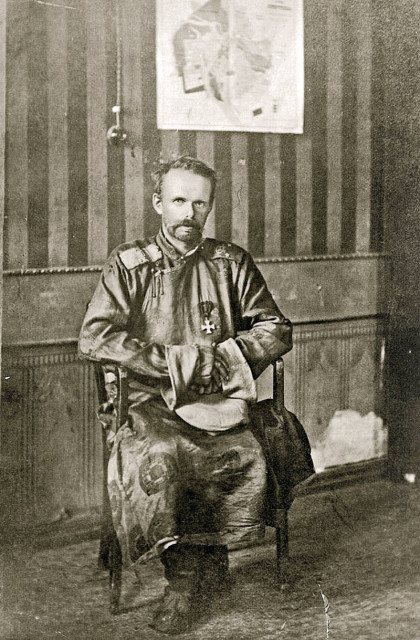
Baron Roman Ungern von Sternberg


A mystic, a savage sadist, a madman or one of the last cavalry strategic geniuses? This peculiar warlord left an interesting trace in Asian history. Baron Roman Ungern von Sternberg was a non-aligned, but anti-Bolshevik general during the Russian Civil War that occurred immediately after the revolution in 1917 and lasted until 1922.

The Civil War divided the nation, but while the Bolsheviks represented a united front, the “White Russians” couldn’t completely agree on the distribution of power among their ranks. When the supreme command over the royalist troops was given to Admiral Kolchak, Ungern von Sternberg refused to follow and continued to wage his own war in the wastelands of Mongolia.

Roman Ungern von Sternberg was born in Austria to a noble Baltic German family. The Baltic Germans lived in the territories of today’s Lithuania, Estonia, and Latvia which was then part of the Russian Empire. He spent his childhood in Tallinn and was educated at the Marine Officers Cadet School in Saint Petersburg.


During the brief Russo-Japanese conflict, von Sternberg volunteered to for the front but arrived too late to participate in combat. Nevertheless, this adventure sparked his fascination with the wonders of the Far East. He would develop this fascination in the following year while serving in Siberia among the Amursky Cossacks where he was introduced to the nomadic lifestyle of the Mongols and Buryats.

During the First World War, von Sternberg was at the frontline, commanding his Cossack cavalry against the Austro-Hungarians in Galicia. He became famous for his rear-action raids with the Cavalry Special Task Force. Von Sternberg gained an ambivalent reputation ― there was no doubt in his bravery, but many wondered about his sanity.

During the February Revolution in 1917, which was a prelude to the October Revolution, the Baron was transferred to the Caucasus where befriended Grigory Semyonov, a Russian officer who was in charge of organizing Assyrian Christians in a struggle against the Ottoman Turks who were fighting on behalf of the Central Powers.

When the civil war broke out most of the Baltic Germans nobility aligned with the anti-Bolshevik coalition including Baron Pyotr Nikolayevich Wrangel who was one of the leading figures of the White movement. Roman Ungern von Sternberg had at that point already developed his political views in which he expressed admiration of the monarchy.

He and Semyonov immediately declared their allegiance to the Tsar and started to combat the revolutionaries. In the meantime, Semyonov gained sponsorship from the Japanese Government and the two began to lead their own counter-revolution, outside of the White Russian movement, which in that time gathered most of the Army elite. The Whites saw this as an act of treason and ended all relationships with Semyonov and Ungern von Sternberg.
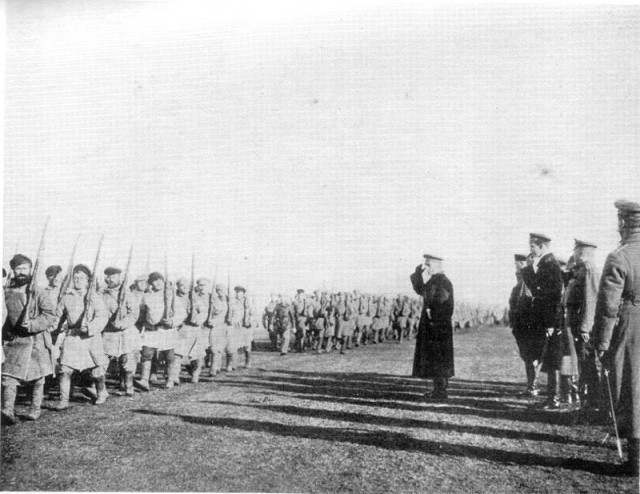
Admiral Kolchak inspecting his troops, 1919. Image credit By Dmitrii Fedotoff-White. Survival Through War And Revolution In Russia. Philadelphia. University of Pennsylvania Press. 1939.

Ungern von Sternberg was soon after dubbed the “Mad Baron” due to his eccentric and often violent behavior. Semyonov and Ungern von Sternberg fought the Bolsheviks in the Baikal Lake area in Central Asia. Semyonov entrusted the Baron with guarding the Dauria railway station which was of great strategic importance.

Von Sternberg organized an Asiatic Cavalry division – a cruel and savage force which controlled the vast Trans-Baikal region with an iron fist.

The Division consisted of many nationalities ― Russians, Buryats, Tatars, Bashkirs, Mongols of various tribes, Chinese, Manchu, Japanese and Polish exiles. They were dubbed “The Savage Division”, a name earlier used by the Russian Imperial Army to classify the units consisted of mountain peoples, mostly from the Caucasus. Ungern von Sternberg plundered and robbed trains that passed through the area under his control, to gain resources for his war effort.Baron Ungern von Sternberg.

He began to pursue his idea of establishing a Mongol Empire with the help of Bogd Khan, the Mongol spiritual leader. At this time, the Baron was heavily involved in studies of Vajrayana Buddhism and other religious sects of the Far East.

His plan wasn’t just to revive the Mongol Empire, but to re-establish monarchies all over the world, as his hate towards Bolshevism grew to an incredible extent. Von Sternberg began planning his expedition into Mongolia in 1919, which was held by Japanese-backed Chinese warlords. Also, part of his plan was to marry a Manchurian princess Ji, thus gaining influence among the Chinese aristocracy.

The political aim of the marriage was to get close to General Zhang Kiuwu, who controlled the Chinese-Manchurian Railway. The railways represented the most important lifeline in Syberia and the Far East. Much of the region’s economic resources were in the hands of those who controlled them. In order to attack the Chinese, who had Japanese support, von Sternberg ended his cooperation with Semyonov even though the two remained friends.

When everything was set, he tried to charge the Mongol capital, the city of Urga (now Ulan Bator) but suffered initially a defeat from the Chinese. In the meantime, he gathered support from the Mongols seeking independence under Bogd Khan, whose influence grew following the invasion. Was it bravery, or madness, or perhaps both that fueled the Baron’s conquest, for his division was 1460 strong and the Chinese garrison numbered 7,000 soldiers who fought the horsemen with machine guns and artillery.

In February 1920, one of von Sternberg’s commanders, Rezukhin, managed to break through the Chinese lines and wreak havoc among the enemy troops. They had captured parts of the city of Urga and liberated a spiritual leader called Bogd Gegeen, which gave his troops a large morale boost.

After this event, the Baron ordered the troops to rest. Reinforcements were arriving just while the Rezukhin detachment held positions within the city. Using an old Genghis Khan tactic, von Sternberg gave orders that numerous campfires be lit in the field just outside the city, by the reinforcements. This gave a fearful impression of an overwhelming force, surrounding the city, even though the Chinese had superior numbers.

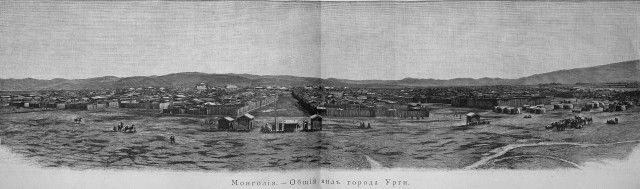
In the next few days, major assaults were conducted, driving the Chinese out of Urga. The remaining Chinese tried to re-organize and conduct a counter-attack, after being driven out of Urga, for they still had several thousand troops in Mongolia. They were met by a few hundred Mongols and Cossacks who fought them fiercely from March 30th to April 2nd. The Chinese were eventually routed and retreated beyond the southern borders of Mongolia.The Urga panorama in late 19th century. Engraving by N.A. Charusin.

Bogd Khan was restored to the throne in February 1921, in a solemn ceremony. As a reward for ousting the Chinese out of Mongolia, Bogd Khan granted Ungern fon Sternberg a hereditary high title darkhan khoshoi chin wang in the degree of khan.

Mongolia was declared an independent monarchy under the spiritual rule of Bogd Khan with Ungern von Sternberg as its de facto dictator. Roman Ungern von Sternberg further developed his streak of mysticism, later, proclaiming himself the reincarnation of Genghis Khan. His philosophy was a mixture of Buddhist mysticism and Russian nationalism. In the eyes of his soldiers, he was a godlike creature who would lead them to countless victories. They called him the “God of War”.

He established a Tibetan colony in Urga and had good relations with the 13th Dalai Lama who supplied him with warriors. Roman Ungern von Sternberg was also a notorious anti-Semite who was personally responsible for the execution of more than 800 Jews within the Mongol region.

He immediately expressed imperialistic tendencies and started a small campaign in the border areas between Mongolia and Russia. His army numbered about 3,000 horsemen. The Bolsheviks had already won the civil war and were amassing their troops to crush the new-formed Mongol Empire and establish a communist state.

The Mad Baron was outnumbered and outgunned. His medieval tactics and extensive cavalry use was no match for the Soviet artillery, armored cars, and machine guns. His own troops started to rebel against him while he desperately tried to retreat to Tibet. Baron Roman Ungern von Sternberg was arrested on August 20th, 1921. A trial was held after which he was executed by a firing squad.

A historian, James Palmer, wrote in his book, The Bloody White Baron, published in 2008:

“When he learned of his death, the Bogd Khan ordered prayers for his soul to be read throughout Mongolia. They were undoubtedly needed.”

Saturday, August 4, 2018

Friday, August 3, 2018