Mishima was born Hiraoka Kimitake in 1925. As the Shōwa era (1926–89) began the following year, the author’s age remained in step with the numbering of the era; he was 20 in 1945 (Shōwa 20) and 45 when he died in 1970 (Shōwa 45). Divide the period into three, and there are the first 20 years of Shōwa that were dominated by years of warfare culminating in unprecedented collapse, the next 25 of rapid economic growth that lifted the country up from its burnt-out ruins, and the 20 or so that followed. Mishima’s life overlapped with the first two of these parts, which could be seen as most representative of the period as a whole. Although the curtain finally came down on the Shōwa era in 1989, as the economic bubble burst, he could be said to have already followed its spirit to the grave.
Mishima believed that literary works represented their age, while at times expressing disagreement and offering new historical visions. This was particularly the case from his 1956 work Kinkakuji (trans. The Temple of the Golden Pavilion) onward. The main genre of modern Japanese literature was the I-novel, in which authors sincerely recorded their own experiences and incidents around them; writers with the same sense of creativity as Mishima were extremely rare. On the international stage, however, authors celebrated for their contributions to the novel like Balzac, Flaubert, Thomas Mann, Tolstoy, and Dostoyevsky all transcended their era, criticizing society and thrusting their artistic vision on the world. Mishima was a writer in this tradition.
Debut at 16
Mishima was born in Yotsuya, Tokyo. This was technically in the prestigious Yamanote district on the west side of the city center, but in fact it was a poor locality, left behind in the reconstruction that followed the Great Kantō Earthquake of 1923. His grandmother Natsuko, from a distinguished samurai family, was dissatisfied with the living environment there. Mishima’s grandfather was formerly the governor of the southern half of the island known as Karafuto in Japan (now wholly administered by Russia as Sakhalin). However, he was forced out of office after a bribery scandal, and Natsuko compensated for her lost dreams and shattered self-esteem through devotion to her grandson.
As Natsuko suffered from sciatica and Mishima had a weak constitution, they often spent their days together in the sickroom. Mishima, who loved fairy tales and picture books, later let his own imagination fly, drawing and writing stories. In “Sekai no kyōi” (The Wonder of the World), a story he wrote when he was 10, autumn comes to an island paradise and with the extinguishing of a candle, it is plunged into darkness.
Although Mishima was not himself from an aristocratic family, he attended Gakushūin, a school for children of the upper classes. His poor health played a part in his undistinguished performance in elementary school. From junior high school, however, his teachers helped lift him to become one of the institution’s outstanding students. At 16, he made his literary debut with his first story to be published outside school magazines. In “Hanazakari no mori” (The Forest in Full Flower; 1941), the narrator enters the flow of time before he was born, and rediscovers the origin of life. This was when Mishima adopted his pen name. It was also the year Japan attacked Pearl Harbor, initiating the Pacific War.
Mishima graduated from Gakushūin High School at the top of his class in 1944 and enrolled in the Faculty of Law at Tokyo Imperial University (now the University of Tokyo). Although poor health exempted him from military service, Mishima’s first collection that year, bringing together “The Forest in Full Flower” with four other stories, had been intended as a posthumous publication. The end of the war the following year left him facing a dilemma. Older authors forced into silence during the war years and up-and-coming writers back from the battlefields let forth a flood of fiction, while Mishima, who despite his youth had been creatively active during this time, found he had lost his place in the literary world. Half deciding to abandon his idea of becoming a novelist, he joined the Ministry of Finance after graduating from university, and began on the bureaucratic career path.
Instead of giving up fiction, however, Mishima quit his job at the ministry after nine months to work on a new novel. Kamen no kokuhaku (trans. Confessions of a Mask), published in 1949, had a narrator based on the author himself, who looks back on the circumstances that led him to accept his homosexuality. In one notable scene, the narrator first becomes sexually excited on seeing a picture of the martyrdom of Saint Sebastian, who was bound to a tree and shot with arrows. The novel did not represent Mishima’s own coming out as gay, though. Rather, with an insistence that everyone is wearing masks, it poured cold water on the kind of sensibility that believes unquestioningly in the identity of the self. This irony resounded with the psychologically troubled young people who had to live through the chaos of wartime and the immediate postwar period, making Confessions of a Mask a bestseller.
Success and Miscalculation
Having returned to the literary scene, Mishima drew a lively picture of the gay community in occupied Japan in Kinjiki (trans. Forbidden Colors), published from 1951 to 1953, and presented an innocent story of first love in his 1954 Shiosai (trans. The Sound of Waves). He also ventured into drama with the 1956 collection Kindai nōgakushū (trans. Five Modern Nō Plays) and the 1954 kabuki play Iwashiuri koi no hikiami (trans. The Sardine Seller’s Net of Love). In 1956, at the age of 31 he published The Temple of the Golden Pavilion, based on the real-life arson of Kinkakuji, the titular Kyoto temple, by one of its acolytes in 1950. It became one of his best received works and was translated into many languages.
By the time it was published, Japan’s economic boom years had begun. What drew so many readers to this novel about the arson incident of six years before? Reborn after the tribulations of war, the country was rising toward prosperity. Even so, it was only a decade or so since the war ended, and the dark memories of that time were slow to fade. They remained deeply rooted in people’s minds as an inner threat to the bright dreams of postwar democracy, progress, and affluence. The Temple of the Golden Pavilion spoke for the internal unease many in the new society felt.
From the inner perspective, democracy and economic growth were nothing other than masks. Continuing to wear them meant losing sight of the roots of existence, and falling into nihilism. Mishima made nihilism the subject of his 1959 work Kyōko no ie (Kyōko’s House), which tells the story of four young people leading lonely lives in Tokyo and New York around 1955.
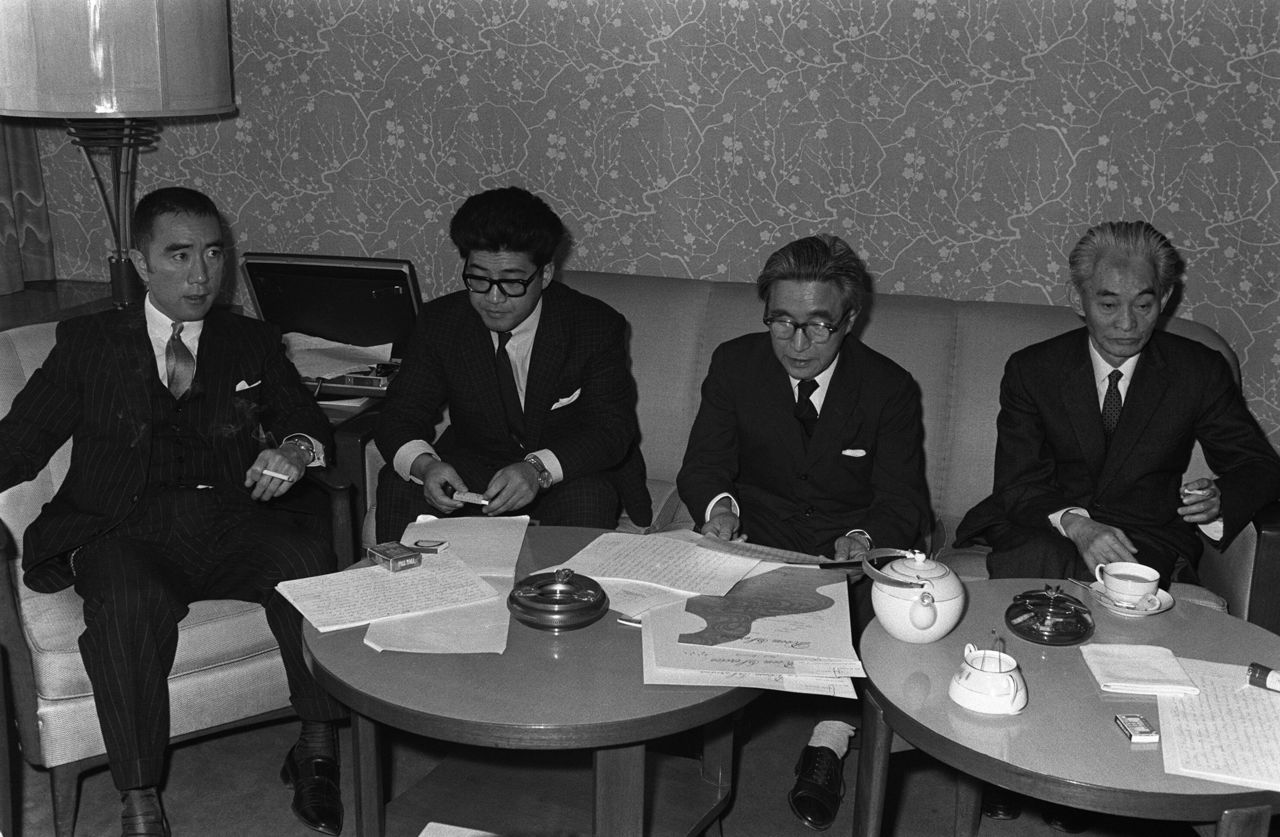
(From left to right) Authors Mishima Yukio, Abe Kōbō, Ishikawa Jun, and Kawabata Yasunari come together to read a joint statement in Tokyo on February 28, 1967, protesting against the Cultural Revolution in China. (© Jiji)
Here he made a great miscalculation. The generation of readers who embraced The Temple of the Golden Pavilion were lukewarm about Kyōko’s House. By 1959, the people bustling through a new and bigger economic boom were no longer interested in the question of nihilism. For Mishima, who had tried to depict some of the darker aspects of the age in his novel, this was a grave shock.
The Final Manuscript
Mishima went on to seek new ways of being outside the literary sphere, acting in the 1960 gangster movie Karakkaze yarō (Afraid to Die) and becoming the subject of the 1963 photography collection Barakei (Ordeal by Roses) by Hosoe Eikō. With their success, he became a media favorite.
This meant, however, catering to the postwar society that made no attempt to understand Kyōko’s House. The greater the media reaction he stirred up, the greater his sense of self-denial. To counter this situation, he could only take on the challenge of creating a literary work that captured the age and offered a new vision of history on a greater scale than ever before. This was the tetralogy Hōjō no umi (trans. The Sea of Fertility).
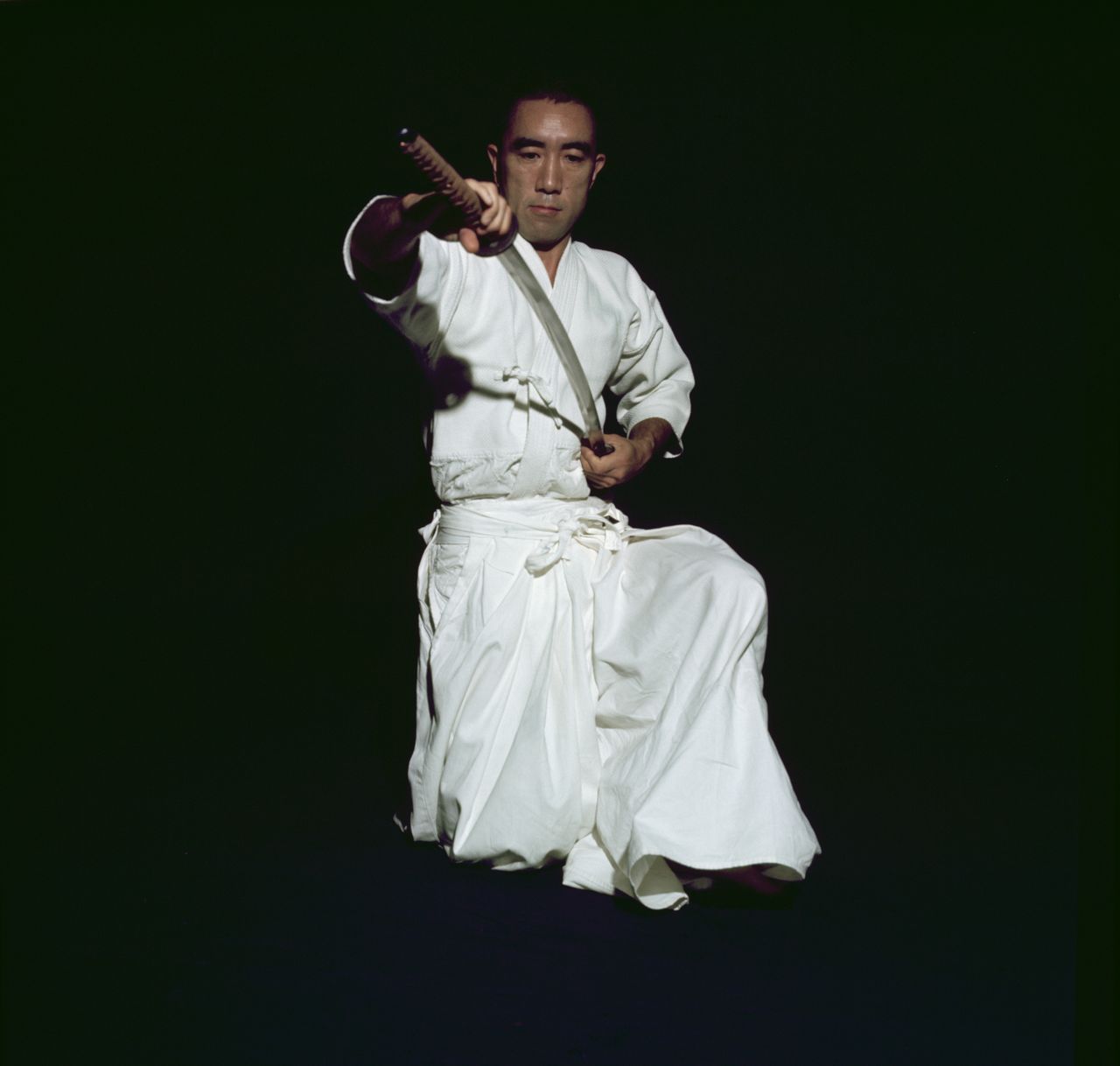
Mishima Yukio practicing the martial art of iaidō on July 3, 1970. (© Jiji)
In the four books, its protagonist apparently reincarnates through the twentieth century. The opening depicts a memorial ceremony for those who died in the Russo-Japanese War of 1904–5. Its bleak atmosphere lingers in the background throughout The Sea of Fertility, demonstrating that the roots of postwar nihilism were already present in the Meiji era (1868–1912). As the successive reincarnations fight against this rejection of principles in their pursuit of life, a joyful enlightenment seems certain in the final part.
However, while this was the ending in the original concept, the fourth book actually finishes with the twist that the stories of reincarnation were no more than an illusion. After handing the final manuscript in to be edited on November 25, 1970, Mishima caused a sensation with his suicide. The truth behind the act is still unknown. One thing I can say is that Mishima vividly portrayed the nihilism the age was moving toward in his ending to The Sea of Fertility. I take his death by his own hand as having been an act aimed at encouraging each one of us to discover how to overcome that nihilism.
This year marks 50 years since Mishima Yukio’s (1925–70) spectacular suicide in November 1970. Events have been held around the world to commemorate the author’s life and work. Featuring somewhere at almost all these events have been the artfully posed photographs of Mishima taken by Hosoe Eikō (1933–) and published in 1963 under the title Barakei (Ordeal by Roses), one of the most original photo books of the twentieth century. The series features Mishima in a variety of poses, proudly showing off his muscular physique, the result of many years of dedicated bodybuilding. The photographs—taken between autumn 1961 and spring 1962, mostly at the writer’s home in the Magome district of Tokyo—encapsulated Mishima’s self-image and brought it to vivid life in photographs that used a variety of sophisticated techniques to create an astonishing world of provocative sensuality and sumptuous estheticism. Hosoe was 28 years old at the time, and one of the rising stars of Japanese art photography.
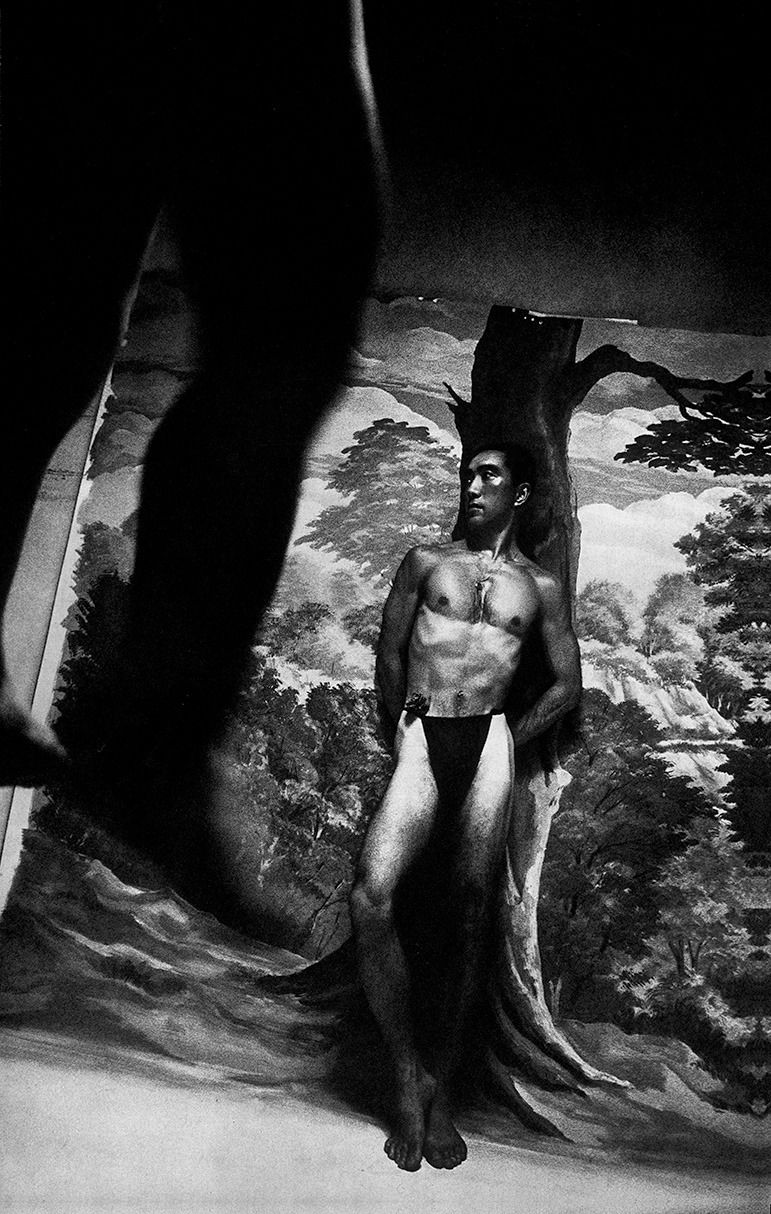
Barakei (Ordeal by Roses) #34, 1961
Visions of an Artist
The initial connection between Hosoe and Mishima came through choreographer Hijikata Tatsumi (1928–86), creator of the dynamic and revolutionary new butoh form of modern dance. Hijikata and Mishima were close friends, and in 1959 Hijikata developed a dance piece based on Mishima’s novel Kinjiki (Forbidden Colors). Hosoe attended a performance, and was immediately struck by the artistic possibilities of the thrilling new style of dance. He visited Hijikata backstage after the performance, and was soon taking photographs of Hijikata, the model Ishida Masako, and their fellow dancers. Hosoe used the bodies of these dancers to create a series of graphic images of “men and women, as human beings captured in the concreteness of sex,” (to borrow the phrase of photography critic Fukushima Tatsuo), in a series of strikingly vivid images, their unembellished rawness accentuated by the stark contrast between black and white. The images came out in book form in 1961, under the title Otoko to onna (Man and Woman).
Mishima saw this collection and other photographs of Hijikata and his troupe that were used in programs for the group’s performances, and became fascinated by Hosoe’s style. Via his editor, he approached Hosoe and commissioned him to take a new series of photographs. The first time they met, Mishima told the photographer: “I will give myself up to you as the subject matter for your camera. I want you to feel free to use me as you see fit and take whatever images your vision suggests.” Hosoe took Mishima’s words at face value, and proceeded to take a series of astonishing photographs whose shocking originality was a world apart from any kind of banal celebrity shoot or conventional author photo. At their first shoot, Hosoe wrapped a naked Mishima in garden hose and stood him on marble flagstones depicting an elliptical mosaic zodiac, with one end of the hose in his mouth. Mishima stands with a mallet in his right hand, Hosoe looking down at him from a stepladder, Mishima staring intensely into the camera with a gaze that seems to contain all the power of his muscular physique.
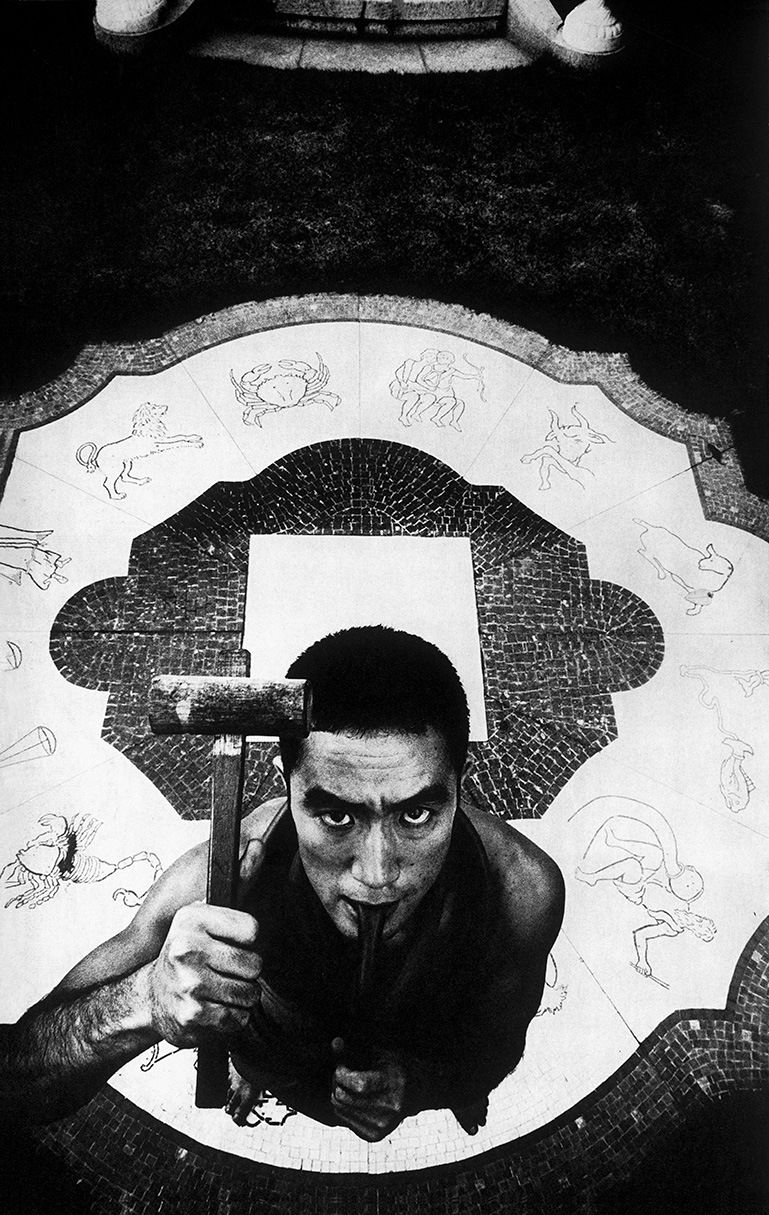
Barakei (Ordeal by Roses) #5, 1961.
Mishima loved these groundbreaking photographs, which seemed to refuse any attempt at straightforward interpretation, and the two men agreed to meet again for further sessions. For the second shoot and the remainder of their collaboration, Mishima sent his wife and children out of the house before shooting started, claiming that the decadent photographer and his friends would have a “bad influence on their morals.” The images often incorporated elements from Mishima’s favorite works of art, such as “Sleeping Venus” by the Venetian painter Georgione, and Botticelli’s “Birth of Venus.” Mishima invited Hijikata and his troupe to his house and posed with them, as well as posing for several shots with the actress Enami Kyōko (1942–2018). Occasionally the collaborators left the Mishima residence to shoot in other locations, including a building site on the grounds of a church strewn with red bricks.
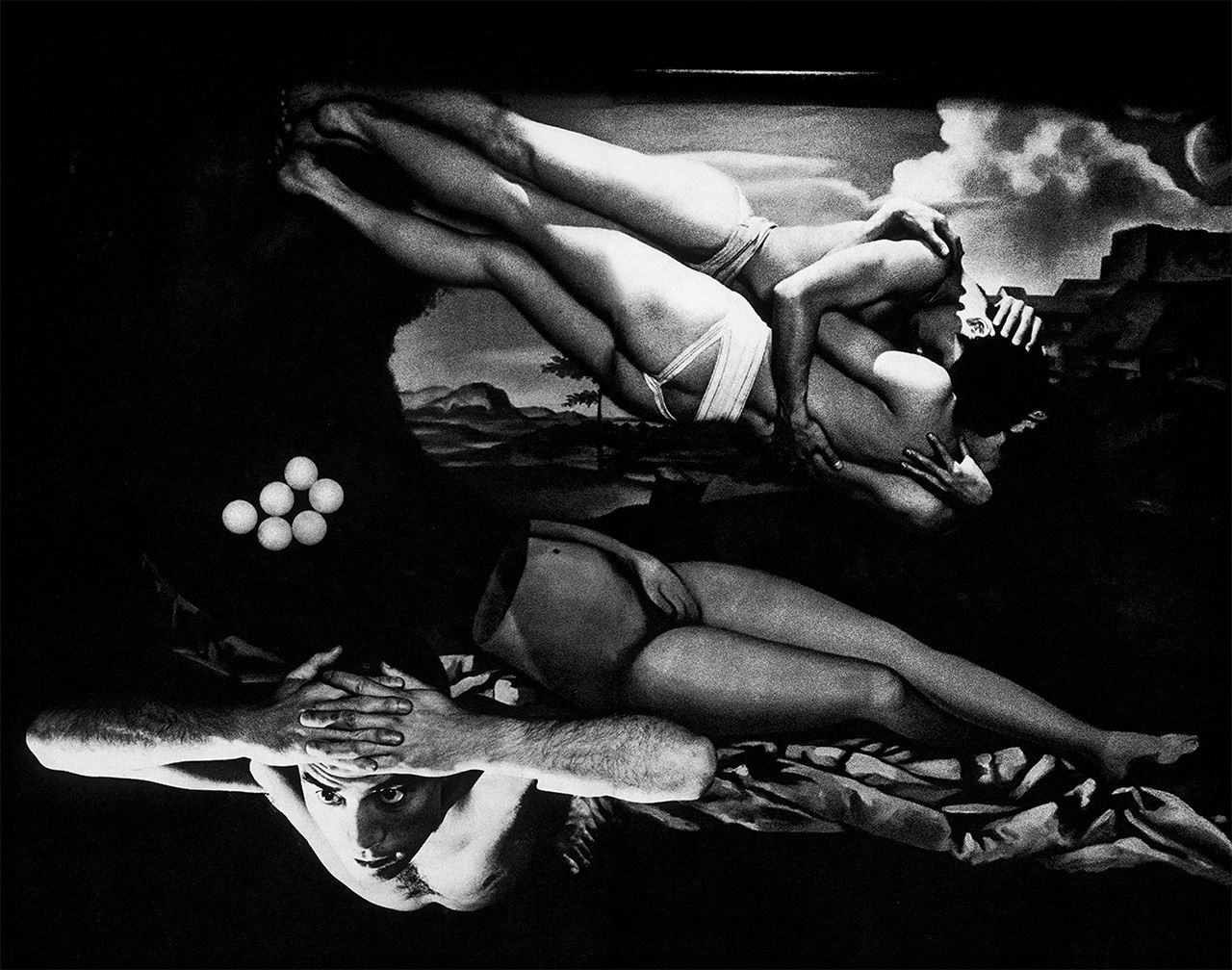
Barakei (Ordeal by Roses) # 16, 1961.
Gradually, a vision took shape that Mishima described in the following terms in his preface to the photographs when they were published in book form: “The world to which I was abducted under the spell of his lens was abnormal, warped, sarcastic, grotesque, savage, and promiscuous . . . yet there was a clear undercurrent of lyricism murmuring gently through its unseen conduits.”
One of the people who played an important role in the darkroom, helping to develop and print the images, was Moriyama Daidō, who later became a well-known photographer in his own right. Moriyama had moved from Osaka to Tokyo in 1961 and was working as Hosoe’s assistant. The Mishima project was one of his first assignments. It was not an easy job, responding to the ideas as they poured from Hosoe and trying to make them a reality. Moriyama remembers the difficulties he faced in the darkroom, where he had to call on all his skills and ingenuity to print images that would match Hosoe’s vision, using low sensitivity mini-copy film, then lowering the sensitivity even further and combining several negatives into a composite montage. Moriyama Daidō later became known for his peerless skills in finishing and developing his prints. It is fair to say that much of the groundwork for his subsequent career was laid down during this period working with Hosoe on his pictures of Mishima.
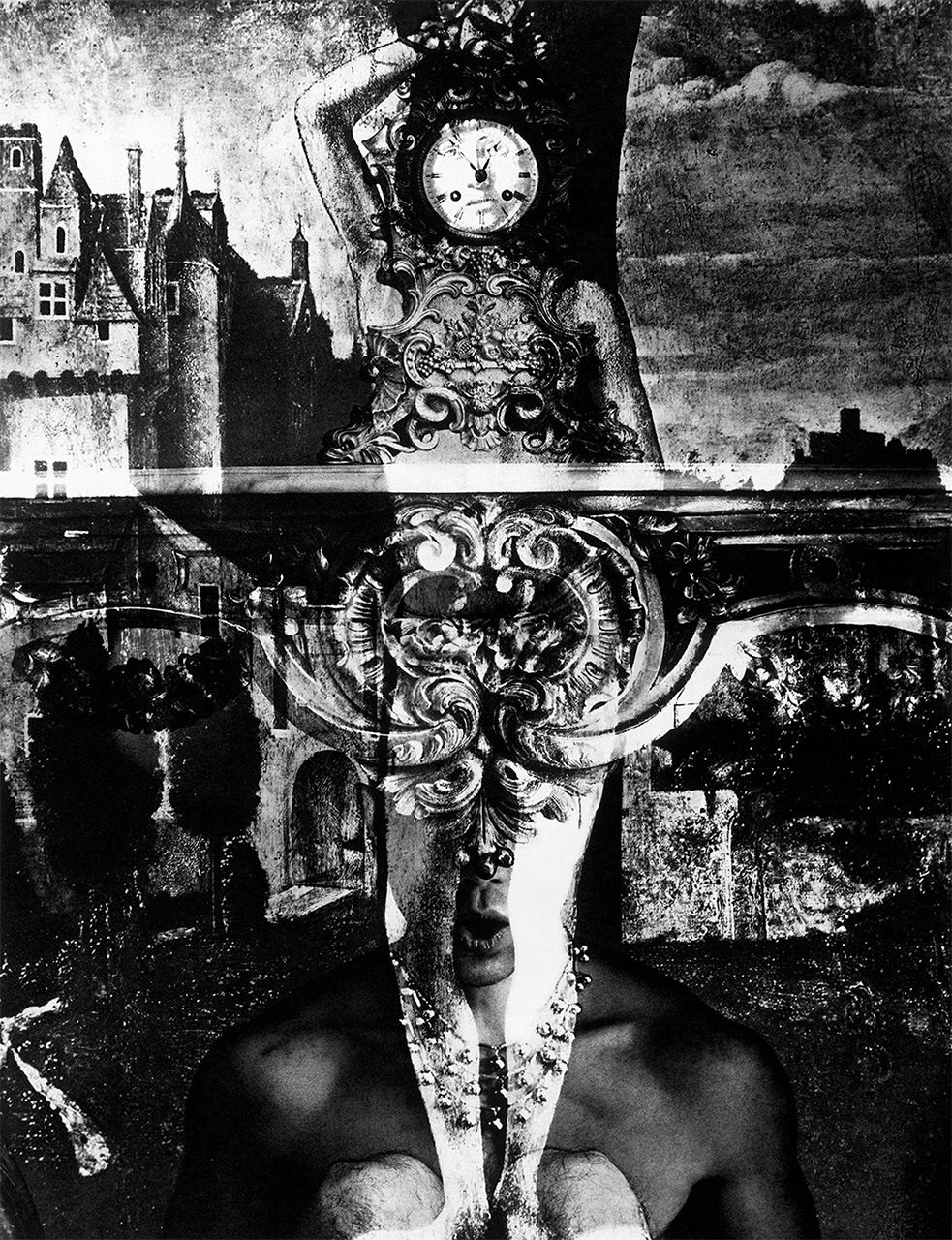
Barakei (Ordeal by Roses) #29, 1961.
Mishima’s Esthetics of Life and Death
The first of the photographs appeared on the cover and frontispiece of Bi no shūgeki (Assault of Beauty), a collection of Mishima’s critical essays published by Kōdansha in 1961. They were then displayed at the Non exhibition at the Matsuya Department Store in Ginza, Tokyo, in January 1962, organized by Fukushima Tatsuo, with the participation of leading photographers including Narahara Ikkō (1931–2020), Tōmatsu Shōmei (1932–2012), Kawada Kikuji (1933–), Ishimoto Yasuhiro (1921–2012), and Imai Hisae (1931–2009).
Then, in March 1963, the photographs were published as Barakei (which originally carried the English title “Killed by Roses,” later amended to “Ordeal by Roses”), in a large-format luxury book designed and bound by designer Sugiura Kōhei (1932–). The photographs were presented in five chapters: “Chapter One: Preface,” “Chapter Two: Daily Civilian Life,” “Chapter Three: The Scornful Clock, or the Slothful Witness,” “Chapter Four: Various Blasphemies,” and “Chapter Five: Ordeal by Roses.”
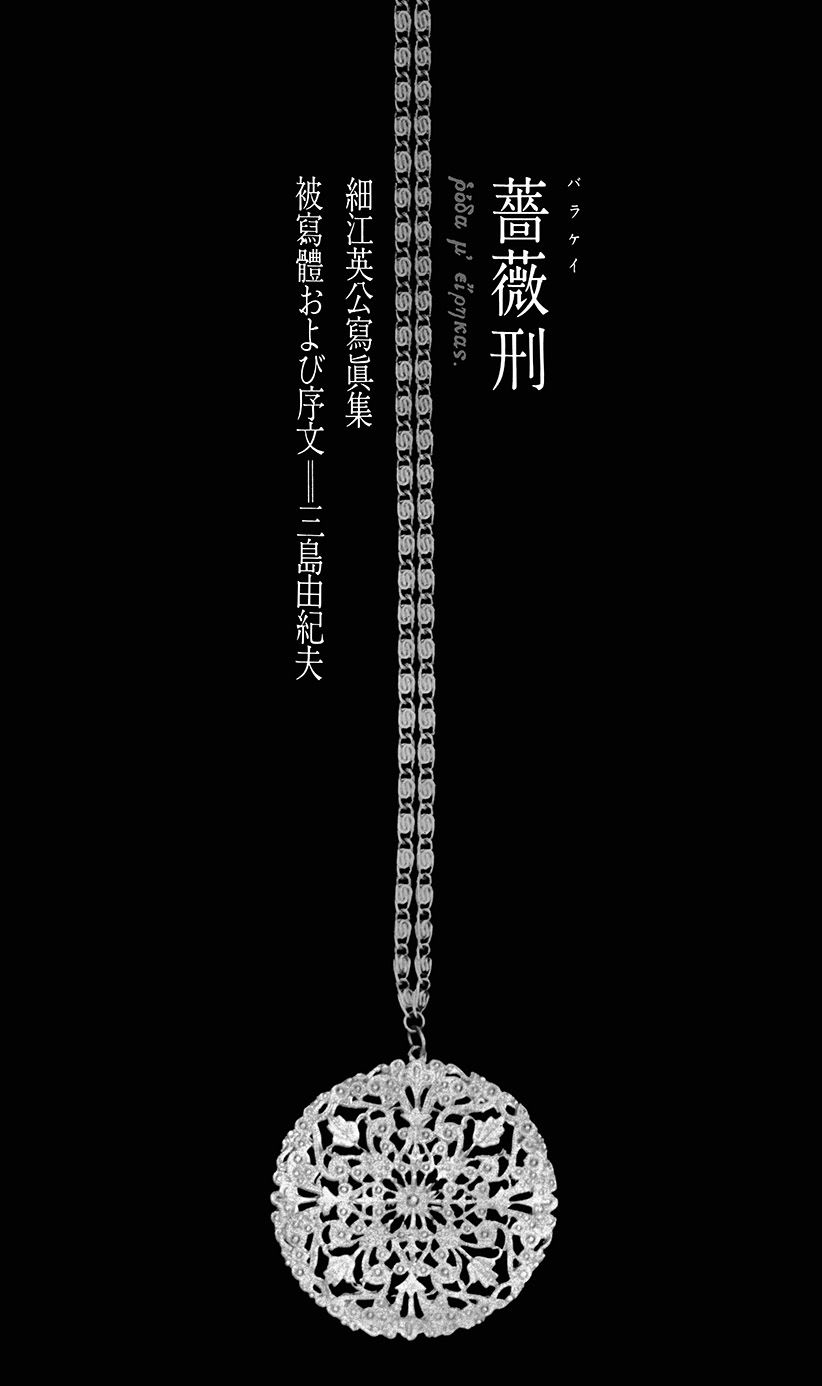
The large-format edition of Barakei, designed by Sugiura Kōhei and published in 1963.
Once a decision was made to publish the photographs in book form, Hosoe wrote to Mishima and asked him to suggest a title. Mishima replied with several suggestions: “Sketches of Martyrdom,” “Man and Roses,” “Passion Variations,” “Death and Loquaciousness,” and Barakei or “Ordeal by Roses,” (literally “punishment by roses,” rendered as “Killed by Roses” in the first edition). Hosoe knew as soon as he saw it that this last suggestion should be the title: it struck him as the perfect encapsulation of Mishima’s esthetic values and his view of life and death. The book was critically well received, and won a prize that year.
Plans for a Revised Edition, Delayed by Seppuku
Hosoe continued to develop his vision, working again with Hijikata Tatsumi on the collection Kamaitachi, named after a legendary weasel-like demon native to the rural Tōhoku region where both men had grown up. Published by Gendai Shichōsha in 1969, the photos showed Hijikata alongside ordinary local people. But the earlier Mishima collection continued to play on Hosoe’s mind. In 1970, a plan arose for a new, international edition of Barakei. The design would be the responsibility this time of Yokoo Tadanori (1936–). After consultation between Hosoe, Mishima, and Yokoo, it was decided to make a number of significant changes to the composition and layout of the photographs. The book was scheduled to come out in November that year, but had to be postponed for a month or so when Yokoo was involved in a car accident.
The galleys for the new edition were shown for the first time at an exhibition on Mishima at the Tōbu Department store in Ikebukuro in October that year. One section of the exhibit featured enlarged images from Barakei under the title “River of Flesh.” Hosoe was struck by a comment Mishima had written for the exhibition: “I will never accept the decay of the flesh.” Around the same time, Mishima delivered the manuscript for a preface he had promised to write for Hosoe’s photography collection Hōyō (Embrace), considerably ahead of schedule: this too was quite out of the ordinary.
Despite these omens, Mishima’s spectacular suicide by seppuku or ritual disembowelment at the Self-Defense Forces headquarters at Ichigaya on November 25, 1970 came as a complete shock. Hosoe immediately suspended work on the new edition of his book—he simply did not know how his photographs of Mishima would be received by the media in the chaos after the author’s death. But the bigger reason had to do with his pride: He did not want anyone to think he was “cashing in” on Mishima’s death by publishing a book of photographs certain to attract controversy so soon after the author’s suicide.
But a phone call from Mishima’s wife Yōko persuaded him to change his mind. “I hope you will go ahead with plans to publish the new edition of the book. My husband was looking forward to it so much.” Following a quick change of plan, the new edition of Barakei saw the light of day after all. The international edition Barakei (Ordeal by Roses) was published by Shūeisha International in January 1971.
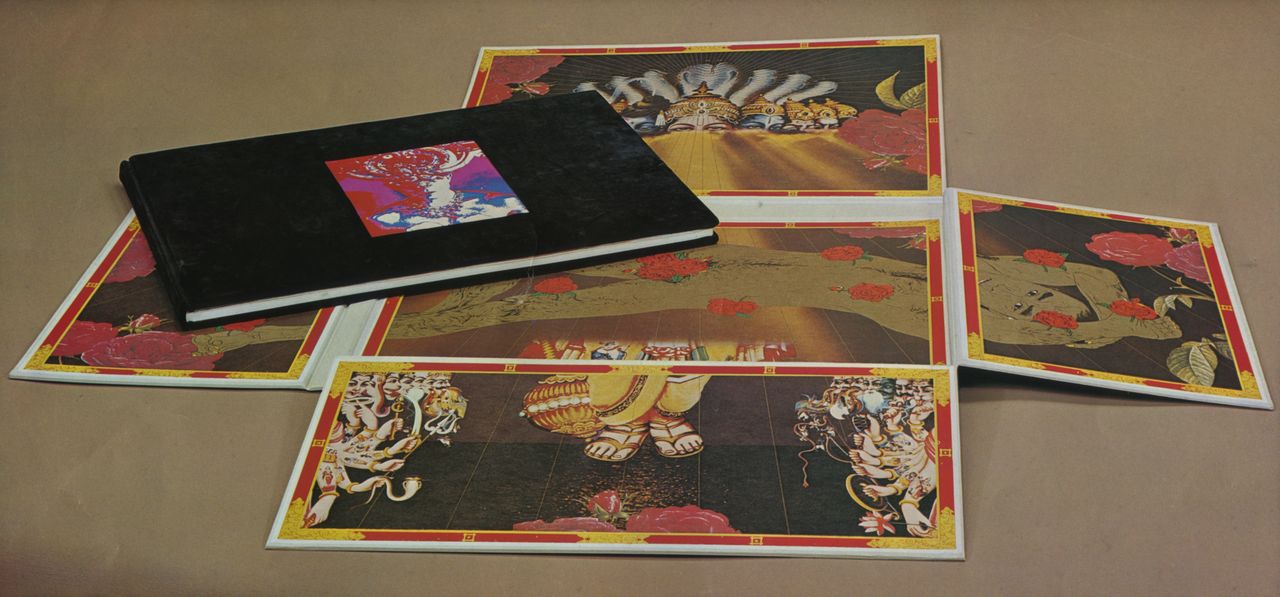
The new edition of Barakei, designed by Yokoo Tadanori and published in 1971. The box containing the collection of photographs opens to reveal a Buddhist-influenced, Indian-style picture of Mishima.
A Collaboration Between Two Uncompromising Artists
Looking at Barakei anew all these years later is to be reminded of how distinctive and special the book was. The slipcase for the original edition attributes the book to “Hosoe Eikō: Photographs; Mishima Yukio: Subject and Preface.” The message was clear: this was a collaboration between two artists in a relationship of equality.
Mishima certainly lived up to his promise to become the “subject matter” for Hosoe’s photos. But he remained a commanding, indelible presence throughout the shoot: in his own house, richly imbued as it was with its owner’s distinctive sense of esthetics, surrounded by the furniture and fittings he had chosen himself, and showing off the toned muscular physique of which he was so proud, Mishima had something of the air of a prowling tiger patrolling his territory. Hosoe refused to take a backward step before this charismatic and dominating personality, maintaining his own individuality and vision as a photographer in the face of one of the dominant writers of his time, manipulating and controlling him just as he would a dancer or bodybuilder or any other model. The result was a competitive collaboration between two gifted artistic sensibilities, the writer and the photographer engaged in an artistic arm-wrestle, each refusing to yield to the other. This remarkable collection of photographs remains a fitting testament to the integrity and vision of two proudly independent artists.

No comments:
Post a Comment