I was contemplating what to write for an article about the game, so I went into my Victory Gamescopy of the Peloponnesian War and found that my old habit of putting all reviews and articles about a game into the box turned this simple act into a walk down memory lane. Everyone who wrote or corresponded with me about the original published game was in the box, to include my articles in The General Vol. 28 #1.
Based on going through all of this correspondence from over 25 years ago, there is nothing to change in the solitaire design. However, the rules will be totally rewritten, and I am going to add two new solo scenarios. For those who have never seen and only heard about this design, it covers the 2nd Peloponnesian War (see my recent Pericles design to see what the 1st Peloponnesian War was all about). I will incorporate all of the new research I used for Pericles to create a 1stPeloponnesian War scenario, with accompanying AI charts (plus an Egypt campaign mini-map extension). The new version will also include the sequel to the Great Peloponnesian War, covering the Fall of Sparta, also with tailored AI charts. So, although the design is the same as the original VG version, you will be getting essentially three games in one package – with new leaders, new counters, and new AI to handle the two new scenarios. In essence it will be three games in one box using the same system.
Now to be clear, this is an AI (as in Artificial Intent) solitaire system that has never been copied or reused by others or myself. It does not use ‘Bots, because you are the opponent. You begin the original game as Athens and as the game progresses, you gain/lose points for victories/ defeats. As your SCI (Strategy Confidence Index) climbs, you are likely to have to change sides and bring your AI opponent back into the game. If your SCI falls, you get to try and climb back into the game. In the end, like golf, your performance is entirely up to your decisions and performance. Based on reviewing my solo game forms (with dates when I played), I hold a losing record with the original game.
Back in the early nineties The General published a Victory Games issue, General Vol. 28 #1, with the three lead articles focused on The Peloponnesian War. As I contemplated writing a new article I realized that my 37 year old self (I’m now 63) knew a lot more about my thinking on this design than I remember now, so instead of trying to recreate a young man’s view of the world, lets hear from him directly. So without further ado, I would like to introduce ‘me’, a quarter of a century ago, to tell you about the design and strategy in Peloponnesian War.
Deus Ex Machina
Struggling Against the Vicisstudes of the Peloponnesian War Game System
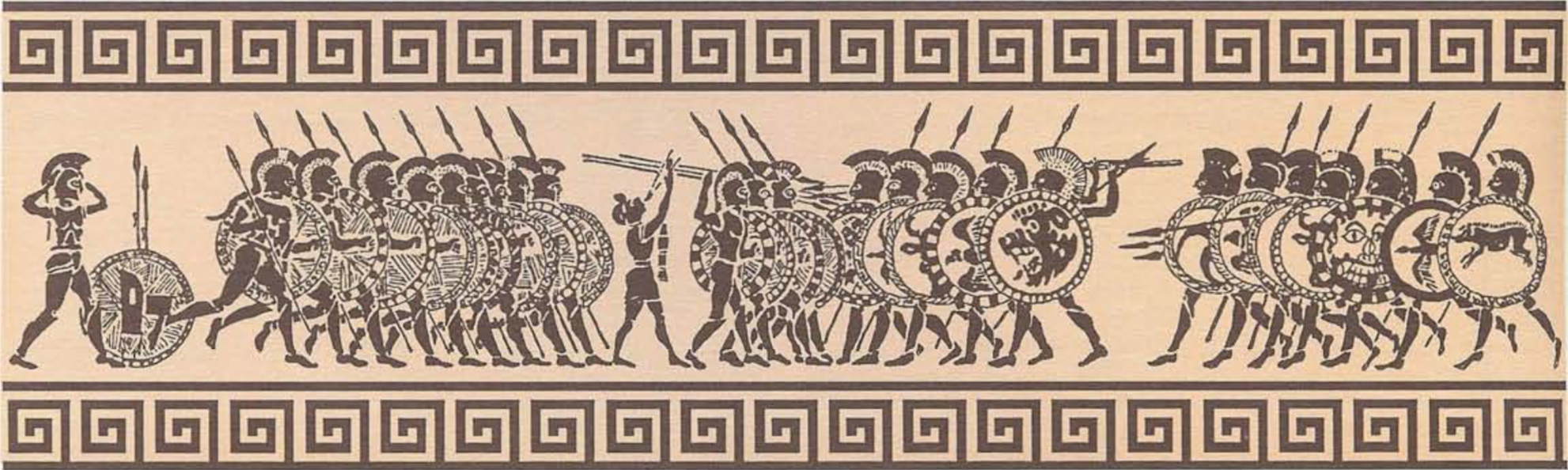
Thucydides said of the Spartans that they were “a convenient enemy”. He was referring to the many times Sparta missed opportunities for a riposte when Athens was vulnerable. Solitaire game systems tend to be convenient enemies, even when computerized, because they usually miss strategic opportunities. To solve this traditional weakness of solitaire systems, I enlisted in my design the services of the person we see in the mirror. If you believe the old adage that we are our own worst enemy, then Peloponnesian War lets you experience this literally.
Those of you who already own Peloponnesian War know what I am talking about. For those who do not I will briefly digress. Peloponnesian War is based on the premise that the sum of good tactics is not strategy. Solitaire systems both computerized and manual tend to handle tactics well but the combination of these moves is usually disjointed and bereft of logic. I chose to take this problem and turn it into an opportunity. The player supplies the long term game strategies for both sides while the system handles the short term tactics of the opponent. Mechanically this is done by the player controlling one side while the game system operates the opponent. As the player gains strategic momentum and begins to defeat the system, he is forced to switch sides and rectify the former opponent’s situation. This constant change of identities allows the player to challenge himself in the true style of a Greek tragedy.
The game mechanic whereby the player changes sides also serves historical purposes. One of the characteristics of this 27-year war was the constantly shifting domestic and coalition priorities that caused a commensurate shifting of state policies. These often illogical strategy shifts are recreated by both the temporary loss of direct player control over a particular side and the opposition leader’s influence on enemy objectives.
The Spartan strategy was driven by the yearly change in the composition of the five Ephors, picked at random, who made Spartan political policy. Traditionally one of the two Spartan kings lead the army on operations while the other stayed home to handle domestic security. As Spartan military operations expanded from their traditional raid and battle strategy (“Attack Athens”) a host of new leaders emerged. These leaders (e.g., Brasidas and Lysander) gained their positions due to the patronage of various Ephors (or the kings), and represent their policies.
Theoretically, Athenian policy was determined by majority vote of the electorate. In actual practice the electorate was dominated by charismatic leaders, initially by Pericles and later by wealthy patrons (Cleon, Alcibiades, and Nicias), whose ability to employ blocks of votes dominated Athenian policy. In the past when these demagogues had reached impasses, one of the opponents was ostracized by the electorate, allowing the survivor to implement his policy. After the death of Pericles and Cleon this political mechanism failed. Nicias and Alcibiades temporarily joined forces to ostracize a third opponent, allowing both of them to continue in office and clash over policy. This political Tug-of-war resulted in the Syracusan expedition and the loss of Athenian naval superiority. Later, an oligarchy temporarily took control of Athens, but the fleet located on Samos refused to acknowledge the new government which was subsequently ousted. In the waning days of the war the electorate self destructed, preventing any coherent strategy from forming prior to defeat.
These radical changes in policy are embedded directly into the solitaire game system. When you control a side you determine its strategic direction. If you control the same side for two or more game turns a period of political unity is simulated. At the same time, the nonplayer side is usually characterized by chaotic changes in policy. When you cease to control a side it now experiences a radical shift in strategy. Although on the surface the political component of the game looks simple, it accounts for the impact of political turmoil upon the course of the war.
Your opponent (the game system) is driven by the historical strategies available to both sides. The opposing political entities employed these strategies in pursuit of their shifting political agendas. It is the intent of this article to acquaint you with the logic and motivations of the strategy matrix lo improve your performance in and enjoyment of the game. Along the way I hope to supply some historical background to illustrate how the game simulates these strategic factors.
Know Your Enemy
What is the System Trying to Accomplish?
The heart of the solitaire game system in Peloponnesian War is the Athenian and Spartan strategy matrices. Only one strategy matrix is active during any game tum. Historically there were a number of strategies used by both sides over the course of the war. The strategics on the matrices represent the policy responses that Athenian and Spartan politics imposed on their military leadership. The leader chosen at the beginning of each tum is the key policy maker, whose influence affects which strategy is implemented.
The game mechanic whereby the player changes sides also serves historical purposes. One of the characteristics of this 27-year war was the constantly shifting domestic and coalition priorities that caused a commensurate shifting of state policies. These often illogical strategy shifts are recreated by both the temporary loss of direct player control over a particular side and the opposition leader’s influence on enemy objectives.
The Spartan strategy was driven by the yearly change in the composition of the five Ephors, picked at random, who made Spartan political policy. Traditionally one of the two Spartan kings lead the army on operations while the other stayed home to handle domestic security. As Spartan military operations expanded from their traditional raid and battle strategy (“Attack Athens”) a host of new leaders emerged. These leaders (e.g., Brasidas and Lysander) gained their positions due to the patronage of various Ephors (or the kings), and represent their policies.
Theoretically, Athenian policy was determined by majority vote of the electorate. In actual practice the electorate was dominated by charismatic leaders, initially by Pericles and later by wealthy patrons (Cleon, Alcibiades, and Nicias), whose ability to employ blocks of votes dominated Athenian policy. In the past when these demagogues had reached impasses, one of the opponents was ostracized by the electorate, allowing the survivor to implement his policy. After the death of Pericles and Cleon this political mechanism failed. Nicias and Alcibiades temporarily joined forces to ostracize a third opponent, allowing both of them to continue in office and clash over policy. This political Tug-of-war resulted in the Syracusan expedition and the loss of Athenian naval superiority. Later, an oligarchy temporarily took control of Athens, but the fleet located on Samos refused to acknowledge the new government which was subsequently ousted. In the waning days of the war the electorate self destructed, preventing any coherent strategy from forming prior to defeat.
These radical changes in policy are embedded directly into the solitaire game system. When you control a side you determine its strategic direction. If you control the same side for two or more game turns a period of political unity is simulated. At the same time, the nonplayer side is usually characterized by chaotic changes in policy. When you cease to control a side it now experiences a radical shift in strategy. Although on the surface the political component of the game looks simple, it accounts for the impact of political turmoil upon the course of the war.
Your opponent (the game system) is driven by the historical strategies available to both sides. The opposing political entities employed these strategies in pursuit of their shifting political agendas. It is the intent of this article to acquaint you with the logic and motivations of the strategy matrix lo improve your performance in and enjoyment of the game. Along the way I hope to supply some historical background to illustrate how the game simulates these strategic factors.
Know Your Enemy
What is the System Trying to Accomplish?
The heart of the solitaire game system in Peloponnesian War is the Athenian and Spartan strategy matrices. Only one strategy matrix is active during any game tum. Historically there were a number of strategies used by both sides over the course of the war. The strategics on the matrices represent the policy responses that Athenian and Spartan politics imposed on their military leadership. The leader chosen at the beginning of each tum is the key policy maker, whose influence affects which strategy is implemented.
An examination of any particular strategy reveals three key parameters: Which areas and their associated spaces on the map are potential objectives, the area/objective probability, and the size and composition of the forces to be sent. The combination of these factors will produce a series of operations consistent with the historical examples which they simulate. Although working from similar principles, the implementation by each side (that is, Athens and Sparta) is unique lo the cultural and historical precedent set by the war as described by Thucydides.

MAP A (Graphic Representation of Spartan Strategy Matrix):
KEY: 1: Defensive Strategy; 2: Cut LOC; 3: Cause Rebellion; 4: Attack Athenian Ally; 5: Attack Athens
Historically, neither side sent out on average more than one expedition per year. With the game turns representing three years, the game system launches from one to four operations per turn. The larger operations, such as the Spartan invasion of Attica, represent a series of expeditions to the same region over three years. The medium and small operations are representative of individual forays that are coordinated around a basic strategic theme.
Sparta
Sparta is a land power whose army is effectively neutralized by the Long Walls of Athens, which connect the city (through its port of Piraeus) to the sea. Traditional Greek siege operations that emphasize starvation over assault cannot work against Athens, because the Athenian navy protects the grain imports from the Crimea. Sparta finds it difficult to build a superior navy, because the Athenian empire has such vast economic strength, and shatters any Spartan navy that begins to form. This historical conundrum was solved by Athens losing over two hundred ships in its disastrous expedition against Syracuse followed by Sparta entering into an alliance with Persia (Random Event). The alliance with Persia gave Sparta a line of credit that enabled her to build and man a succession of fleets which supported a series of Delian League revolts that sapped the economic strength of Athens. These Spartan-commanded fleets lost a series of naval battles, which stretched out over the better part of the war’s last decade, but whose singular significant victory at Aegospotami led to victory.
Spartan strategy has four basic thrusts. One focus is to attack Athens directly. This represents the traditional objective of forcing a Hoplite battle on the opponent by holding his crops and agricultural infrastructure hostage. Against a normal city state this tried-and-true method allowed the Spartans to force amateur opponents into disadvantageous battles against their own professional army.
Athens, under the leadership of Pericles, broke with tradition and allowed its lands to be ravaged without a battle, thus neutralizing this Spartan strategy. There were economic implications for Athens, as the wealthier members of the community lost their agricultural enterprises and became less able to sponsor military activities such as building triremes for the state. In the game this is represented by denying the Eisphora revenue to Athens on turns when Attica is ravaged.
When the Spartans (as controlled by the game system) use this strategy (” Attack Athens”) they employ most of their available land forces and conduct only one operation over the game tum. This allows you to respond by employing a series of operations to gain a common objective. An example would be to capture the five Peloponnesian coastal spaces which spark a Helot rebellion, or to open a Line of Communication to Epidanos to offset the economic loss of a ravaged Attica.
Causing rebellion amongst Delian League members is another Spartan strategy. Historically, the Spartan king Archidamus, in his assessment of the coming war, speaks of this as a key to defeating Athens. In antiquity, political theory and practices were constantly evolving. Most city states had disaffected factions who disagreed with the current political structure or treaty relationships. These groups, if properly motivated, would allow enemy forces to compel a change in government and allegiance, with themselves as the chief benefactors.
Over the course of the war both sides utilized this tactic to gain surreptitious entry through a city’s defenses and capture it by coup de main. Of all the strategies available to the player this one is the most overlooked. Rebellions do not survive if you or the game system do not support them. Often an unsupported rebellion could be overawed by the presence of their former ally armed to the teeth and offering clemency, if the ringleaders were turned over for punishment. Early in the game, if the Spartans succeed in causing a rebellion in the Aegean or Asia Minor, it is difficult for the supporting military force to pass through the Saronic Gulf (Aegina space). The best response in this circumstance is to send one squadron containing a single naval SP (Strength Point) to an adjacent space and arrest the guilty without siege. The best opportunities for the Spartan side to support rebellions will be in Thrace and the Chalcidice, where overland access cannot be denied by the Athenian forces.
During the latter half of the war the Spartans attempted, and ultimately succeeded in, cutting off Athenian access to the Crimea – the “Cut LOC” (Line of Control) strategy. This strategy, initiated by Sparta and sustained by Persian gold, broke the economic back of Athens and won the war. The “Cut LOC” strategy objectives focus on the Eastern end of the map (See Table 1), and attempt to interrupt Athens’ communication with the Euxine. The forces sent are small in size and are meant to dilute Athenian responses. It was the ability of Spartan naval forces to maintain themselves in Asia Minor that allowed the Athenian empire to rebel en masse. These massive defections reduced the tribute that funded the Athenian navy and diminished her ability to maintain her lines of communication. In the game it is the combination of supporting rebellions and extensive ravaging that reduces Athenian revenue. Since the size of the forces sent by the Spartans are small, several tend to be sent out per game tum, with a reasonable likelihood that one arrives at its objective. Unfortunately for these historical rebellions, they were unaware of the fine print in the Spartan-Persian alliance, which ceded to the Persians all of the Greek city states in Asia Minor. C’est La Guerre.

Table 1: Strategy Matrix Area Probabilities (All values in table %)
The last Spartan strategy is to attack an Athenian ally. Its objectives have the same probabilities as the Cause Rebellion strategy, but the forces sent are of medium size, not small. Usually two such expeditions will be successfully sent out in a game turn. They attempt to capture Athenian spaces and project a ZOI (Zone of Influence) in that area to inhibit Athenian movement. This strategy does not hurt Athens directly unless the operation arrives in an area with numerous Athenian garrisons. In this circumstance, the Spartan force can destroy Athenian control over whole sections of the map in one combat phase.
If you maintain a sizeable naval force in Piraeus, the game system when playing Sparta is fairly controllable. The one critical Athenian vulnerability is Sparta’s ability to move over land into Thrace and subsequently by land to the Hellespont. It was Brasidas who employed this strategy, thus probably having found the weak link in the Athenian chain; his early death was a significant aid to Athens. It is when the game system attempts to fulfill Brasida’s strategy that you need to watch out. The other danger from Sparta is its ability to counterpunch with its defensive strategy. Ambitious land operations into the Peloponnesus can be crushed by a massive Spartan reaction. If Athens is confronted with naval parity, then the situation changes dramatically, as it did historically, should the game system move directly to the Eastern Aegean and Asia Minor to cut the Athenian Line of Communication. Since the player will usually not permit this type of situation to arise by choice, it usually occurs when the game system is playing Athens, followed by an inopportune change of sides. C’est La Vie.
Athens
Athens is a naval power whose forces diminish in capability as they project power inland. When thrust into its Athenian persona, the game system acts like its historic counterpart. The navy protects the critical Lines of Communication to the Euxine, which makes Athens impervious to siege. The Spartan army is best avoided unless the context of the battle gives the Athenian force superior size, or a skirmish escalates unavoidably into an Athenian disaster.
Naval power is exhaustive, not decisive in nature. The “exhaustive nature” of naval forces is represented by a coastal raiding strategy. Small Athenian forces ravage the Peloponnesian coastline as they move toward their objectives in Achaea/Arcadia, the Isthmus, and the Peloponnesus/Messenia.
Historically, Athens had two basic ways of defeating Sparta: The first was to defeat Sparta’s center of gravity, her army. Defeating Sparta’s army required Athens to develop its land forces and conquer Sparta directly. Athens had limited numbers of Hoplites, especially after the plague, but the potential for allying with Argos would have ameliorated some of the numerical disparity. It was this strategy that was favored by Alcibiades during the Peace of Nicias. In the game you, as Athens, can either outmaneuver the Spartan army with superior mobility (naval transport capability) in order to defeat it in detail, or attempt to win one decisive land battle.
The second is the Periclean strategy of exhaustion, which attempts to wear down Sparta’s economy and Will (Bellicosity), through coastal raids and emplacement of forward fortified positions. Pericles preferred this strategy, but the Athenian democracy had difficulty maintaining its patience and treasury. After Pericles’ death, the shifting political balance in Athens produced several erratic changes in strategic direction, which were most pronounced with the disastrous Sicilian expedition.
Athenian naval losses at Syracuse and Persian gold allowed Sparta to finally achieve naval parity. Over the last decade of the war, the superior Athenian steersmen still produced a string of naval victories, but the economic strength of Persia was too much for Athens. The destruction of the last Athenian fleet resulted in the Athenian Euxine LOC being cut, and the subsequent Spartan siege forced Athens to surrender. In the game, you will usually avoid losing the Athenian navy, but the game system may not. When playing Sparta, you must be prepared to exploit opportunities to sink the Athenian fleet if you desire to reproduce history.
Like Sparta, when the game system handles Athens it chooses from four basic strategies. The “Attack Spartan Ally” strategy emphasizes conquering components of the Peloponnesian League or expansion of the Athenian empire by conquering neutrals. The forces sent on these expeditions are medium sized combined forces (4N, 4H or 7H, 2C). Since the cost of this force is 1,800 or 2,400 talents there are usually no more than two operations sent per game tum. As can be seen on Table 1, the expeditions have equal probabilities for choosing an objective. This is consistent with the changing mood of the Athenian demagogues and their followers. This strategy option is the only one which can cause an operation against Thebes.
The “Cause Rebellion” strategy focuses on striking at Sparta’s greatest weakness; its slave population (Helot Rebellion). The most likely objectives are on the Peloponnesian coastline. It was from such locations as Pylos that Athenian forces offered havens for runaway Helots. The Spartans relied on the Helots to operate their economy and free the Spartan population for military service. The long-term loss of slave labor severely damaged the Spartans in a manner analogous to the effect that emancipation had on the Confederate economy during the American Civil War. The Athenians use small forces which, due to their lower cost, can result in three to four operations, limited more by the Auguries than their treasury. Once one of these Athenian forces captures a coastal fortress they are difficult to dislodge, because the Spartans are usually hard-pressed to produce two naval SP’s to win a siege; so forcing a “No Battle” with a small force is preferable. The Athenian matrix has a special emphasis (See Note on Matrix) concerning the Helot rebellion, which forces it to go after the fifth required location if the other four are already controlled.
When the “Cut LOC” strategy is employed, the Isthmus and Spartan holdings in the Peloponnesus are the focus. Athens employs medium sized forces which keeps the number of operations down to around three for the game tum. This strategy also tends to place an Athenian force in a coastal fortress, where they are even harder to dislodge due to the larger land and naval contingents.
Syracuse, the site of Athens’ greatest defeat, should be mentioned, given its importance to any Peloponnesian wargame design. In the two player version Syracuse is rarely attacked, since it has enough force to require a serious operation while the long-term benefits come only after Sicily is subjugated. The problem is that subjugating Sicily with ZOI’s is more trouble than the economic benefit is usually worth. In the solitaire version there is a sixteen percent probability in each of the strategies (except “Attack Sparta”) for Sicily to be chosen as an Area of operations. Within that area, Syracuse is a fifty percent probability, with the remainder accounting for other historical operations conducted by Athens in Sicily during the war. If the Athenian strategy is “Attack Spartan Ally”, the size of the force (4N, 4H) is usually large enough to defeat Syracuse, barring a Spartan relief operation. The other two strategies produce smaller forces, allowing for the historical disaster. One of the best responses is to send a leader to the Syracuse LOC via the Cape Taenarum and offset some of the Athenian advantage with Spartan leadership.
The “Attack Sparta” strategy can only occur if Athens has built up its land forces in Athens to maximum (14H), and this force can move north to absorb the 2H SP’s and the required cavalry contingent in Larisa. If Argos is in the war and its 4H SP’ s are available, the Athenian contingent of Hoplites can be smaller to make the required IS Hoplite SP force. However, in all cases, Larisa or Macedon (if an Athenian Ally) are needed to fulfill the 4C SP requirement, since Athens can never produce more than 2C SP’s during the game. When Athens produces this strategy, it will never conduct more than one operation that game tum, but it often passes for lack of resources. The large force requirement ensures that the game system will not commit suicide against the Spartan army. If the Athenian land forces get this large, the game system can go for the decisive win, so be careful when these conditions come into conjunction.
The game system plays fairly well as Athens when it is moving its naval forces around the Peloponnesus and ravaging your territory. Often you will find it hard to score points with Sparta since there aren’t many Athenian locations that are vulnerable to Spartan land power except Thessaly and Thrace. Unless there are Spartan locations that can be recaptured, you can often play Sparta for several turns in a row, since you are limited in your opportunities to score victories and to consequently drive the SCI into a large die modifier for switching sides.
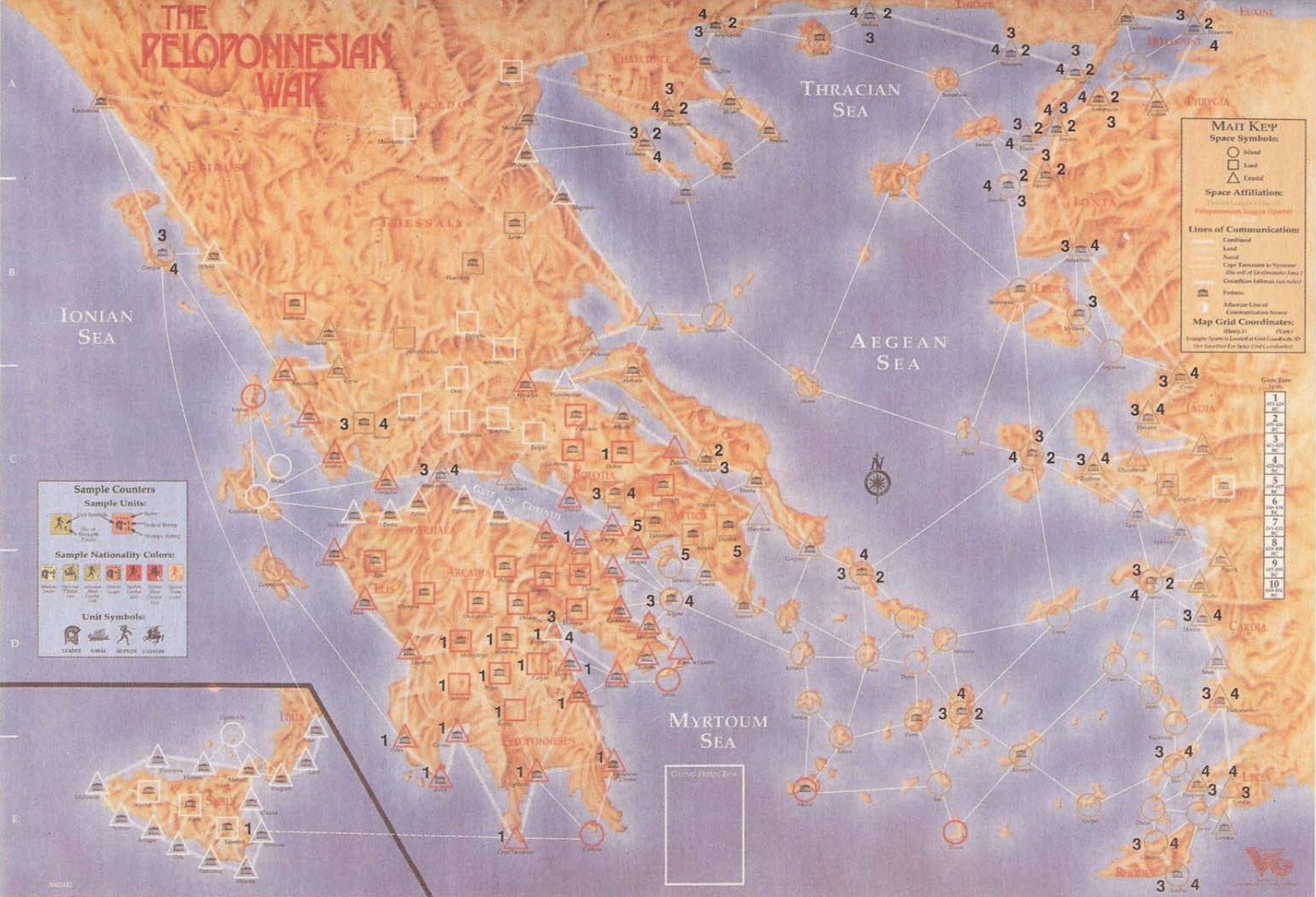
MAP A (Graphic Representation of Spartan Strategy Matrix):
KEY: 1: Defensive Strategy; 2: Cut LOC; 3: Cause Rebellion; 4: Attack Athenian Ally; 5: Attack Athens
Historically, neither side sent out on average more than one expedition per year. With the game turns representing three years, the game system launches from one to four operations per turn. The larger operations, such as the Spartan invasion of Attica, represent a series of expeditions to the same region over three years. The medium and small operations are representative of individual forays that are coordinated around a basic strategic theme.
Sparta
Sparta is a land power whose army is effectively neutralized by the Long Walls of Athens, which connect the city (through its port of Piraeus) to the sea. Traditional Greek siege operations that emphasize starvation over assault cannot work against Athens, because the Athenian navy protects the grain imports from the Crimea. Sparta finds it difficult to build a superior navy, because the Athenian empire has such vast economic strength, and shatters any Spartan navy that begins to form. This historical conundrum was solved by Athens losing over two hundred ships in its disastrous expedition against Syracuse followed by Sparta entering into an alliance with Persia (Random Event). The alliance with Persia gave Sparta a line of credit that enabled her to build and man a succession of fleets which supported a series of Delian League revolts that sapped the economic strength of Athens. These Spartan-commanded fleets lost a series of naval battles, which stretched out over the better part of the war’s last decade, but whose singular significant victory at Aegospotami led to victory.
Spartan strategy has four basic thrusts. One focus is to attack Athens directly. This represents the traditional objective of forcing a Hoplite battle on the opponent by holding his crops and agricultural infrastructure hostage. Against a normal city state this tried-and-true method allowed the Spartans to force amateur opponents into disadvantageous battles against their own professional army.
Athens, under the leadership of Pericles, broke with tradition and allowed its lands to be ravaged without a battle, thus neutralizing this Spartan strategy. There were economic implications for Athens, as the wealthier members of the community lost their agricultural enterprises and became less able to sponsor military activities such as building triremes for the state. In the game this is represented by denying the Eisphora revenue to Athens on turns when Attica is ravaged.
When the Spartans (as controlled by the game system) use this strategy (” Attack Athens”) they employ most of their available land forces and conduct only one operation over the game tum. This allows you to respond by employing a series of operations to gain a common objective. An example would be to capture the five Peloponnesian coastal spaces which spark a Helot rebellion, or to open a Line of Communication to Epidanos to offset the economic loss of a ravaged Attica.
Causing rebellion amongst Delian League members is another Spartan strategy. Historically, the Spartan king Archidamus, in his assessment of the coming war, speaks of this as a key to defeating Athens. In antiquity, political theory and practices were constantly evolving. Most city states had disaffected factions who disagreed with the current political structure or treaty relationships. These groups, if properly motivated, would allow enemy forces to compel a change in government and allegiance, with themselves as the chief benefactors.
Over the course of the war both sides utilized this tactic to gain surreptitious entry through a city’s defenses and capture it by coup de main. Of all the strategies available to the player this one is the most overlooked. Rebellions do not survive if you or the game system do not support them. Often an unsupported rebellion could be overawed by the presence of their former ally armed to the teeth and offering clemency, if the ringleaders were turned over for punishment. Early in the game, if the Spartans succeed in causing a rebellion in the Aegean or Asia Minor, it is difficult for the supporting military force to pass through the Saronic Gulf (Aegina space). The best response in this circumstance is to send one squadron containing a single naval SP (Strength Point) to an adjacent space and arrest the guilty without siege. The best opportunities for the Spartan side to support rebellions will be in Thrace and the Chalcidice, where overland access cannot be denied by the Athenian forces.
During the latter half of the war the Spartans attempted, and ultimately succeeded in, cutting off Athenian access to the Crimea – the “Cut LOC” (Line of Control) strategy. This strategy, initiated by Sparta and sustained by Persian gold, broke the economic back of Athens and won the war. The “Cut LOC” strategy objectives focus on the Eastern end of the map (See Table 1), and attempt to interrupt Athens’ communication with the Euxine. The forces sent are small in size and are meant to dilute Athenian responses. It was the ability of Spartan naval forces to maintain themselves in Asia Minor that allowed the Athenian empire to rebel en masse. These massive defections reduced the tribute that funded the Athenian navy and diminished her ability to maintain her lines of communication. In the game it is the combination of supporting rebellions and extensive ravaging that reduces Athenian revenue. Since the size of the forces sent by the Spartans are small, several tend to be sent out per game tum, with a reasonable likelihood that one arrives at its objective. Unfortunately for these historical rebellions, they were unaware of the fine print in the Spartan-Persian alliance, which ceded to the Persians all of the Greek city states in Asia Minor. C’est La Guerre.

Table 1: Strategy Matrix Area Probabilities (All values in table %)
The last Spartan strategy is to attack an Athenian ally. Its objectives have the same probabilities as the Cause Rebellion strategy, but the forces sent are of medium size, not small. Usually two such expeditions will be successfully sent out in a game turn. They attempt to capture Athenian spaces and project a ZOI (Zone of Influence) in that area to inhibit Athenian movement. This strategy does not hurt Athens directly unless the operation arrives in an area with numerous Athenian garrisons. In this circumstance, the Spartan force can destroy Athenian control over whole sections of the map in one combat phase.
If you maintain a sizeable naval force in Piraeus, the game system when playing Sparta is fairly controllable. The one critical Athenian vulnerability is Sparta’s ability to move over land into Thrace and subsequently by land to the Hellespont. It was Brasidas who employed this strategy, thus probably having found the weak link in the Athenian chain; his early death was a significant aid to Athens. It is when the game system attempts to fulfill Brasida’s strategy that you need to watch out. The other danger from Sparta is its ability to counterpunch with its defensive strategy. Ambitious land operations into the Peloponnesus can be crushed by a massive Spartan reaction. If Athens is confronted with naval parity, then the situation changes dramatically, as it did historically, should the game system move directly to the Eastern Aegean and Asia Minor to cut the Athenian Line of Communication. Since the player will usually not permit this type of situation to arise by choice, it usually occurs when the game system is playing Athens, followed by an inopportune change of sides. C’est La Vie.
Athens
Athens is a naval power whose forces diminish in capability as they project power inland. When thrust into its Athenian persona, the game system acts like its historic counterpart. The navy protects the critical Lines of Communication to the Euxine, which makes Athens impervious to siege. The Spartan army is best avoided unless the context of the battle gives the Athenian force superior size, or a skirmish escalates unavoidably into an Athenian disaster.
Naval power is exhaustive, not decisive in nature. The “exhaustive nature” of naval forces is represented by a coastal raiding strategy. Small Athenian forces ravage the Peloponnesian coastline as they move toward their objectives in Achaea/Arcadia, the Isthmus, and the Peloponnesus/Messenia.
Historically, Athens had two basic ways of defeating Sparta: The first was to defeat Sparta’s center of gravity, her army. Defeating Sparta’s army required Athens to develop its land forces and conquer Sparta directly. Athens had limited numbers of Hoplites, especially after the plague, but the potential for allying with Argos would have ameliorated some of the numerical disparity. It was this strategy that was favored by Alcibiades during the Peace of Nicias. In the game you, as Athens, can either outmaneuver the Spartan army with superior mobility (naval transport capability) in order to defeat it in detail, or attempt to win one decisive land battle.
The second is the Periclean strategy of exhaustion, which attempts to wear down Sparta’s economy and Will (Bellicosity), through coastal raids and emplacement of forward fortified positions. Pericles preferred this strategy, but the Athenian democracy had difficulty maintaining its patience and treasury. After Pericles’ death, the shifting political balance in Athens produced several erratic changes in strategic direction, which were most pronounced with the disastrous Sicilian expedition.
Athenian naval losses at Syracuse and Persian gold allowed Sparta to finally achieve naval parity. Over the last decade of the war, the superior Athenian steersmen still produced a string of naval victories, but the economic strength of Persia was too much for Athens. The destruction of the last Athenian fleet resulted in the Athenian Euxine LOC being cut, and the subsequent Spartan siege forced Athens to surrender. In the game, you will usually avoid losing the Athenian navy, but the game system may not. When playing Sparta, you must be prepared to exploit opportunities to sink the Athenian fleet if you desire to reproduce history.
Like Sparta, when the game system handles Athens it chooses from four basic strategies. The “Attack Spartan Ally” strategy emphasizes conquering components of the Peloponnesian League or expansion of the Athenian empire by conquering neutrals. The forces sent on these expeditions are medium sized combined forces (4N, 4H or 7H, 2C). Since the cost of this force is 1,800 or 2,400 talents there are usually no more than two operations sent per game tum. As can be seen on Table 1, the expeditions have equal probabilities for choosing an objective. This is consistent with the changing mood of the Athenian demagogues and their followers. This strategy option is the only one which can cause an operation against Thebes.
The “Cause Rebellion” strategy focuses on striking at Sparta’s greatest weakness; its slave population (Helot Rebellion). The most likely objectives are on the Peloponnesian coastline. It was from such locations as Pylos that Athenian forces offered havens for runaway Helots. The Spartans relied on the Helots to operate their economy and free the Spartan population for military service. The long-term loss of slave labor severely damaged the Spartans in a manner analogous to the effect that emancipation had on the Confederate economy during the American Civil War. The Athenians use small forces which, due to their lower cost, can result in three to four operations, limited more by the Auguries than their treasury. Once one of these Athenian forces captures a coastal fortress they are difficult to dislodge, because the Spartans are usually hard-pressed to produce two naval SP’s to win a siege; so forcing a “No Battle” with a small force is preferable. The Athenian matrix has a special emphasis (See Note on Matrix) concerning the Helot rebellion, which forces it to go after the fifth required location if the other four are already controlled.
When the “Cut LOC” strategy is employed, the Isthmus and Spartan holdings in the Peloponnesus are the focus. Athens employs medium sized forces which keeps the number of operations down to around three for the game tum. This strategy also tends to place an Athenian force in a coastal fortress, where they are even harder to dislodge due to the larger land and naval contingents.
Syracuse, the site of Athens’ greatest defeat, should be mentioned, given its importance to any Peloponnesian wargame design. In the two player version Syracuse is rarely attacked, since it has enough force to require a serious operation while the long-term benefits come only after Sicily is subjugated. The problem is that subjugating Sicily with ZOI’s is more trouble than the economic benefit is usually worth. In the solitaire version there is a sixteen percent probability in each of the strategies (except “Attack Sparta”) for Sicily to be chosen as an Area of operations. Within that area, Syracuse is a fifty percent probability, with the remainder accounting for other historical operations conducted by Athens in Sicily during the war. If the Athenian strategy is “Attack Spartan Ally”, the size of the force (4N, 4H) is usually large enough to defeat Syracuse, barring a Spartan relief operation. The other two strategies produce smaller forces, allowing for the historical disaster. One of the best responses is to send a leader to the Syracuse LOC via the Cape Taenarum and offset some of the Athenian advantage with Spartan leadership.
The “Attack Sparta” strategy can only occur if Athens has built up its land forces in Athens to maximum (14H), and this force can move north to absorb the 2H SP’s and the required cavalry contingent in Larisa. If Argos is in the war and its 4H SP’ s are available, the Athenian contingent of Hoplites can be smaller to make the required IS Hoplite SP force. However, in all cases, Larisa or Macedon (if an Athenian Ally) are needed to fulfill the 4C SP requirement, since Athens can never produce more than 2C SP’s during the game. When Athens produces this strategy, it will never conduct more than one operation that game tum, but it often passes for lack of resources. The large force requirement ensures that the game system will not commit suicide against the Spartan army. If the Athenian land forces get this large, the game system can go for the decisive win, so be careful when these conditions come into conjunction.
The game system plays fairly well as Athens when it is moving its naval forces around the Peloponnesus and ravaging your territory. Often you will find it hard to score points with Sparta since there aren’t many Athenian locations that are vulnerable to Spartan land power except Thessaly and Thrace. Unless there are Spartan locations that can be recaptured, you can often play Sparta for several turns in a row, since you are limited in your opportunities to score victories and to consequently drive the SCI into a large die modifier for switching sides.

No comments:
Post a Comment