Saturday, February 29, 2020

Friday, February 28, 2020
Thursday, February 27, 2020
Byron at Chillon

Au milieu de tous les noms obscurs qui égratignent et encombrent la pierre, il reluit seul en trait de feu. J’ai plus pensé à Byron qu’au prisonnier. [In the midst of all the obscure names which scar and clutter the stone, his alone glows with fire. I thought more of Byron than of the imprisoned.] Gustave Flaubert (1845)
As enthusiastic readers of Jean Jacques Rousseau’s Julie, ou La Nouvelle Hélöise (1761), Lord Byron and Percy Bysshe Shelley sailed around Lake Geneva from 22 to 30 June 1816, visiting settings made famous by the novel, including Chillon Castle at the eastern end of Lake Geneva (or Leman), on Tuesday, June 25, 1816. This first visit inspired Byron’s poem The Prisoner of Chillon, composed in Ouchy two days later on the subject of François Bonnivard (1493-1570), a famous political prisoner held there by the Duke of Savoy between 1530 and 1536. Byron returned to Chillon with his friend John Cam Hobhouse on 18 September 2016, on the first day of their Alpine tour. Louis Simond, who visited Chillon a full year after Byron, on 4 August 1817, was the first to record the presence of Byron’s autograph in the castle’s souterrain, or dungeon, carved into the southern side of the third column, 1.45 meters from the lower edge of the shaft.
The authenticity of this autograph has been a matter of controversy and criticism almost from the very beginning.
None of the members of the Byron-Shelley circle, and no traveller who visited the castle before Simond, mentions it. It was only on returning to Chillon in August 1828, that Hobhouse noted, with telling amusement, that ‘the woman who showed Chillon pointed out to us “Monsieur Lord Byron’s” name’. Furthermore, the lettering of Byron’s autograph at the Temple of Poseidon in Suniun, Greece, supposedly carved by the poet in 1810, looks nothing like the Chillon autograph, strongly suggesting that either one, or both of these signatures are fakes.
The Romantic pilgrims who flocked to Chillon to see Byron’s signature regularly debated its authenticity. One tourist, for example, Austin Henry Layard, remarks in his 1835 journal that it was doubtful that the poet could have signed his name. Others, inspired by the age’s Byronmania, preferred believing that it was real and sometimes even embroidered the myth surrounding it. The notoriously unreliable Alexandre Dumas, for instance, claimed that Byron engraved his name on the column alone, and at night. In 1842, Victor Hugo added that Byron did this using an old ivory-handled awl (‘un vieux poinçon à manche d’ivoire’) found in the very chamber of the Duke of Savoy. John Ruskin in 1833, and Nikolai Gogol in 1836 carved their names on the same pillar, presumably in homage and emulation. Dorothy Wordsworth, Maria Edgeworth, Charles Dickens, Matthew Arnold, Harriet Beecher Stowe, Nathaniel Hawthorne, Mark Twain, and William Dean Howells are only a few of the nineteenth-century literary personalities who remarked on the inscription in their journals, letters and travel-writings.
So far, literary historians have been unable to definitively prove or disprove the autograph’s authenticity. Most agree with Ernest Giddey, who has argued that Byron’s established celebrity coupled with the immediate popularity of The Prisoner of Chillon, published in late 1816, would have led the castle’s gaolers or guides to inscribe the author’s name in order to boost the site’s appeal. More recently, however, David Ellis has cited the fact that, according to John Cam Hobhouse, on the same day in 1816 Byron also wrote his name in the neighbouring Castle of Châtelard and, a week later, on a scrap of paper at the top of the Lauberhorn in the Bernese Alps, strong indications that the Chillon autograph is the real thing. What is certain is that the inscription, along with Byron’s poem, helped transform Chillon from a setting branded to Rousseau to a place branded to Byron, and so into one of European Romanticism’s most sacred places from 1816 onwards, in turn making it Switzerland’s most visited monument.
The Prisoner of Chillon
My hair is grey, but not with years,
Nor grew it white
In a single night,
As men's have grown from sudden fears:
My limbs are bow'd, though not with toil,
But rusted with a vile repose,
For they have been a dungeon's spoil,
And mine has been the fate of those
To whom the goodly earth and air
Are bann'd, and barr'd—forbidden fare;
But this was for my father's faith
I suffer'd chains and courted death;
That father perish'd at the stake
For tenets he would not forsake;
And for the same his lineal race
In darkness found a dwelling place;
We were seven—who now are one,
Six in youth, and one in age,
Finish'd as they had begun,
Proud of Persecution's rage;
One in fire, and two in field,
Their belief with blood have seal'd,
Dying as their father died,
For the God their foes denied;—
Three were in a dungeon cast,
Of whom this wreck is left the last.
Wednesday, February 26, 2020
Tuesday, February 25, 2020
Monday, February 24, 2020
Sunday, February 23, 2020
Questions From a Worker Who Reads
Who built Thebes of the 7 gates ?
In the books you will read the names of kings.
Did the kings haul up the lumps of rock ?
And Babylon, many times demolished,
Who raised it up so many times ?
In what houses of gold glittering Lima did its builders live ?
Where, the evening that the Great Wall of China was finished, did the masons go?
Great Rome is full of triumphal arches.
Who erected them ?
Over whom did the Caesars triumph ?
Had Byzantium, much praised in song, only palaces for its inhabitants ?
Even in fabled Atlantis, the night that the ocean engulfed it,
The drowning still cried out for their slaves.
The young Alexander conquered India.
Was he alone ?
Caesar defeated the Gauls.
Did he not even have a cook with him ?
Philip of Spain wept when his armada went down.
Was he the only one to weep ?
Frederick the 2nd won the 7 Years War.
Who else won it ?
Every page a victory.
Who cooked the feast for the victors ?
Every 10 years a great man.
Who paid the bill ?
So many reports.
So many questions.
Saturday, February 22, 2020
Friday, February 21, 2020


Thursday, February 20, 2020
The Four Modernisations
 |
Study hard and prepare to devote your efforts to socialist modernisation |
 |
| Science is a productive force |

 |
Study, study, and study again |
Wednesday, February 19, 2020
Utopian thinking in the ether: an interview with Boris Frankel
https://overland.org.au/2019/12/utopian-thinking-in-the-ether-an-interview-with-boris-frankel/
Is utopian thinking akin to casting a net into the ether – collecting the unimaginable and dragging it into the realm of the possible? Or, by neglecting to consider any parameters of the possible, is it a fanciful distraction from meaningful politics? Well, perhaps it depends on the type of utopian thinking. In Fictions of Sustainability: The Politics of Growth and Post-Capitalist Futures, social theorist Boris Frankel takes aim at certain types of utopian thinking: proposals that he argues are unrealisable or unsustainable regardless of whether political obstacles have been removed or transformed. Throughout the book, which was released earlier this year, Professor Frankel seeks to ask the difficult questions surrounding concepts such as green growth, degrowth and post-scarcity, not with the aim of opposing radical solutions, but to facilitate the development of more plausible and effective policies. Political-economic dilettante Zacharias Szumer met with Frankel recently to try to get his head around this somewhat heavy going but important book.
ZS: In the conclusion of Fictions of Sustainability, you write that one of your aims in writing the book was to “bridge the political and theoretical chasm or ‘analytical apartheid’ that characterizes so much socio-economic policy on the one side and environmental analyses on the other.” What do you mean by analytical apartheid? And how did you attempt to bridge this chasm?
BF: In the past, conservatives, liberal Keynesians, Marxists and anarchists were divided over how to analyse capitalism and debated its virtues and failings. Today, it is not enough to have a knowledge of political economy, whatever the political perspective, if it excludes crucial environmental issues. On the other hand, you’ve got many people who are active and concerned about environmental issues, but who neglect political economy. The ‘analytical apartheid’ I refer to is that environmental issues cannot be separated from political economy yet, political economists and environmentalists talk past one another and rarely consider one another’s issues and positions. Despite environmental crises being highlighted for over fifty years, traditional political economists and many on the left still treat environmental issues as marginal to the main issue of capital versus labour. This is now changing. But you’ll still find many leading political economists are completely silent on environmental issues. It’s important to bridge these two worlds. Similarly, many committed environmentalists have a detailed understanding of the damage being done to so many ecological habitats and the need to transform existing consumption and production. But apart from generalised ‘wish lists’ have a very limited understanding of how existing political institutions and the economy of capitalism works. So, in order to achieve their environmental goals, it’s critical that they become more familiar with the political economic debates that have been developed by non-environmentalists.
ZS: You refer to popular leftist thinkers such as Paul Mason and Inventing the Future authors Nick Srnicek and Alex Williams as “technological Prometheans” in your book. Could you explain your critique of those theorists?
BF: I call these people technological Prometheans because they believe that all that you need is to take the most advanced technologies that capitalism has developed, change the ownership of capitalism and utilise them in a different way in a socialist society.
There are some fantastic schemes put forward by a whole range of left theorists about how we’re going to have fully automated luxury communism. However, in most of those scenarios what people focus on is mainly ‘software’ rather than on ‘hardware’. Certainly, you can bring about a whole range of new innovative software-driven technologies, but mobile phones, iPads and 3D printers are all hardware. And who makes the hardware? Low-paid workers in low- and middle-income countries getting infinitely less per day and per week, than what workers in Australia or other equivalent countries are getting. So, if you don’t consider how the hardware is made plus the environmental resources used in production or the enormous problem of mountains of E-waste, then your software is not going to get you too far. Most of the examples that people like Paul Mason and others use are in communications, for example, CDs, publications, etc which can be made at almost zero marginal cost and reprinted or distributed free via the internet. But freeing intellectual property from the Googles and Apples of this world is quite different to ‘free’ hardware of everyday life. In order for people to live, they need access to tangible items, not just software. People forget that 3D printers use toxic chemicals to reproduce material things. And what about food? In places such as Australia, America, Europe and Japan, transforming the food production, distribution and food consumption system is a massive political task. People can point to alternative eco-agriculture or organic food or reduced meat consumption; all of these things are fine in theory or limited practice. But implementing these necessary alternatives requires major changes that will be bitterly resisted in capitalist countries. Currently, the production of food on the land in advanced capitalist countries is capital intensive. Only about 2 percent of the workforce now work and produce food in our countries. Agro-ecology and organic food is much more labour intensive. You would have to shift the population from the cities to the food areas (which have poor basic services) or transform cities into food baskets which affects property prices. Transforming monopolies such as Coles, Safeway, ALDI, or the corporations running the transport system is a major political struggle. How do you change the cost of food and still keep workers and low-income people onside if their wages and pensions aren’t increased and would result in riots as we’ve seen in a number of countries? All of these issues are neglected by the ‘technological Prometheans’. Utopian dreaming that ignores environmental and political limits is self-defeating as creating post-capitalist societies requires a combination of imagination and practical on-the-ground answers.
Regarding the proposal for a Universal Basic Income (UBI), which has been flavour of the month across the world, I used to support a guaranteed adequate income about 30 years ago, but I changed my mind in recent years because I regard a UBI as politically and economically unattainable and divisive. You could certainly implement a UBI that paid a pittance, but this wouldn’t be enough to live on. Srnicek and Williams and other advocates are proposing a UBI that would free workers from wage labour and accelerate the process of capitalist disintegration. In other words, they are not looking at what is feasible at the moment, but how to use the UBI as a political strategy to bring about the end of capitalism. My argument is that this is putting the political cart before the horse. They are not considering how you would actually implement a UBI, which segments of the working class would actually be supportive of a UBI given, and this is what they ignore, that the bulk of direct and indirect taxation in capitalist countries is paid for by the working class.
Normally the calculations made about a basic income are based on adding up all the type of taxes avoided or increasing them so that you can cover the cost of a UBI. But once you start to add all of these up and close all the tax havens or levy taxes on robots that replace workers, the total does not add up to an adequate UBI and is either a one-off that dries up in subsequent years or creates a Depression if companies flee rather than pay higher taxes. Supporters of UBI say, ‘well, that’s a beginning.’ This is what we were told a century ago when they introduced old age pensions and said welfare will expand into a larger system. Well, it did expand a bit, but it never reached a full welfare state anywhere in the world. Even the so-called comprehensive welfare states in France, Sweden and Denmark have people begging on the streets.
If a UBI does not cut all the other aspects of welfare support such as pensions, housing, rent subsidies, health, childcare or whatever, as the right-wing versions of a UBI propose, then this would double or triple the welfare bill. Any UBI that equalled aged pensions would be much higher than most UBI proposals and if you’re not going to cut other welfare subsidies then you’re talking about a massive shift in the political economy of capitalism. Now, that’s fine by me if you can achieve it, but if you’re not counting on revolution, you’ve got to be able to deliver this through the electoral system. No party is going to go to the election on a platform of a UBI (apart from the Greens), which involves large tax increases for wage workers or a massive tax increase on businesses which already oppose and want to cut the inadequate welfare system.
My objection to the UBI is not an objection to what it could hopefully achieve such as freeing up time for people to have more fulfilling lives, for sole parents, women especially, to be able to look after their children or for people on welfare entitlements to avoid the type of absolute hounding by bureaucratic Centrelink and other social security departments around the world. These are all incredibly important objectives, but they cannot be achieved under proposed UBI frameworks. So, I’d like to see, a) how the UBI is funded, b) whether they’ve considered the political divisions it will certainly cause and c) at what level, if it were implemented, would it not result in major economic dislocation. Remember, once there is major economic dislocation, you don’t have the funds to pay a UBI, because it must come out of general tax revenue. If the economy has gone into a depression, how are you going to fund it?
Tuesday, February 18, 2020
Winternag
Marais wrote the single most famous poem in the Afrikaans language, "Winternag", published in 1904. Here it is in the original Afrikaans.


Monday, February 17, 2020
Sunday, February 16, 2020
Charles V
Yuste - the retirement of Emperor Charles V
Set in the woods near the village of Cuacos de Yuste, in Extremadura, Spain, is the monastery of Yuste. It was here that Emperor Charles V, Europe’s most powerful man for nearly forty years in the 16th century, lived from February 1557 until his death in September 1558. He had abdicated as Duke of Burgundy, King of Spain and Holy Roman Emperor during 1555 and 1556, while in Brussels, and he travelled with his sisters Eleanor and Mary to Spain, in the autumn of 1556. As soon as his accommodation was ready in February the following year he moved in.
His two-story villa, built on the south side of the monastic church, consisted of four rooms on each floor. A ramp provided him with easy access to the upper floor where he usually lived. This led to a shady terrace from where he could enjoy a view of the gardens and pools. Inside, the square rooms opened off a central corridor. From the Audience Room a door led to his personal study. Opposite that was his bedroom, which had a specially constructed opening to enable Charles to look down on the altar in the church. Above the altar was hung Titian’s ‘La Gloria’ (sometimes known as 'The Trinity' or 'The Final Judgement' or 'Paradise'), commissioned by Charles in 1550 and completed in 1554. In it Charles is portrayed with his family at prayer, dressed in shrouds, with his crown at his feet, representing his withdrawal from earthly power.
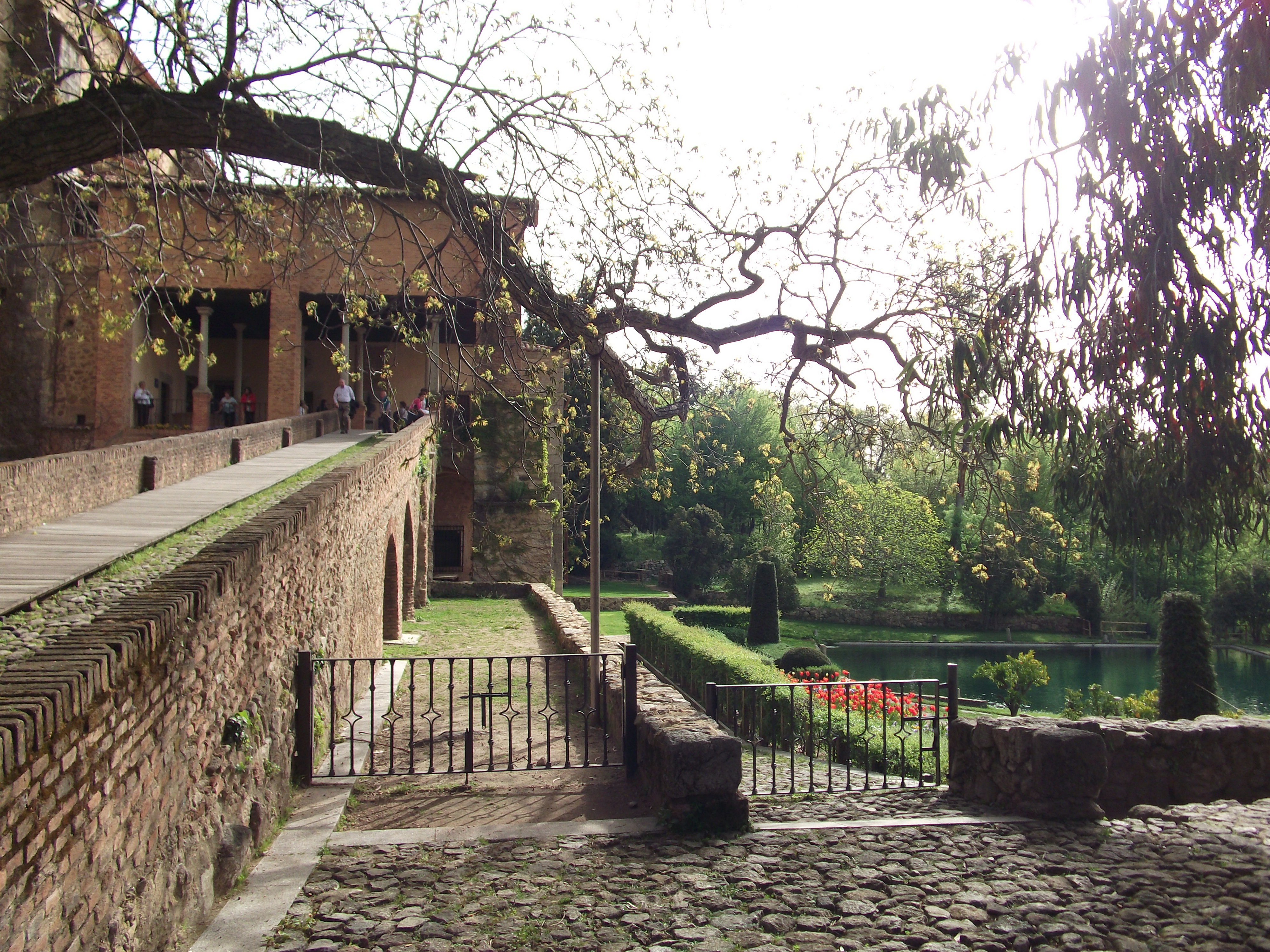
The ramp to the first floor of Charles' villa at Yuste.
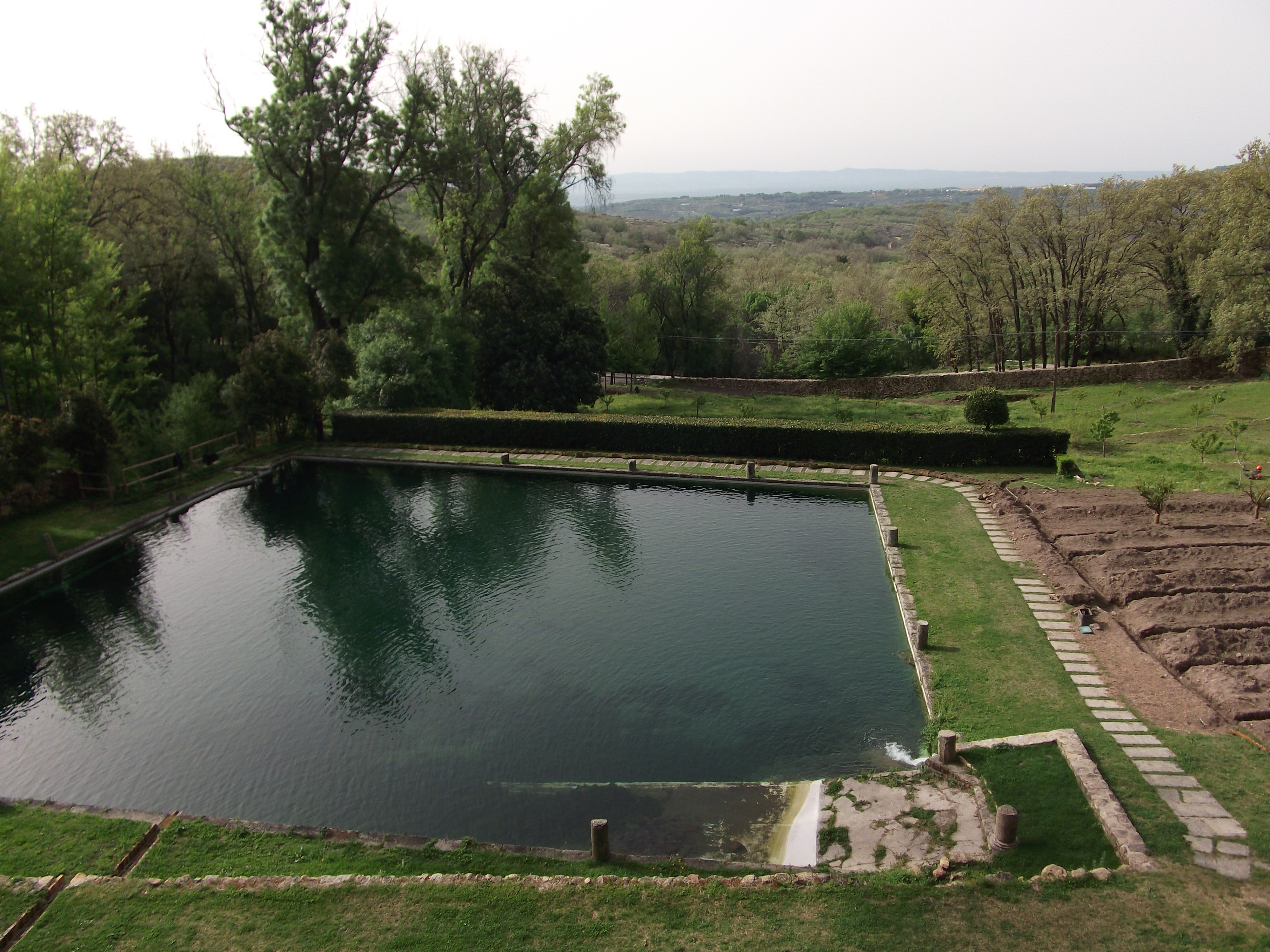
The view from the terrace at Yuste.
Although he wished for a quieter life he was not completely out of touch with the world that he had once dominated. His sisters, Eleanor and Mary, lived in nearby Jarandilla. Charles asked that his natural son, Jeromin (later known as Don John of Austria) be brought to the village of Cuacos and introduced to him. Other visitors came with news and provided the chance to talk about old times. He communicated regularly with his son Philip and received news and requests for advice brought by couriers from the Low Countries. He was always ready to give voice to his concerns when he heard of instances of Lutheranism in his former lands.
Charles developed a daily routine, adjusted in accordance with the season and his health. Breakfast, prayers with his confessor, time spent with his clocks and, after dressing, mass in the church, would take up his mornings. This would be followed by dinner at midday. He always enjoyed his food. Many of his remaining staff were cooks and regular deliveries enabled them to produce roasted wild boar and venison, black hares marinated in wine, bay leaves and onions, and all kinds of fish. After dinner he would frequently read from his small library - mainly theology, history, philosophy and astronomy - before a siesta. Later in the afternoon he fished in the ponds, visited his aviary, talked to visitors, or discussed theological and philosophical points from sermons or bible readings, sitting on his first floor veranda or in the garden with its terraces and ornamental flower beds, which he continued to re-design. He would usually take a light meal before he retired for the night.
It was in his bed, looking through to the church altar, at about 2-30 a.m. on 21st September 1558, that Charles died, surrounded by monks, his confessor and the Archbishop of Toledo.
Saturday, February 15, 2020
Talking Heads by Alan Bennett
Alan Bennett's much-loved collection of monologues, giving us a glimpse in to the lives of six ordinary British people.
1 - Talking about Talking Heads
2 - A Chip in the Sugar read by Alan Bennett
Life for Graham and his elderly mother has settled into a comfortable pattern when a face from the past appears to threaten his peace of mind.
3 - A Lady of Letters read by Patricia Routledge
Irene thinks 'corresponding' is every citizen's right in a free society, but she gets her first taste of real freedom in the most unlikely place.
4 - Bed Among the Lentils read by Anna Massey
Susan doesn't feel she has any of the talents needed to be a vicar's wife and finds herself seeking comfort elsewhere.
5 - Her Big Chance read by Julie Walters
Lesley is an actress who works hard at her craft but needs a career leg-up. Will a chance encounter at a party provide just that?
6 - Soldiering On read by Stephanie Cole
Muriel is determined not to let her recent widowhood get her down, but the fallout is far more serious than she could ever have expected.
7 - A Cream Cracker Under the Settee read by Thora Hird
Doris has fallen off the buffet and, while sitting in the dark waiting for help, she looks back on a life dedicated to fighting dirt.
Friday, February 14, 2020
Thursday, February 13, 2020
Wednesday, February 12, 2020
Tuesday, February 11, 2020
Monday, February 10, 2020
Sunday, February 9, 2020
The Ten Foot Square Hut 方丈記
Introduction
Kamo no Chomei (1153-1216) was born into a family of Shinto priests in Kyoto, Japan, and began his career as a poet at the imperial court. Later, the retired Emperor appointed Chomei (or Komei) to the Poetry Bureau, made up of Japan’s leading poets. There Chomei published an essay on poetic technique. He later gave up Shintoism and became a Buddhist monk, spending much of his time as a hermit living in a small, isolated hut. Chomei wrote the essay An Account of My Hut (Hojoki), in which he describes the advantages of a life of isolation and tranquility compared to the turbulence, hazards and upheavals of city life.
The essay, recognized as a masterpiece in the Japanese essay tradition, is believed to be autobiographical. In it, Chomei explains that he enjoyed the pleasures of writing and music in his hut, two activities that are more often associated with participation in society rather than a life of solitude. He also writes of the pleasures of enjoying the phenomena of nature, reading Buddhist texts, and engaging in simple forms of companionship. Chomei’s elegantly written and structured text offers a powerful argument in the humanistic tradition that sees virtue in the simple, rural life. Extracts from his essay follow.
1 Transitory Man and His Dwellings
Ceaselessly the river flows, and yet the water is never the same, while in the still pools the shifting foam gathers and is gone, never staying for a moment. Even so is man and his habitation.
In the stately ways of our shining capital the dwellings of high and low raise their roofs in rivalry as in the beginning, but few indeed there are that have stood for many generations. This year falling into decay and the next built up again, how often does the mansion of one age turn into the cottages of the next. And so, too, are they who live in them. The streets of the city are thronged as of old, but of the many people we meet there how very few are those that we knew in our youth. Dead in the morning and born at night, so man goes on forever, unenduring as the foam on the water.
And this man that is born and dies, who knows whence he came and whither he goes? And who knows also why with so much labor he builds his house, who knows which will survive the other? The dew may fall and the flower remain, but only to wither in the morning sun, or the dew may stay on the withered flower, but it will not see another evening.
During the forty years or so that I have lived since I began to understand the meaning of things I have seen not a few strange happenings.
2 Gale and Fire Storm
In the third year of the era Angen [1175 CE], and the twenty-eighth day of the fourth month I think it was, the wind blew a gale, and at the hour of the Dog (8 p.m.) a fire started in the south-east of the Capital and was blown across to the north-west. And everything as far as the Shujaku Gate, the Daikyoku Hall and the Office of Internal Affairs was reduced to ashes in a single night. They say it started at Higuchi Tominokoji in a temporary structure used as a hospital. Now as the flames came on they spread out like an opened fan, and the remoter houses were smothered in smoke while those nearer roared up in flames. The sky was dark with ashes and against this black background the fire glowed red like early dawn, while everywhere the flames driven by the wind went leaping on over a space more than a hundred yards wide. And of those caught by it some fell choked in the smoke, while others were overtaken by the flames and perished suddenly. And those few who managed with difficulty to escape were quite unable to take their goods with them, and how many precious treasures were thus lost none can tell.
Of the palaces of the great nobles sixteen were entirely destroyed, and of the houses of lesser people the number is unknown. One third of the city was burnt and many thousands must have perished, and cattle and horses beyond reckoning. The handiwork of man is a vain thing enough in any place, but to spend money and time on building houses in such a dangerous spot as the capital is foolish indeed beyond measure.
3 Political Upheaval
And in the Waterless Month (sixth) [of the fourth year of the era Jisho] . . . suddenly and without warning the capital was moved. And this was a most extraordinary thing, for they say that the capital was first fixed here in the August Age of the Mikado Saga, and so it has remained for all these centuries. And thus to change it without any good reason was a very great mistake, and it was no wonder that the people should complain and lament. Still that was, of course, quite unavailing, and all the inhabitants, beginning with His August Majesty the Mikado, and the ministers and great nobles of the court, had perforce to remove to the new capital at Naniwa in Settsu.
And of those who wished to get on in the world who would stay in the former capital? All who coveted court rank, or were the expectant clients of some great lord, bustled about to get away as soon as possible. It was only a few inflexible people who had nothing to hope for, who stayed behind in the ancient capital.
And those mansions that stood so proudly side by side from day to day became more ruinous. Many were broken up and floated down the river Yodo, while their pleasure grounds were turned into ricefields. And the fashions changed also in these days, so that every one came to ride on horseback, while the more dignified ox-car was quite forsaken. And everybody was scrambling to get land by the Western Sea and none cared for manors in the north and east.
Now it happened at this time that I chanced to go down myself to the new capital in the province of Settsu. And when I came to look at it the site was cramped and too narrow to lay out the Avenues properly. And the mountains towered over it to the north while the sea hemmed it in on the south and the noise of the waves and the scent of the brine were indeed too much to be borne.
The Palace was right up against the hills, a "Log-hut Palace" built of round timbers. It all seemed so very strange and rough, and yet somehow not a little elegant. And as for all those houses that had been broken up and brought down, so that the river was almost dammed up by them, I wondered wherever they were going to put them, for still there was so much empty ground, and very few dwellings had been built. So the old capital was already a waste and the new one not yet made. Every one felt as unsettled as drifting clouds. And the natives of the place were full of complaints over losing their land, while the new inhabitants grumbled at the difficulty of building on such a site. And of the people one met in the streets those who ought to have been riding in carriages were on horseback and those who usually wore court costume were in military overcoats. The whole atmosphere of the capital was altered and they looked like a lot of country samurai. And those who said that these changes were a portent of some civil disturbance seemed to be not without reason, for as time went on things became more and more unquiet and there was a feeling of unrest everywhere.
But the murmurings of the people proved of some effect, for in the following winter they were ordered back to the ancient capital But all the same the houses that had been destroyed and removed could not at once be restored to their former condition.
4 Death from Famine
And if this were not enough, in the era Yowa [1181 CE] I think it was, but so many years have elapsed that I am not certain, there were two years of famine, and a terrible time indeed it was. The spring and summer were scorching hot, and autumn and winter brought typhoons and floods, and as one bad season followed another the five cereals could not ripen. Spring plowing was in vain, and the summer sowing was but labor lost. Neither did you hear the joyous clamor of the harvest and the laying up of stores in autumn and winter.
Some deserted their land and went to other provinces, and others left their houses and dwelt in the hills. Then all sorts of prayers were said and special services recited, but things grew no better. And since for everything the people of the capital had to depend on the country around it, when no farmers came in with food how could they continue their usual existence? Though householders brought out their goods into the street and besought people to buy, like beggars with no sense of shame, yet no one would even look at them, and if there should be any ready to barter they held money cheap enough, but could hardly be brought to part with grain. Beggars filled the streets and their clamor was deafening to the ears.
So the first year passed and it was difficult enough to live, but when we looked for some improvement during the next it was even worse, for a pestilence followed, and the prayers of the people were of no effect. As the days passed they felt like fish when the water dries up, and respectable citizens who ordinarily wore hats and shoes now went barefooted begging from house to house. And while you looked in wonder at such a sight they would suddenly fall down and die in the road. And by the walls and in the highways you could see everywhere the bodies of those who had died of starvation. And as there was none to take them away, a terrible stench filled the streets, and people went by with their eyes averted. The ordinary roads were bad enough, but in the slums by the river-bed there was not even room for carts and horses to pass.
As for the poor laborers and woodcutters and such like, when they could cut no more firewood and there was none to help them, they broke up their own cottages and took the pieces into the city to sell. And what one man could carry was hardly enough to provide him with food for one day.
And it was a shocking thing to see among these scraps of firewood fragments with red lacquer and gold and silver foil still sticking to them. And this because those who could get nothing else broke into the mountain temples and stole the images and utensils and broke them up for kindling. It must be a wretched and degenerate age when such things are done.
Another very sad thing was that those who had children who were very dear to them almost invariably died before them, because they denied themselves to give their sons and daughters what they needed. And so these children would always survive their parents. And there were babies who continued to feed at their mother's breast, not knowing she was already dead. . .
And the number that they counted within the city, in the space of four or five months, between the First and Ninth Avenues on the north and south and between Kyogoku and Shujaku on the east and west, was at least forty-two thousand three hundred. And when there is added to this those who perished before and after this period, and also those in the River-bed and Shirakawa and Western City quarters, they must have been almost beyond count. And then there were all the other provinces of the Empire. It is said that not long ago in the August Age of the Mikado Sutoku-in in the era Chosho [1132 CE] there was such a visitation. But of that I know nothing. What I have seen with my own eyes was strange and terrible enough.
5 Destruction by Earthquake
Then in the second year of the era Gen-ryaku [1184] there was a great earthquake. And this was no ordinary one. The hills crumbled down and filled the rivers, and the sea surged up and overwhelmed the land. The earth split asunder and water gushed out. The rocks broke off and rolled down into the valleys, while boats at sea staggered in the swell and horses on land could find no sure foothold. What wonder that in the capital, of all the temples, monasteries, pagodas and mausoleums, there should not be one that remained undamaged. Some crumbled to pieces and some were thrown down, while the dust rose in clouds like smoke around them, and the sound of the falling buildings was like thunder. Those who were in them were crushed at once, while those who ran out did so to find the ground yawning before them. If one has no wings he cannot fly . . . For one terror following on another there is nothing equal to an earthquake.
Among those who suffered was the child of a warrior some six or seven years old. He had made a little hut under the eaves of the earthen wall and was playing there when the whole wall fell and buried him. And it was very sad to see how his parents cried aloud in their grief as they picked him up all battered and with his eyes protruding from his head. Even a stern samurai at such a time thought it no shame to show signs of his deep feelings. And indeed I think it quite natural.
The worst shocks soon ceased, but the after tremors continued for some time. Every day there were some twenty or thirty that were beyond the ordinary. After the tenth and twentieth day they gradually came at longer intervals, four or five, and then two or three in a day. Then there would be a day and then several without any shock at all, but still these after shocks lasted, it may be three months. . .
On these occasions it is the way of people to be convinced of the impermanence of all earthly things, and to talk of the evil of attachment to them, and of the impurity of their hearts, but when the months go by and then the years, we do not find them making mention of such views any more.
6 The Move Towards Tranquility
I inherited the estate of my great-grandmother on the father's side, and there I lived for a while. But then I left home and came down in the world, and as there were very many reasons why I wished to live unnoticed, I could not remain where I was, so I built a cottage just suited to my wants. It was only a tenth of the size of my former home and contained only a living-room for myself, for I could not build a proper house. It had rough plastered walls and no gate, and the pillars were of bamboo, so it was really nothing more than a cart shed. And as it was not far from the river bed there was some peril from floods as well as anxiety about thieves.
I went on living in this unsympathetic world amid many difficulties for thirty years, and the various rebuffs that I met left me with a poor opinion of this fleeting life. So when I arrived at the age of fifty I abandoned the world and retired. Since I had no wife or child it was by no means difficult to leave it, neither had I any rank or revenue to be a tie to hold me. And so it is that I have come to spend I know not how many useless years hidden in the mists of Mount Ohara. I am now sixty years old, and this hut in which I shall spend the last remaining years of my dew-like existence is like the shelter that some hunter might build for a night's lodging in the hills, or like the cocoon some old silkworm might spin.
7 The Ten Foot Hut
If I compare it to the cottage of my middle years it is not a hundredth of the size. Thus as old age draws on my hut has grown smaller and smaller. It is a cottage of quite a peculiar kind, for it is only ten feet square and less than seven feet high, and as I did not decide to fix it in any definite place I did not choose the site by divination as usual. The walls are of rough plastered earth and the roof is of thatch. All the joints are hinged with metal so that if the situation no longer pleases me I can easily take it down and transport it elsewhere. And this can be done with very little labor, for the whole will only fill two cart-loads, and beyond the small wage of the carters nothing else is needed.
Now hidden deep in the fastnesses of Mount Hino, I have put up eaves projecting on the south side to keep off the sun and a small bamboo veranda beneath them. On the west is the shelf for the offerings of water and flowers to Buddha, and in the middle, against the western wall is a picture of Amida Buddha so arranged that the setting sun shines from between his brows as though he were emitting his ray of light, while on the doors of his shrine are painted pictures of Fugen and Fudo. Over the sliding doors on the north side is a little shelf on which stand three or four black leather cases containing some volumes of Japanese poems and music and a book of selections from the Buddhist Sutras. Beside these stand a harp and a lute, of the kind called folding harp and jointed lute. On the eastern side is a bundle of fern fronds and a mat of straw on which I sleep at night. In the eastern wall there is a window before which stands my writing-table. A fire-box beside my pillow in which I can make a fire of broken brushwood completes the furniture. To the north of my little hut I have made a tiny garden surrounded by a thin low brushwood fence so that I can grow various kinds of medicinal herbs. Such is the style of my unsubstantial cottage.
8 Contemplation of Scenery
As to my surroundings, on the south there is a little basin that I have made of piled-up rocks to receive the water that runs down from a bamboo spout above it, and as the forest trees reach close up to the eaves it is easy enough to get fuel.
The place is called Toyama. It is almost hidden in a tangled growth of evergreens. But though the valley is much overgrown it is open toward the west, so that I can contemplate the scenery and meditate on the enlightenment that comes from the paradise in that quarter. In the spring I behold the clusters of wisteria shining like the purple clouds on which Amida Buddha comes to welcome his elect. In the summer I hear the cuckoo, and his note reminds me that he will soon guide me over the Hills of Death of which they call him the Warden. In autumn I hear everywhere the shrilling of the evening cicada and inquire of him if he is bewailing the vanity of this fleeting life, empty as his own dried up husk, while in winter the snow as it piles up and melts seems like an allegory of our evil Karma.
If I get tired of repeating the Invocation to Buddha or feel disinclined to read the Sutras, and go to sleep or sit idly, there is none to rebuke me, no companion to make me feel ashamed. I may not have made any special vow of silence, but as I am all alone I am little likely to offend with the tongue, and even without intending to keep the Buddhist Commandments, separated from society it is not easy to break them.
9 Poetry and Music
In the morning, as I look out at the boats on the Uji River by Okanoya I may steal a phrase from the monk Mansei and compare this fleeting life to the white foam in their wake, and association may lead me to try a few verses myself in his style. Or in the evening, as I listen to the rustling of the maples in the wind, the opening lines of the Lute Maiden by the great Chinese poet Po-chu-i naturally occur to my mind, and my hand strays to the instrument and I play perhaps a piece or two in the style of Minamoto Tsunenobu. And if I am in the mood for music I may play the piece called Autumn Wind to the accompaniment of the creaking of the pine trees outside, or that entitled Flowing Waters in harmony with the purling of the stream. I have little skill in verse or music, but then I only play and compose for my own amusement and not for the ears of other people.
10 Enjoying Simple Company
At the foot of the hill there is a little cottage of brushwood where lives the keeper of these hills. And he has a boy who sometimes comes to bear me company, and when time is heavy on my hands we go for a walk. He is sixteen and I am sixty and though the difference in age is so great, we find plenty of amusement in each other's society.
Sometimes we gather the Lalong grass or the rock-pear or help ourselves to wild potatoes or parsley, or we may go as far as the rice-fields at the foot of our hills and glean a few ears to make an offering to the deities. If the day is fine we may climb up some high peak and look out over the Capital in the distance and enjoy the views of Mt. Kobata, Fushimi, Toba or Hatsukashi. Fine scenery has no landlord, so there is nothing to hinder our pleasure. . .
Then on our way back, according to the season, there will be the cherry-blossoms to pluck and the maple or the bracken or some sort of berries to gather. And of these some we can offer to the Buddha and some we can eat ourselves.
11 Unwearying Beauty
In the quiet evenings I look out of my window at the moon and think over the friends of other days, and the mournful cry of the monkey often makes me moisten my sleeve with tears. I might imagine the cloud of fire-flies to be the fishing-fires at Makinoshima, or the rain at dawn to be the patter of the leaves driven by the wind. When I hear the hollow cry of the pheasant that might be mistaken for a father or mother hallooing to their children, as Gyogi Bosatsu's verse has it. When I see :the mountain deer approach me without any fear, then I understand how remote I am from the world. And I stir up the embers of my smoldering fire, the best friend an old man can find by him when he wakes. The mountains themselves are not at all awesome, though indeed the hooting of the owls is sometimes melancholy enough, but of the beauties of the ever-changing scenery of the hills one never becomes weary. And to one who thinks deeply and has a good store of knowledge such pleasure is indeed inexhaustible.
12 A House for My Own Needs
When I first came to live in this place I thought it would be but for a little space, but five years have already passed. This temporary hut of mine looks old and weather-beaten and on the roof the rotting leaves lie deep, while the moss has grown thick on the plastered wall. By occasional tidings that reach me from the capital, I learn that the number of distinguished people who have passed away is not small, and as to those of no consequence it must be very great indeed. And in the various fires I wonder how many houses have been burnt.
But in this little impermanent hut of mine all is calm and there is nothing to fear. It may be small, but there is room to sleep at night, and to sit down in the day-time, so that for one person there is no inconvenience. The hermit-crab chooses a small shell and that is because he well knows the needs of his own body. The fishing-eagle chooses a rough beach because he does not want man's competition. Just so am I. If one knows himself and knows what the world is he will merely wish for quiet and be pleased when he has nothing to grieve about, wanting nothing and caring for nobody.
It is the way of people when they build houses not to build them for themselves, but for their wives and family and relations, and to entertain their friends, or it may be their patrons or teachers, or to accommodate their valuables or horses or oxen.
But I have built mine for my own needs and not for other people. And for the good reason that I have neither companion nor dependant, so that if I built it larger who would there be to occupy it? And as to friends they respect wealth and prefer those who are hospitable to them, but think little of those who are kindly and honest. The best friends one can have are flowers and moon, strings and pipe. And servants respect those who reward them, and value people for what they get. If you are merely kind and considerate and do not trouble them they will not appreciate it. So the best servant you can have is your own body, and if there is anything to be done, do it yourself. It may be a little troublesome perhaps, but it is much easier than depending on others and looking to them to do it.
13 Rely On Your Own Feet
If you have to go anywhere go on your own feet. It may be trying, but not so much so as the bother of horses and carriages. Every one with a body has two servants, his hands and feet, and they will serve his will exactly. And since the mind knows the fatigue of the body it works it when it is vigorous and allows it to rest when it is tired. The mind uses the body, but not to excess, and when the body fires it is not vexed. And to go on foot and do one's own work is the best road to strength and health.
Clothes and food are just the same. Garments woven from wisteria-vines, and bed-clothes of hemp, covering the body with what comes nearest to hand, and sustaining one's life with the berries and fruits that grow on the hills and plains, that is best. If you do not go into society you need not be ashamed of your appearance, and if your food is scanty it will have the better relish. I do not say these things from envy of rich people, but only from comparison of my early days with the life I live now.
14 Achieving a Mind at Rest
Since I forsook the world and broke off all its ties, I have felt neither fear nor resentment. I commit my life to fate without special wish to live or desire to die. Like a drifting cloud I rely on none and have no attachments. My only luxury is a sound sleep and all I look forward to is the beauty of the changing seasons.
Now the Three Phenomenal Worlds, the World of Desire, the World of Form, and the World of No-form, are entirely of the mind. If the mind is not at rest, horses and oxen and the Seven Precious Things and Palaces and Pavilions are of no use. With this lonely cottage of mine, this hut of one room, I am quite content. If I go out to the Capital I may feel shame at looking like a mendicant priest, but when I come back home here I feel compassion for those who are still bound by the attraction of earthly things. If any doubt me let them consider the fish. They do not get tired of the water; but if you are not a fish you cannot understand their feelings. Birds too love the woods, but unless you are yourself a bird you cannot know how they feel. It is just so with the life of a hermit: How can you understand unless you experience it?
Now the moon of my life has reached its last phase and my remaining years draw near to their close. When I soon approach the Three Ways of the Hereafter what shall I have to regret? The law of Buddha teaches that we should shun all clinging to the world of phenomena, so that the affection I have for this thatched hut is in some sort a sin, and my attachment to this solitary life may be a hindrance to enlightenment. Thus I have been babbling, it may be, of useless pleasures, and spending my precious hours in vain.
In the still hours of the dawn I think of these things, and to myself I put these questions: Thus to forsake the world and dwell in the woods, has it been to discipline my mind and practice the law of Buddha or not? Have I put on the form of a recluse while yet my heart has remained impure? Is my dwelling but a poor imitation of that of the Saint Vimalakirrti while my merit is not even equal to that of Suddhipanthaka, the most stupid of the followers of Buddha? Is this poverty of mine but the retribution for the offences of a past existence, and do the desires of an impure heart still arise to hinder my enlightenment? And in my heart there is no answer. The most I can do is to murmur two or three times a perchance unavailing invocation to Buddha.
Saturday, February 8, 2020
Kankyō Ongaku: Japanese Ambient, Environmental & New Age Music 1980-1990
Light In The Attic’s Japan Archival Series continues with Kankyō Ongaku: Japanese Ambient, Environmental & New Age Music 1980-1990, an unprecedented overview of the country’s vital minimal, ambient, avant-garde, and New Age music – what can collectively be described as kankyō ongaku, or environmental music. The collection features internationally acclaimed artists such as Haruomi Hosono, Ryuichi Sakamoto and Joe Hisaishi, as well as other pioneers like Hiroshi Yoshimura, Yoshio Ojima and Satoshi Ashikawa, who deserve a place alongside the indisputable giants of these genres.
In the 1970s, the concepts of Brian Eno’s “ambient” and Erik Satie’s “furniture music” began to take hold in the minds of artists and musicians around Tokyo. Emerging fields like soundscape design and architectural acoustics opened up new ways in which sound and music could be consumed. For artists like Yoshimura, Ojima and Ashikawa, these ideas became the foundation for their musical works, which were heard not only on records and in live performances, but also within public and private spaces where they intermingled with the sounds and environments of everyday life. The bubble economy of 1980s Japan also had a hand in the advancement of kankyō ongaku. In an attempt to cultivate an image of sophisticated lifestyle, corporations with expendable income bankrolled various art and music initiatives, which opened up new and unorthodox ways in which artists could integrate their avant-garde musical forms into everyday life: in-store music for Muji, promo LP for a Sanyo AC unit, a Seiko watch advert, among others that can be heard in this collection.
Kankyō Ongaku is expertly compiled by Spencer Doran (Visible Cloaks) who, with a series of revelatory mixtapes as well as his label Empire of Signs (Music For Nine Postcards), has been instrumental in shepherding interest in this music outside of Japan. Together with Light In The Attic’s celebrated anthologies I Am The Center and The Microcosm, Kankyō Ongaku helps to broaden our understanding of this quietly profound music, regardless of the environment in which it’s heard
Friday, February 7, 2020
On First Looking into Chapman's Homer BY JOHN KEATS
Much have I travell'd in the realms of gold,
And many goodly states and kingdoms seen;
Round many western islands have I been
Which bards in fealty to Apollo hold.
Oft of one wide expanse had I been told
That deep-brow'd Homer ruled as his demesne;
Yet did I never breathe its pure serene
Till I heard Chapman speak out loud and bold:
Then felt I like some watcher of the skies
When a new planet swims into his ken;
Or like stout Cortez when with eagle eyes
He star'd at the Pacific—and all his men
Look'd at each other with a wild surmise—
Silent, upon a peak in Darien.
Thursday, February 6, 2020
Wednesday, February 5, 2020
‘Beat Zen, Square Zen, and Zen’ by Alan Watts
It is as difficult for Anglo-Saxons as for the Japanese to absorb anything quite so Chinese as Zen. For though the word “Zen” is Japanese and though Japan is now its home, Zen Buddhism is the creation of T’ang dynasty China. I do not say this as a prelude to harping upon the incommunicable subtleties of alien cultures. The point is simply that people who feel a profound need to justify themselves have difficulty in understanding the viewpoints of those who do not, and the Chinese who created Zen were the same kind of people as Lao-tzu, who, centuries before, said, “Those who justify themselves do not convince.” For the urge to make or prove oneself right has always jiggled the Chinese sense of the ludicrous, since as both Confucians and Taoists-however different these philosophies in other ways-they have invariably appreciated the man who can “come off it.” To Confucius it seemed much better to be human-hearted than righteous, and to the great Taoists, Lao-tzu and Chang-tzu, it was obvious that one could not be right without also being wrong, because the two were as inseparable as back and front. As Chang-tzu said, “Those who would have good government without its correlative misrule, and right without its correlative wrong, do not understand the principles of the universe.”
To Western ears such words may sound cynical, and the Confucian admiration of “reasonableness” and compromise may appear to be a weak-kneed lack of commitment to principle. Actually they reflect a marvelous understanding and respect for what we call the balance of nature, human and otherwise-a universal vision of life as the Tao or way of nature in which the good and evil, the creature and the destructive, the wise and the foolish are the inseparable polarities of existence. “Tao,” said the Chung-yung, “is that from which one cannot depart. That from which one can depart is not the Tao.” Therefore wisdom did not consist in trying to wrest the good from the evil but learning to “ride” them as a cork adapts itself to the crests and troughs of the waves. At the roots of Chinese life there is a trust in the good-and-evil of one’s own nature which is peculiarly foreign to those brought up with the chronic uneasy conscience of the Hebrew-Christian cultures. Yet it was always obvious to the Chinese that a man who mistrusts himself cannot even trust his mistrust, and must therefore be hopelessly confused.
For rather different reasons, Japanese people tend to be as uneasy in themselves as Westerners, having a sense of social shame quite as acute as our more metaphysical sense of sin. This was especially true of the class most attracted to Zen, the samurai. Ruth Benedict, in that very uneven work Chrysanthemum and Sword, was, I think, perfectly correct in saying that the attraction of Zen to the samurai class was its power to get rid of an extremely awkward self-consciousness induced in the education of the young. Part-and-parcel of this self-consciousness is the Japanese compulsion to compete with oneself-a compulsion which turns every craft and skill into a marathon of self-discipline. Although the attraction of Zen lay in the possibility of liberation from self-consciousness, the Japanese version of Zen fought fire with fire, overcoming the “self observing the self” by bringing it to an intensity in which it exploded. How remote from the regimen of the Japanese Zen monastery are the words of the great T’ang master Lin-chi:
In Buddhism there is no place for using effort. Just be ordinary and nothing special. Eat your food, move your bowels, pass water, and when you’re tired go and lie down. The ignorant will laugh at me, but the wise will understand.
Yet the spirit of these words is just as remote from a kind of Western Zen which would employ this philosophy to justify a very self-defensive Bohemianism.
There is no single reason for the extraordinary growth of Western interest in Zen during the last twenty years. The appeal of Zen arts to the “modern” spirit in the West, the words of Suzuki, the war with Japan, the itchy fascination of “Zen-stories,” and the attraction of a non-conceptual, experiential philosophy in the climate of scientific relativism-all these are involved. One might mention, too, the affinities between Zen and such purely Western trends as the philosophy of Wittgenstein, Existentialism, General Semantics, the metalinguistics of B. L. Whorf, and certain movements in the philosophy of science and in psychotherapy. Always in the “anti-naturalness” of both Christianity, with its politically ordered cosmology, and technology, with its imperialistic mechanization of a natural world from which man himself feels strangely alien. For both reflect a psychology in which man is identified with a conscious intelligence and will standing apart from nature to control it, like the architect-God in whose image this version of man is conceived. This disquiet arises from the suspicion that our attempt to master the world from the outside is a vicious circle in which we shall be condemned to the perpetual insomnia of controlling controls and supervising supervision ad infinitum.
To the Westerner in search of the reintegration of man and nature there is an appeal far beyond the merely sentimental in the naturalism of Zen—in the landscapes of Ma-yuan and Sesshu, in an art which is simultaneously spiritual and secular, which conveys the mystical in terms of the natural, and which, indeed, never even imagined a break between them. Here is a view of the world imparting a profoundly refreshing sense of wholeness to a culture in which the spiritual and the material, the conscious and the unconscious, have been cataclysmically split. For this reason the Chinese humanism and naturalism of Zen intrigue us much more strongly than Indian Buddhism or Vedanta. These, too, have their students in the West, but their followers seem for the most part to be displaced Christians—people in search of a more plausible philosophy than Christian supernaturalism to carry on the essentially Christian search for the miraculous. The ideal man of Indian Buddhism is clearly a superman, a yogi with absolute mastery of his own nature, according perfectly with the science-fiction ideal of “man beyond mankind.” But the Buddha or awakened man of Chinese Zen is “ordinary and nothing special”; he is humorously human like the Zen tramps portrayed by Mu-chi and Liang-k’ai. We like this because here, for the first time, is a conception of the holy man and sage who is not impossibly remote, not superhuman but fully human, and, above all, not a solemn and sexless ascetic. Furthermore, in Zen the satori experience of awakening to our “original inseparability” with the universe seems, however elusive, always just round the corner. One has even met people to whom it has happened, and they are no longer mysterious occultist in the Himalayas nor skinny yogis in cloistered ashrams. They are just like us, and yet much more at home in the world, floating much more easily upon the ocean of transience and insecurity.
But the Westerner who is attracted by Zen and who would understand it deeply must have one indispensable qualification: he must understand his own culture so thoroughly that he is no longer swayed by its premises unconsciously. He must really have come to terms with the Lord God Jehovah and with his Hebrew-Christian conscience so that he can take it or leave it without fear or rebellion. He must be free of the itch to justify himself. Lacking this, his Zen will be either “beat” or “square,” either a revolt from the culture and social order or a new form of stuffiness and respectability. For Zen is above all the Liberation of the mind from conventional thought, and this is something utterly different from rebellion against convention, on the one hand, or adopting foreign conventions, on the other.
Conventional thought is, in brief, the confusion of the concrete universe of nature with the conceptual things, events, and values of linguistic and cultural symbolism. For in Taoism and Zen the world is seen as an inseparably interrelated field or continuum, no part of which can actually be separated from the rest or valued above or below the rest. It was in this sense that Hui-neng, the Sixth Patriarch, meant that “fundamentally not one thing exists,” for he realized that things are terms, not entities. They exist in the abstract world of thought, but not in the concrete world of nature. Thus one who actually perceives or feels this to be so no longer feels that he is an ego, except by definition. He sees that his ego is his persona or social role, a somewhat arbitrary selection of experiences with which he has been taught to identify himself. (Why, for example, do we say “I think” but not “I am beating my heart”?) Having seen this, he continues to play his social role without being taken by it. He does not precipitately adopt a new role or play the role of having no role at all. He plays it cool.
The “beat” mentality as I am thinking of it is something much more extensive and vague than the hipster life of New York and San Francisco. It is a younger generation’s nonparticipation in “the American Way of Life,” a revolt which does not seek to change the existing order but simply turns away from it to find the significance of life in subjective experience rather than objective achievement. It contrasts with the “square” and other-directed mentality of beguilement by social convention, unaware of the correlativity of right and wrong, the mutual necessity of capitalism and communism to each other’s existence, of the inner identity of puritanism and lechery, or of, say, the alliance of church lobbies and organized crime to maintain the laws against gambling.
Beat Zen is a complex phenomenon. It ranges from a use of Zen for justifying sheer caprice in art, literature, and life to a very forceful social criticism and “digging of the universe” such as one may find in the poetry of Ginsberg and Snyder, and, rather unevenly, in Kerouac. But, as I know it, it is always a share too self-conscious, too subjective, and too strident to have the flavor of Zen. It is all very well for the philosopher, but when the poet (Ginsberg) says—
live
in the physical world
moment to moment
I must write down
every recurring thought-
stop every beating second
this is too indirect and didactic for Zen, which would rather hand you the thing itself without comment.
The sea darkens;
The voices of the wild ducks
Are faintly white.
Furthermore, when Kerouac gives his philosophical final statement, “I don’t know. I don’t care. And it doesn’t make any difference”—the cat is out of the bag, for there is a hostility in these words which clangs with self-defense. But just because Zen truly surpasses convention and its values, it has no need to say “To hell with it,” nor to underline with violence the fact that anything goes.
Now the underlying protestant lawlessness of beat Zen disturbs square Zennists very seriously. For square Zen is the Zen of established tradition in Japan with its clearly defined hierarchy, its rigid discipline, and its specific tests of satori. More particularly, it is the kind of Zen adopted by Westerners studying in Japan, who will before long be bringing it back home. But there is an obvious difference between square Zen and the common-or-garden squareness of the Rotary Club or the Presbyterian Church. It is infinitely more imaginative, sensitive, and interesting. But it is still square because it is a quest for the right spiritual experience, for a satori which will receive the stamp (inka) of approved and established authority. There will even be certificates to hang on the wall.
I see no real quarrel in either extreme. There was never a spiritual movement without its excesses and distortions. The experience of awakening which truly constitutes Zen is too timeless and universal to be injured. The extremes of beat Zen need alarm no one since, as Blake said, “the fool who persists in his folly will become wise.” As for square Zen, “authoritative” spiritual experiences have always had a way of wearing thin, and thus of generating the demand for something genuine and unique which needs no stamp.
I have known followers of both extremes to come up with perfectly clear satori experiences, for since there is no real “way” to satori the way you are following makes very little difference.
But the quarrel between the extremes is of great philosophical interest, being a contemporary form of the ancient dispute between salvation by works and salvation by faith, or between what the Hindus called the ways of the monkey and the cat. The cat—appropriately enough—follows the effortless way, since the mother cat carries her kittens. The monkey follows the hard way, since the baby monkey has to hang on to its mother’s hair. Thus for beat Zen there must be no effort, no discipline, no artificial striving to attain satori or to be anything but what one is. But for square Zen there can be no true satori without years of meditation-practice under the stern supervision of a qualified master. In seventeenth-century Japan these two attitudes were approximately typified by the great masters Bankei and Hakuin, and it so happens that the followers of the latter “won out” and determined the present-day character of Rinzai Zen.
(Rinzai Zen is the form most widely known in the West. There is also Soto Zen which differs somewhat in technique, but is still closer to Hakuin then to Bankei. However, Bankei should not exactly be identified with beat Zen as I have described it, for he was certainly no advocate of the life of undisciplined whimsy despite all that he said about the importance of the uncalculated life and the folly of seeking satori.)
Satori can lie along both roads. It is the concomitant of a “nongrasping” attitude of the senses to experience, and grasping can be exhausted by the discipline of directing its utmost intensity to a single, ever-elusive objective. But what makes the way of effort and will-power suspect to many Westerners is not so much an inherent laziness as a thorough familiarity with the wisdom of our own culture. The square Western Zennists are often quite naive when it comes to an understanding of Christain theology or of all that has been discovered in modern psychiatry, for both have been long concerned with the fallibility and unconscious ambivalence of the will. Both have proposed problems as to the vicious circle of seeking self-surrender or of “free-associating on purpose” or of accepting one’s conflicts to escape from them, and to anyone who knows anything about either Christianity or psychotherapy these are very real problems. The interest of Chinese Zen and of people like Bankei is that they deal with these problems in a most direct and stimulating way, and being to suggest some answers. But when Herrigel’s Japanese archery master was asked, “How can I give up purpose on purpose?” he replied that no one had ever asked him that before. He had no answer except to go on trying blindly, for five years.
Foreign relations can be immensely attractive and highly overrated by those who know little of their own, and especially by those who have not worked through and grown out of their own. This is why the displaced or unconscious Christian can so easily use either beat or square Zen to justify himself. The one wants a philosophy to justify him in doing what he pleases. The other wants a more plausible authoritative salvation than the Church or the psychiatrists seem to be able to provide. Furthermore the atmosphere of Japanese Zen is free from all one’s unpleasant childhood associations with God the Father and Jesus Christ—though I know many young Japanese who feel the same way about their early training in Buddhism. But the true character of Zen remains almost incomprehensible to those who have not surpassed the immaturity of needing to be justified, whether before the Lord God or before a paternalistic society.
The old Chinese Zen masters were steeped in Taoism. They saw nature in its total interrelatedness, and saw that every creature and every experience is in accord with the Tao of nature just as it is. This enabled them to accept themselves as they were, moment by moment, without the least need to justify anything. They didn’t do it to defend themselves or to find an excuse for getting away with murder. They didn’t brag about it and set themselves apart as rather special. On the contrary, their Zen was wu-shih, which means approximately “nothing special” or “no fuss.” But Zen is “fuss” when it is mixed up with Bohemian affectations, and “fuss” when it is imagined that the only proper way to find it is to run off to a monastery in Japan or to do special exercises in the lotus posture five hours a day. And I will admit that the very hullabaloo about Zen, even in such an article as this, is also fuss—but a little less so.
Having said that, I would like to say something for all Zen fussers, beat or square. Fuss is all right, too. If you are hung on Zen, there’s no need to try to pretend that you are not. If you really want to spend some years in a Japanese monastery, there is no earthly reason why you shouldn’t. Or if you want to spend your time hopping freight cars and digging Charlie Parker, it’s a free country.